Five Miami Beach candidates frame a private-client review of ownership costs, reserve discipline and service charges. The briefing order is a due-diligence shortlist, not an endorsement of verified HOA performance or current availability.

For a private client buying in Miami Beach, financial clarity deserves the same attention as architecture, privacy and service. The question is not simply what a residence costs to acquire, but which obligations come with it, how future replacements will be funded and which services remain discretionary.
This five-project briefing order is a due-diligence shortlist, not a verified ranking of HOA transparency or reserve strength. Current sales activity, availability and construction milestones require confirmation. Inclusion alone does not establish predictable dues, adequate reserves or fewer fee surprises.
That distinction matters when evaluating a residence at Five Park Miami Beach: lifestyle appeal and association economics belong in the same conversation, but neither establishes the other. A useful private-client brief makes that separation explicit before comparing prices.
1. Casa Cipriani Miami Beach - Mid-Beach boutique scale
Casa Cipriani Miami Beach is presented as a pre-construction development in Mid-Beach’s “Billionaires Beach” area. Approximately 23 residences and advertised starting prices around $25 million make it the shortlist’s high-end, small-scale operating-cost case study. These figures are marketing indications, not confirmation of current inventory.
Its value in the briefing lies in the questions that boutique scale raises. Request the expense-allocation structure, reserve contribution assumptions and a written distinction between included services and separately charged offerings. A small residence count does not establish economical operations, stable dues or disciplined funding.
2. 7200 Collins - North Beach scale comparison
At 7200 Collins Avenue in North Beach, 7200 Collins is listed with 222 residences across 12 floors. That larger ownership base offers a useful contrast with Casa Cipriani, but does not demonstrate lower costs for an individual residence.
Advertised starting prices vary between $700,000 and $800,000. A March 2026 groundbreaking and late-2027 completion target are indicated; neither replaces a current project update. The financial review should establish what any quoted association charge includes and whether it is proposed or adopted.
3. Five Park Miami Beach - South Beach gateway
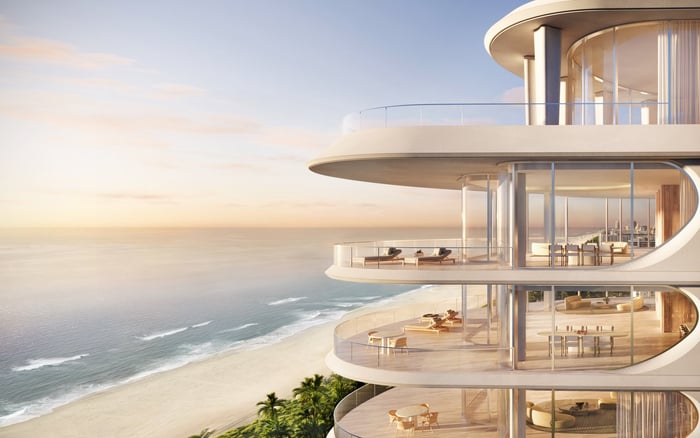
Five Park Miami Beach provides the South Beach gateway comparison: a luxury high-rise suited to a discussion of amenity and service costs. Its place in the briefing establishes neither a particular HOA charge nor a reserve position.
Ask how promised service levels are reflected in the budget. Identify what owners fund collectively, what is billed separately and which future obligations are addressed through reserves. Luxury positioning alone answers none of those questions.
4. Ella Miami Beach - Smaller North Beach comparison
Ella Miami Beach is listed with 103 residences across 10 floors and advertised starting prices of $600,000. Its scale offers a useful North Beach counterpoint to 7200 Collins, not evidence of more moderate dues or simpler replacement requirements.
A February 2025 groundbreaking is indicated, while delivery estimates range from 2026 to early 2027. Resolve that timing discrepancy before relying on a purchase timeline. Then examine the budget on its own terms: residence count provides context, not a conclusion about reserve funding.
5. The Perigon Miami Beach - Luxury comparison candidate
The Perigon is a named candidate within the Miami Beach and islands luxury-development landscape. It belongs in this briefing as a point of comparison, not as an endorsed leader in fee transparency.
Confirm its address, current active-sales status and association economics before a client relies on the comparison. Request the same budget, reserve and service-charge documentation sought for the other candidates, rather than inferring financial advantages from its positioning.
Organize the cost discussion around recurring association charges, mandatory assessments and genuinely optional services. A single headline number obscures the distinction between a continuing obligation, an additional association charge and discretionary spending.
A special assessment is a one-time or limited-term charge for expenses that regular dues and reserves do not cover. Potential uses include major repairs, capital projects, insurance deductibles and litigation costs. A charge outside ordinary dues should not be confused with an elective service.
For The Perigon Miami Beach, request written answers to three questions: what must be paid, what may be elected and what can change? This is a review framework, not a description of its charges. Never assume project-specific optional fees from the marketing presentation.
Reserves are intended to fund predictable long-term replacements rather than leave their entire cost to a future assessment. The buyer’s task is to understand how expected work, accumulated funds and continuing contributions align.
Request the applicable adopted budget, reserve study, reserve balances and assessment history. For a project still under development, distinguish projections from adopted commitments and ask which assumptions remain subject to revision. Read the documents together; a single balance or contribution figure is not a verdict.
Apply the same standard if the search expands to The Residences at Six Fisher Island, another named candidate in the broader luxury landscape. Its inclusion extends the comparison; it makes no claim about the project’s reserves. Branding, new construction and exclusivity are not substitutes for financial evidence.
Acquisition pricing and ownership economics answer different questions. Casa Cipriani’s approximately $25 million starting point, Ella’s $600,000 indication and the differing $700,000 and $800,000 figures for 7200 Collins do not establish which residence offers the most predictable annual obligation.
Before committing, request a dated availability statement and a budget applicable to the residence under consideration. Reconcile delivery expectations separately, particularly where estimates conflict. A projected completion date is not an independently verified commitment.
The strongest private-client briefing should produce a concise written record for each candidate: recurring charges, reserve contributions, any disclosed assessments and any documented elective charges. Label projections as projections and unresolved questions as unresolved. Do not fill gaps with assumptions about luxury service.
For optional offerings, request the fee schedule and terms that establish whether participation is genuinely discretionary. Do not count a service as included merely because it features prominently in a presentation, or assume it is optional because it is separately billed.
The objective is not necessarily the lowest dues. It is a clear relationship between the residence, the services the client values and the obligations ownership creates.
For a discreet conversation about your Miami Beach shortlist and ownership priorities, connect with MILLION.
If branded residences are on your mind — as a home or as an allocation — we would be glad to share what we are seeing, privately.
Begin a quiet conversationNo. The order is a due-diligence shortlist, not a verified ranking of transparent fees, reserve adequacy or predictable carrying costs.
Current active-sales status and availability require confirmation. Inclusion in the briefing is not verification of either.
Its approximately 23 residences and advertised starting prices around $25 million offer a high-end, small-scale comparison. Those marketing figures do not establish current availability or operating costs.
7200 Collins is listed with 222 residences across 12 floors at 7200 Collins Avenue in North Beach. That scale does not prove lower per-residence costs.
Advertised starting figures differ between $700,000 and $800,000. Buyers should obtain a dated availability and pricing statement before relying on either figure.
The briefing prioritizes how amenities and services translate into collective expenses and separate charges. It does not establish a specific HOA charge or reserve position.
Delivery estimates differ between 2026 and early 2027. Buyers should resolve that discrepancy before relying on a purchase timeline.
It is a one-time or limited-term association charge for expenses that regular dues and reserves do not cover. Potential expenses include major repairs, capital projects, insurance deductibles and litigation costs.
Reserves are intended to fund predictable long-term replacements rather than leave their entire cost to a future assessment. Buyers should review expected work, balances and contributions together.
Request written fee schedules and terms distinguishing included services, mandatory charges and genuinely discretionary offerings. Separately billed does not necessarily mean optional.