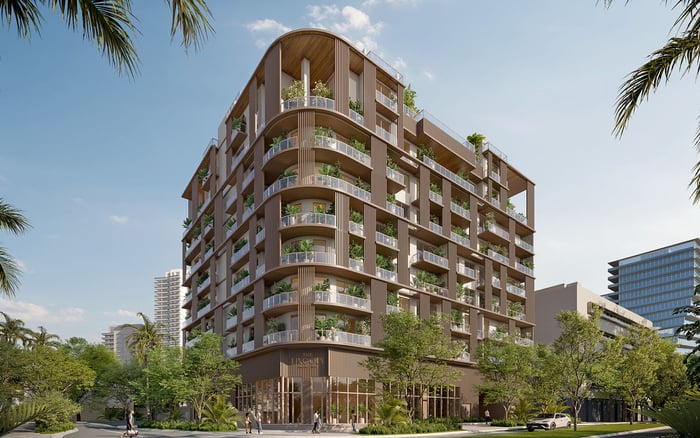
Five active Coconut Grove and Coral Gables projects frame a private-client briefing on conditioned storage, wine protection, and documented access between visits, with a clear distinction between development credentials and services requiring written confirmation.
For an owner who moves between residences, the most consequential luxury may be continuity: belongings remain protected, wine receives appropriate care, and every delivery or removal is accounted for before the next arrival. In Coconut Grove and Coral Gables, an active development pipeline offers several settings in which to negotiate those expectations before occupancy.
The five projects below are ranked for development activity, luxury positioning, and residential format-not demonstrated storage performance. Conditioned owner storage, wine-protection specifications, and formal inventory programs are not established across this shortlist. Each requires written confirmation, not an inference from branding, price, or building size.
At Four Seasons Residences Coconut Grove, the branded setting makes service responsibility an essential discussion. At Ziggurat Coconut Grove, boutique scale invites a different conversation about owner-specific arrangements. Neither characteristic substitutes for a documented commitment.
1. Four Seasons Private Residences Coconut Grove - 2699 South Bayshore Drive
Under construction, this planned 20-story waterfront tower comprises 70 residences. Reported entry pricing is just under $6 million for an approximately 2,000-square-foot, two-bedroom residence. Its first-place position reflects branded-luxury positioning, not verified custody or climate-control capabilities.
The briefing should distinguish hospitality-supported requests from continuing obligations. Ask who would monitor a storage space, respond to an environmental alert, and authorize entry while the owner is away. Any proposed arrangement should name the responsible party and define the limits of its service.
2. Ziggurat Coconut Grove - 3101 Grand Avenue
With approximately 19 residences and architecture by Oppenheim Architecture, Ziggurat is an active boutique-development prospect. Its proposed mixed-use program includes offices, retail, dining, and landscaped pedestrian areas alongside residences.
That format makes separation of access an important point of review. Ask whether any owner-storage provision would have a distinct residential access route, how vendors would be admitted, and who could enter without the owner present. The small residence count is a reason to explore tailored procedures, not evidence that they are available.
3. The Lincoln Coconut Grove - Lincoln Avenue
The Lincoln is planned with 48 residences, has begun construction, and has secured a reported $58 million construction loan. Completion is targeted for Q3 2028, with reported entry pricing around $1.5 million.
Its construction stage makes pre-delivery operating discussions particularly relevant. Buyers should ask which storage provisions, if any, belong to the purchased residence and which depend on a separate agreement or future operating policy. The completion target is not a guaranteed delivery date, and pricing should be reconfirmed.
4. OPUS Coconut Grove - 3137 SW 27th Avenue
OPUS is a six-story, 14-residence condominium under construction, with reported pricing for remaining residences beginning around $3.1 million. Its limited residence count makes it a focused candidate for discussing owner-specific procedures.
The practical question is whether responsibility for a requested service can be assigned and documented. A buyer should establish whether building staff, an outside specialist, or the owner's representative would inspect stored belongings, receive deliveries, and record removals. Small scale alone does not establish staffing depth or monitoring coverage.
5. Ponce Park - Downtown Coral Gables
Located near Ponce Circle Park, Ponce Park is part of the active Downtown Coral Gables residential-development pipeline. It is the shortlist's Coral Gables candidate for examining receiving arrangements, vendor access, and between-visit property controls.
The briefing should begin with the receiving process: where an item goes on arrival, who accepts it, and how custody transfers to the residence or any designated storage area. Obtain detailed storage specifications and operating commitments directly rather than infer them from the project's location.
A storage discussion should begin with legal allocation and physical location. Ask whether the space is assigned to the residence, separately acquired, licensed, or subject to an operating arrangement. Request its permitted uses and any restrictions on access or contents.
Next, seek written details on HVAC zoning, humidity monitoring, backup power, leak detection, and pest controls. Establish who receives alerts and who has authority to act. The objective is not merely an equipment description, but an accountable response procedure.
For a purchase at The Lincoln Coconut Grove, these questions belong alongside pre-delivery decisions. At Opus Coconut Grove, the same checklist can frame a discussion about any proposed owner-specific arrangement. Neither project's format confirms that conditioned storage is included.
Wine warrants its own brief rather than treatment as another category of stored property. Request contractual temperature and humidity tolerances for any proposed wine-storage solution, together with monitoring responsibility and an outage procedure. A general reference to conditioned space does not answer those questions.
The agreement should clarify who investigates an alert, who may enter, and who can authorize relocation if necessary. Ask how an interruption would be documented and how responsibility is allocated between the owner, operator, building, and insurer. Review coverage against the actual storage arrangement rather than assume it from a service description.
No wine-protection performance is established for these five projects. Until specifications and responsibilities are documented, treat wine care as an unresolved purchase requirement, not an amenity already secured.
For Ponce Park Coral Gables, as for the Grove candidates, a useful operational review follows a single delivery from arrival to final placement. Request delivery photographs, signed receipts, barcode records where appropriate, and a record of the person accepting custody at each stage.
Removal deserves equal attention. Ask for access and removal logs identifying the authorized person, the item, and the approval behind the action. Define who may inspect, restock, rotate, or remove belongings between visits. An owner's representative should not be left to interpret an informal understanding after departure.
Before committing, assemble the proposed storage allocation, climate specifications, access permissions, insurance responsibilities, and service scope into one review package. Distinguish what is included from what requires a separate provider or fee. The strongest choice is not necessarily the largest tower or smallest building, but the residence whose documented arrangements fit the owner's absence as carefully as the owner's arrival.
For a discreet discussion of these residences and your between-visit requirements, connect with MILLION.
If branded residences are on your mind — as a home or as an allocation — we would be glad to share what we are seeing, privately.
Begin a quiet conversationThe shortlist ranks Four Seasons Private Residences Coconut Grove, Ziggurat Coconut Grove, The Lincoln Coconut Grove, OPUS Coconut Grove, and Ponce Park, in that order.
No; it reflects development activity, luxury positioning, and residential format, not verified storage capacity, wine protection, or inventory-management performance.
Its branded-luxury positioning places it first for this briefing. The planned waterfront tower has 70 residences across 20 stories and is under construction.
Its approximately 19 residences and Oppenheim Architecture design provide a boutique setting for discussing owner-specific requirements. Its proposed mixed-use program also makes access separation a useful review topic.
The project targets Q3 2028 completion and has begun construction. That target should not be treated as a guaranteed delivery date.
OPUS is a six-story, 14-residence condominium at 3137 SW 27th Avenue. It is under construction, with reported remaining-residence pricing beginning around $3.1 million.
Ponce Park is part of the active Downtown Coral Gables residential-development pipeline near Ponce Circle Park. It is the shortlist's Coral Gables candidate for reviewing receiving, vendor access, and custody procedures.
Request written confirmation of availability, legal allocation, location, HVAC zoning, humidity monitoring, backup power, leak detection, and pest controls. Identify who receives alerts and responds.
It should specify temperature and humidity tolerances, monitoring responsibility, outage procedures, authorized access, and insurance allocation. These capabilities are not established across the shortlist.
Request delivery photographs, signed receipts, appropriate barcode records, access logs, and removal logs. Define who may inspect, restock, rotate, or remove items and how each custody transfer is documented.