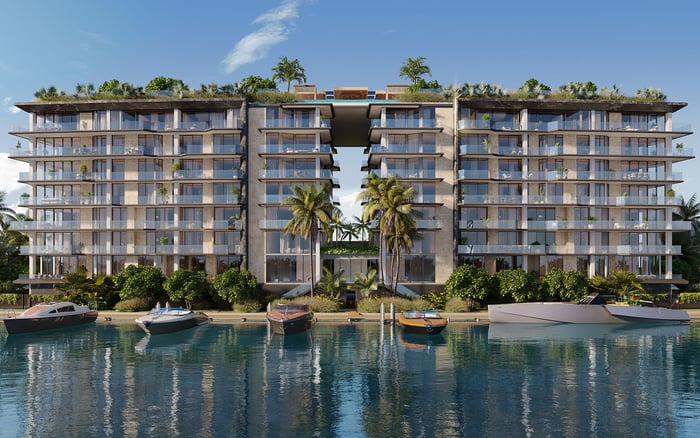
Origin’s published schedule calls for 40% before closing, but Florida law does not treat every deposit dollar alike. The executed contract determines whether amounts above the protected first 10% may be released for construction.

For a buyer considering Origin Bay Harbor Islands, the published payment schedule is only the first page of the diligence file. It calls for 10% at reservation, another 10% 30 days after contract, 10% at groundbreaking, 10% at top-off, and the remaining 60% at closing. In practical terms, 40% of the purchase price is due before closing and title transfer.
That sequence matters, but it does not answer the more consequential question: When may any portion of those funds leave escrow? A payment coming due at groundbreaking or top-off does not automatically mean it must be released to the developer at that moment. Withdrawal authority is governed by the executed purchase agreement, escrow agreement, public offering documents, and applicable Florida condominium law.
A deposit milestone tells the buyer when to pay, not necessarily when the developer may withdraw.
The prudent lens is contractual rather than promotional. Buyers comparing nearby boutique options such as Alana Bay Harbor Islands should apply the same discipline to each project’s governing documents rather than assume similar payment schedules offer identical protection.
Florida’s escrow framework distinguishes among reservation funds, the protected first 10% of the purchase price, and deposits exceeding 10%. Each category may receive different legal treatment, so buyers should resist referring to the entire 40% simply as “the escrow deposit.”
Payments up to 10% of the purchase price must remain in escrow pending closing or another legally authorized disposition. This first 10% receives the strongest statutory protection and cannot be withdrawn by the developer to fund construction. Amounts exceeding 10% must initially be placed in a special escrow account.
The analysis changes once construction begins. Deposits above the initial 10% may be withdrawn for actual construction and development costs when the purchase contract expressly authorizes that use. Applied to Origin’s published schedule, the remaining 30% of pre-closing deposits may therefore become construction funding if the signed contract provides the required authority.
If the contract does not properly authorize construction use, amounts above 10% generally remain in special escrow until closing, refund, or another lawful release. “Held in escrow” is therefore not synonymous with “untouchable until closing.” The buyer must know which account receives each installment, which conditions control withdrawal, and what remains if the transaction does not close.
A contract permitting construction use must include a conspicuous boldface legend immediately above the buyer’s signature stating that payments exceeding 10% may be used for construction. This is not a detail to examine after execution. It is a central allocation of risk that should be reviewed alongside the operative release provisions before the buyer signs.
Florida condominium counsel should confirm whether the legend and contract language align, how the documents define the start of construction, and whether any certification is required before a withdrawal. Counsel should also determine whether release is automatic after a stated event or contingent on additional evidence delivered to the escrow agent.
Milestone definitions warrant particular scrutiny. “Groundbreaking” and “top-off” may determine when an installment becomes payable, but buyers should ask who certifies the event, what notice must be provided, and whether a dispute procedure exists. Someone considering The Well Bay Harbor Islands or another local condominium should make this document-level comparison before drawing conclusions from headline percentages.
Escrow must be controlled by a qualifying escrow agent. The developer’s officers, directors, and employees cannot serve in that role. A serious buyer should request the agent’s identity, qualifications, depository bank, and written explanation of how reservation funds, the protected first 10%, and amounts above 10% are accounted for and segregated.
The reservation stage requires separate confirmation. Reservation funds are generally held in escrow and refundable on request until the buyer enters a binding purchase contract. The buyer should establish precisely when the reservation converts, how the initial payment is credited, and which documents govern a refund before signing anything that changes the funds’ legal status.
The checklist should include five direct document questions:
Which account receives each installment?
What clause expressly authorizes any construction withdrawal?
Which milestone, notice, or certification must precede release?
Who verifies compliance for the escrow agent?
What accounting will the buyer receive after a withdrawal?
These questions apply throughout the broader coastal market, including purchases in Bal Harbour such as Rivage Bal Harbour. Location and design may frame the lifestyle decision, but escrow language defines the buyer’s pre-closing capital exposure.
Project financing neither replaces statutory protections nor alters the permissions written into the purchase contract. Buyers should ask how any construction-loan draws interact with released purchaser deposits.
The objective is not to infer a project problem from the use of multiple capital sources, but to understand the order, conditions, and documentation governing those sources. Counsel can examine whether purchaser funds may be applied before, after, or alongside construction-loan proceeds and whether the contract limits their use to actual construction and development costs.
The diligence file should be tested against three outcomes: an ordinary closing, a valid buyer termination, and a buyer default. The purchase agreement and applicable Florida law determine when funds must be returned after a valid termination and what happens to escrowed funds if the buyer defaults.
That distinction makes the outside closing date, extension rights, notice requirements, cure periods, and default remedies economically significant. Potential claims arising from noncompliant handling or release of deposits are no substitute for careful drafting and timely compliance.
Before committing the second, third, or fourth installment, the buyer and counsel should reconcile the purchase agreement, escrow agreement, and public offering documents line by line. The decisive checklist is straightforward: identify every payment date, assign each dollar to its statutory bucket, locate the withdrawal authority, verify the signature legend, define each release condition, confirm the escrow agent, and model the refund and default outcomes.
For discreet guidance on South Florida’s finest residences, connect with MILLION.
If branded residences are on your mind — as a home or as an allocation — we would be glad to share what we are seeing, privately.
Begin a quiet conversationThe published schedule places 40% of the purchase price into deposits before closing and title transfer.
It calls for 10% at reservation, 10% 30 days after contract, 10% at groundbreaking, 10% at top-off, and 60% at closing.
No. The first 10% receives the strongest statutory protection, while the next 30% may be available for construction use if the executed contract permits it.
No. The protected first 10% cannot be withdrawn by the developer to fund construction.
They may be released after construction begins if the purchase contract expressly authorizes their use for actual construction and development costs.
Not necessarily. The installment may become due at that milestone, but the contract and escrow terms determine whether it may be withdrawn.
A construction-use contract must include a conspicuous boldface legend stating that payments exceeding 10% may be used for construction.
A qualifying escrow agent must control it, and the developer’s officers, directors, and employees cannot serve as that agent.
Buyers and counsel should review the contract’s termination rights, notice requirements, deadlines, and refund provisions alongside applicable Florida law.
No. Project financing does not replace the statutory protections or contractual permissions governing purchaser deposits.