A disciplined, door-to-door airport test reveals whether Aria Reserve’s Edgewater location truly fits a private aviation buyer’s recurring travel pattern.
For private aviation buyers, the airport question is rarely answered by a map pin or a favorable midday estimate. What matters is repeatable, door-to-door performance from residence to aircraft. At Aria Reserve Miami, that exercise should begin at the selected tower entrance at 700 or 725 NE 24th Street-not at a generic Edgewater location.
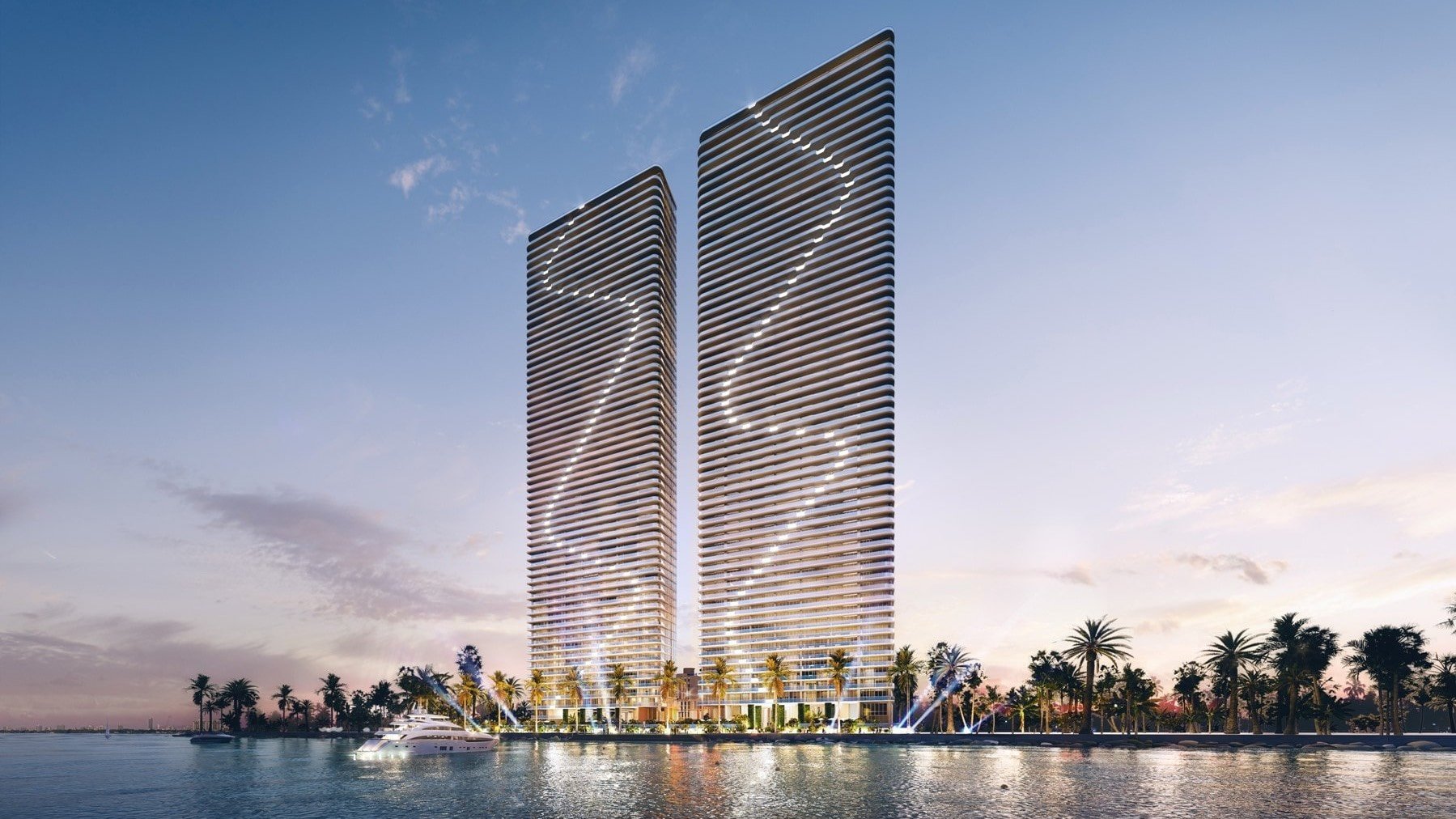
The development occupies an approximately five-acre site directly on Biscayne Bay. Its two 62-story towers, designed by Arquitectonica and developed by Melo Group, comprise approximately 782 one- to four-bedroom residences. At that scale, entrance selection, valet procedures, vehicle staging, and after-hours access all factor into the transfer calculation.
Miami International Airport, or MIA, is approximately 15 minutes away by car. A serious buyer should treat that figure as a useful benchmark, not a guaranteed transfer time. Traffic conditions, vehicle retrieval, terminal access, and the owner’s actual departure schedule can materially shape the full journey.
For an aviation buyer, consistency is often more valuable than the fastest recorded drive.
MIA may be the obvious first test because it carries a stated 15-minute benchmark. Miami Opa-locka Executive Airport, or OPF, Fort Lauderdale-Hollywood International Airport, or FLL, and Palm Beach International Airport, or PBI, require independent testing because comparable transfer estimates are not specified.
Run each route at the hours the owner is most likely to travel. That may include weekday mornings, late afternoons, evenings, weekends, and arrivals after dinner. Repeat the exercise during seasonal congestion and major Miami events. One exceptional run proves little; a range of realistic results reveals whether the residence works as an operational base.
Record each journey in components. Begin with the request for the car and valet retrieval. Then capture curb-to-curb road time, terminal or FBO entry, security or access gates, luggage handling, and any aircraft-side transfer. A nominally longer route may ultimately feel more efficient if its final access sequence is predictable.
The overlooked portion of an airport transfer often occurs before the vehicle leaves the property or after it enters the aviation facility. Aria Reserve offers 24-hour valet service, an important lifestyle consideration for early departures and late arrivals. Buyers should nevertheless confirm how that service operates for their routine.
Ask which address serves the selected tower, residents, guests, deliveries, and overnight arrivals. Confirm driver waiting rules, luggage assistance, oversized-SUV handling, parking capacity, and overnight vehicle storage. If a chauffeur will arrive before dawn, determine where the vehicle may stage and how the driver communicates with the residence or valet team.
At each preferred FBO, ask whether a chauffeured vehicle may meet the aircraft directly or must collect passengers at a landside entrance. That distinction belongs in the timing log. The same applies to gate clearance, passenger identification, baggage movement, and the handoff from aircraft to car. These are not minor details when the objective is a seamless arrival.
With no on-site heliport specified, buyers should underwrite airport transfers as ground journeys unless a different arrangement is separately verified.
An airport is only one point in an owner’s weekly geography. Aria Reserve is about five minutes from Downtown Miami and Brickell, while Wynwood and the Design District are also minutes away. The more useful question is whether airport access and daily access coexist well for the buyer’s particular calendar.
This centrality is part of Edgewater’s appeal. A buyer considering EDITION Edgewater or Villa Miami can apply the same disciplined test, always beginning at the exact entrance rather than assuming every waterfront address performs identically.
Likewise, a purchaser whose meetings cluster farther south may compare the daily circuit with a Downtown or Brickell alternative, such as Aston Martin Residences Downtown Miami. The purpose is not to declare a universal winner, but to establish which residential origin produces the most coherent pattern across home, office, culture, dining, and aircraft.
Aviation convenience should not eclipse the residential experience. Aria Reserve includes 547 feet of baywalk and a custom watersports dock with storage and service. Private watersports facilities provide access to paddleboards, kayaks, and inflatables. The outdoor amenities also encompass resort pools, a semi-Olympic lap pool, tennis and basketball facilities, miniature golf, landscaped gardens, dining areas, and a dog park.
Inside, the amenity program includes coworking and meeting spaces, lounges, a fitness center, a screening room, a wine cellar, and waterfront dining facilities. For an owner who moves frequently between Miami and other homes, these offerings may reduce the need to leave the property for work, exercise, or leisure.
The watersports marina language deserves precise review. Buyers should not assume that yacht slips, tender handling, or seaplane access are included. Inspect the dock in person and verify vessel limits, permitted uses, access rules, operating hours, staffing, storage procedures, and whether tender pickups may occur. Waterfront living and aviation mobility can complement one another, but they should be evaluated as separate operational systems.
A useful buyer file should contain multiple timed runs for MIA, OPF, FLL, and PBI, separated by departure hour and day type. Include the fastest, slowest, and typical observed experiences, but place the greatest weight on consistency. Add notes on valet readiness, route interruptions, FBO access, luggage transfer, and chauffeur staging.
Then repeat the preferred route in reverse. An outbound morning journey may perform differently from an evening arrival, and the residence-to-aircraft sequence may not mirror the aircraft-to-residence return. If family members, staff, or guests travel independently, test their likely scenarios as well.
This is the core discipline of MILLION's Buyer's Guides: converting an appealing location claim into an owner-specific operating picture. At Aria Reserve, the 15-minute MIA benchmark is a sensible starting point. The purchase decision, however, should rest on repeated door-to-door evidence across the airports the owner will actually use.
For private guidance on Aria Reserve and South Florida residences, connect with MILLION.
If branded residences are on your mind — as a home or as an allocation — we would be glad to share what we are seeing, privately.
Begin a quiet conversationUse the entrance serving the selected tower at 700 or 725 NE 24th Street. Confirm the correct resident and valet entrance before timing a route.
No. Approximately 15 minutes is a promoted benchmark, not a guaranteed transfer time under all traffic and access conditions.
Test MIA, Miami Opa-locka Executive Airport, FLL, and PBI if they are relevant to the owner’s travel pattern.
Repeated runs reveal consistency across weekday peaks, evenings, weekends, seasonal congestion, and major Miami events.
Include valet retrieval, road travel, terminal or FBO entry, security gates, luggage handling, and aircraft-side transfer.
Aria Reserve offers 24-hour valet service. Buyers should still verify staging, waiting, luggage, and after-hours procedures.
No on-site heliport is specified. Buyers should plan airport transfers by road unless another arrangement is verified.
No. Buyers should not assume yacht slips, tender handling, or seaplane access and should verify permitted dock uses directly.
The property provides 547 feet of baywalk and a custom watersports dock with storage and service, plus access to selected watersports equipment.
Traffic and access sequences can differ by direction and time of day. Testing both directions creates a more realistic ownership picture.