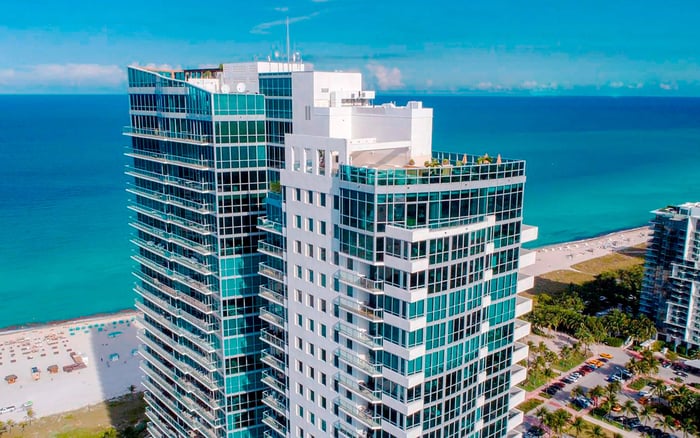
A $5 million Miami Beach condominium requires more than a purchase-price calculation. Understand the distinction between municipal and combined property taxes, then evaluate association dues, structural reserves, inspections, and property-specific expenses before setting an ownership budget.

A $5 million Miami Beach condominium is a lifestyle purchase with financial obligations beyond the asking price. The view and architecture may establish its appeal, but the ownership decision also depends on taxes, association obligations, insurance, and the building’s future repair needs. Those expenses deserve the same scrutiny as the residence itself.
The useful question is not what a luxury condominium typically costs to carry. It is what this particular residence will require under its applicable tax treatment and its association’s financial plan. A credible budget separates recurring expenses from potential capital obligations, then distinguishes both from acquisition costs and financing.
For a buyer considering 57 Ocean Miami Beach, that means pairing the residential search with a unit-specific financial review. A project name is a starting point for selection, not a substitute for the documents that establish ownership obligations.
The most consequential budgeting error is treating Miami Beach’s municipal operating millage as the entire property-tax rate. For fiscal year 2026, the city adopted a general operating rate of 5.8560 mills. One mill represents $1 for every $1,000 of taxable value.
Assuming $5 million in taxable value, that municipal operating component produces $29,280 annually. It is not the complete bill. School, county, debt-service, and other applicable taxing components must also be considered.
A combined-rate illustration for Miami Beach uses an adopted 2026 rate of 18.6681 mills. Applied to the same hypothetical $5 million taxable value, the calculation is:
$5,000,000 ÷ 1,000 × 18.6681 = $93,340.50 Annually, or approximately $93,341.
This is an illustration, not a tax quote for every $5 million condominium. The applicable taxing district, taxable value, and tax year must be confirmed for the individual property. The city’s fiscal-year operating rate and the combined tax-year figure also serve different purposes; they are not interchangeable measures.
The distinction is substantial: budgeting only for the municipal operating component would omit a large portion of the illustrated combined amount.
A $5 million purchase price does not automatically establish $5 million in taxable value. The illustration above assumes that taxable value; it does not determine it for a prospective purchase.
Before committing, request a property-specific tax calculation using the correct parcel, applicable year, and relevant taxing district. Confirm whether the rates are adopted or merely proposed. An existing tax bill provides useful background, but the purchase decision should rest on an estimate appropriate to the buyer’s situation.
Apply that discipline when comparing residences at Faena House Miami Beach with other candidates. Matching asking prices do not establish matching tax obligations. Keep the assumptions visible so the comparison remains meaningful.
Association dues belong in every carrying-cost calculation, but the advertised monthly amount is only the beginning. Ask what the current budget covers, what remains the owner’s responsibility, and how future major work is being funded.
For qualifying condominium and cooperative buildings, a Structural Integrity Reserve Study, commonly called a SIRS, assesses reserve funding needs for future structural repairs. Through a visual inspection of common areas, it evaluates funding for their major repair and replacement. A SIRS generally must be completed at least every 10 years.
That recurring obligation makes the reserve study an essential companion to the operating budget. Ask how its findings connect to current reserve contributions, planned work, and identified funding needs. Monthly dues alone cannot answer those questions.
When evaluating Five Park Miami Beach, request the applicable association budget and reserve materials rather than treating presentation or positioning as evidence of financial condition. This is a diligence principle, not a statement about that project’s expenses or reserve status.
Florida requires structural milestone inspections for qualifying condominium and cooperative buildings. The standard framework begins at 30 years of age and repeats every 10 years, subject to applicable statutory and local requirements. Florida’s 2025 changes specify three or more habitable stories for the relevant height threshold, rather than simply counting every story.
For a Miami Beach purchase, confirm the requirements and deadlines applicable to the actual building. A general description of Florida’s framework is no substitute for local confirmation.
The financial questions are practical: Has the required inspection been completed? Which findings require attention? Has the work been scoped and funded? Are there approved assessments or unresolved funding decisions?
A milestone inspection and a reserve study serve different purposes. Review both where applicable. Inspection findings help identify structural concerns; reserve planning addresses funding for future major repair and replacement needs. Neither review should stop at whether the document is complete.
A useful comparison sheet separates annual recurring commitments from capital obligations and transaction expenses. It also distinguishes confirmed amounts from estimates that still require documentation.
For each residence, organize the review into four categories:
Property taxes: a parcel-specific estimate with its taxable-value and rate assumptions stated.
Association obligations: current dues, budget inclusions, reserve contributions, and approved assessments.
Owner-level expenses: insurance quotations, utilities, maintenance, and any chosen services, checked against association inclusions to avoid double counting.
Capital and acquisition items: identified future work, potential funding obligations, and transaction costs, kept separate from ordinary annual carrying costs.
A residence at Apogee South Beach should enter that comparison through its own documents and quotations, not a generic luxury allowance. Apply the same standard to every candidate.
There is no defensible universal annual ownership figure for every $5 million Miami Beach condominium. The tax illustration shows why a shorthand allowance can mislead; reserve obligations and inspection findings explain why monthly dues cannot complete the picture.
Before proceeding, assemble a tax estimate, current association financial materials, applicable structural documentation, and owner-specific expense quotations. Identify what is confirmed, what is projected, and what remains contingent. The objective is not to eliminate every future uncertainty, but to understand the obligations that accompany the residence and how they fit your financial plans.
For a considered approach to your next Miami Beach residence, explore MILLION.
If branded residences are on your mind — as a home or as an allocation — we would be glad to share what we are seeing, privately.
Begin a quiet conversationThere is no universal figure. A reliable budget requires property-specific taxes, association obligations, owner-level expenses, and a separate review of capital funding needs.
No. It is the city’s fiscal-year 2026 general operating component, not the combined rate that includes other applicable taxing components.
Applying 18.6681 mills to an assumed $5 million taxable value produces $93,340.50 annually, or approximately $93,341. The actual amount depends on the property’s taxing district, taxable value, and tax year.
Not automatically. The taxable value must be established for the particular property rather than assumed from its purchase price.
Yes. A property-specific tax estimate should identify which rates it uses and confirm the applicable year and taxing district.
No. Review the operating budget alongside reserve funding, structural findings, approved assessments, and expenses that remain the owner’s responsibility.
A SIRS evaluates reserve funding needed for future major repair and replacement of common areas, based on a visual inspection. Qualifying condominium and cooperative buildings must obtain one.
A SIRS generally must be completed at least every 10 years. Reserve planning is therefore a recurring obligation rather than a one-time exercise.
The standard framework begins at 30 years of age and repeats every 10 years, subject to applicable statutory and local requirements. Confirm the actual building’s Miami Beach requirements and deadlines.
The changes specify three or more habitable stories for the relevant height threshold. Counting every story without considering whether it is habitable is not the same test.