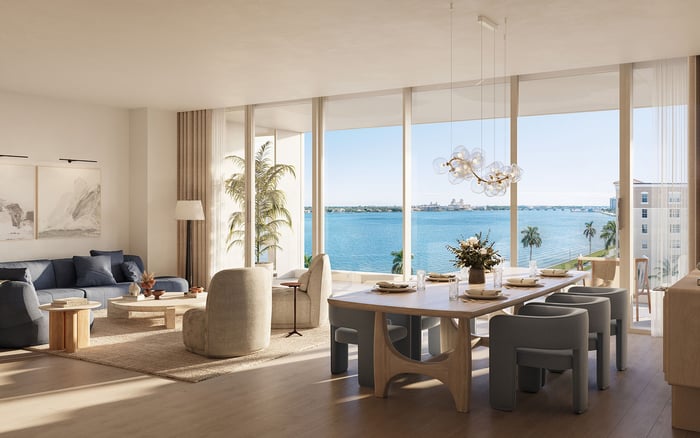
The Berkeley Palm Beach advertises pet amenities and private elevator vestibules, but primary-residence buyers should distinguish those features from the written rules governing everyday access, outages, and evacuation.

A primary residence must work as convincingly at dawn with a dog on a leash as it does on an afternoon arrival. At The Berkeley Palm Beach, that means examining how the residence, elevator, pet facilities, and emergency exits connect-not evaluating each amenity in isolation.
The project is planned for 550 South Australian Avenue in West Palm Beach, on the Clear Lake waterfront, not in the Town of Palm Beach. It is marketed as a 25-story condominium with 193 residences measuring approximately 2,061 to 5,834 square feet. Those dimensions establish the residential offering; they do not establish how the building will operate.
The central distinction is straightforward: pet facilities and private elevator vestibules are advertised, but detailed pet-relief routes, elevator protocols, and evacuation procedures are not disclosed in the reviewed materials. That is a reason to request documentation, not evidence that policies do not exist.
A covered dog run and grooming room are planned amenities. The ground-floor amenity offering also includes dog grooming, a dog run, package receiving, concierge service, and valet parking. For a year-round owner, the appeal is clear: pet care could become part of the building's daily rhythm.
Pets are described as permitted with restrictions, though the details remain to be determined. Permitted numbers, weight and breed limits, registration, and leash requirements remain unconfirmed in this review. A dog run should never be read as permission for a household's particular animals.
Request the declaration, bylaws, rules, amendments, and any pet addendum. Check the household's actual pet profile against the written terms. Then ask for dog-run hours, access controls, waste-disposal rules, cleaning standards, and any separate treatment of service animals. These are questions to resolve, not established Berkeley policies.
A designated route from residences to the dog run is not disclosed in the reviewed materials. That operational gap matters more than the amenity's name: a covered destination does not establish a continuously covered journey.
Ask for a marked plan tracing the route from the prospective residence's vestibule to the permitted elevator, through the ground floor, and into the pet area. Clarify whether it intersects the arrival lobby, valet circulation, or package receiving, and whether access changes outside staffed amenity hours. None of these arrangements should be assumed.
Evaluate the route against actual household needs: an older dog, a carrier, limited mobility, or a late-night outing. Ask what alternative is available when the run is being cleaned or access is interrupted. The objective is a repeatable routine, not merely a photograph of an attractive facility.
For buyers also considering Alba West Palm Beach, the same route-by-route review provides a useful comparison framework without assuming equivalent pet rules or facilities.
Private elevator vestibules describe an arrival experience. They do not establish whether pets may use passenger elevators or must use a service or freight elevator. That question remains unresolved in this review.
Elevator-car counts, brands, service-elevator arrangements, destination-control systems, backup-power coverage, and outage procedures are also undisclosed in the reviewed materials. Without those details, it would be premature to promise short waits, dedicated pet access, or uninterrupted service.
Request specifications alongside the operating rules. Determine which cars serve the prospective residence, which are available to pets, and whether deliveries, moves, or maintenance affect access. Ask what happens when the usual permitted car is unavailable and who communicates the alternative.
The advertised 24/7 concierge and valet services do not resolve these questions. They define neither elevator response times nor emergency staffing responsibilities or assistance for residents unable to use elevators. Service availability and a documented assistance procedure are not interchangeable.
General references to marked emergency exits, evacuation plans, resident education, and drills should not be treated as a published Berkeley operating policy. Berkeley-specific exit maps, refuge areas, stairwell locations, fire-command procedures, and resident notification protocols are not disclosed in the reviewed materials.
Request the approved life-safety plans and resident-facing instructions applicable to the intended residence. Clarify stair access, alarm procedures, elevator recall, and how instructions will reach residents and guests. For anyone with mobility limitations, seek written confirmation of accessibility accommodations and assistance responsibilities.
Pet evacuation warrants a separate discussion. Ask about carriers, temporary evacuation arrangements, service-animal treatment, rescue coordination, and any pet emergency registry. Do not assume concierge personnel will transport an animal or assist a resident unless that responsibility is expressly established.
This review supports purchase diligence; it is not a substitute for emergency instructions. During an incident, follow emergency personnel and the building's applicable procedures rather than relying on an amenity description.
The Clear Lake address does not, by itself, establish an evacuation zone or storm-surge exposure. A building-specific hurricane evacuation zone, shelter assignment, flood-response plan, storm-shutter procedure, and re-entry policy are not identified in the reviewed materials.
Request address-specific confirmation and the building's storm procedures. Clarify any elevator shutdown process, emergency-power coverage, resident communications, and conditions for returning after an evacuation. Resolve pet arrangements before a departure becomes time-sensitive.
A primary-residence comparison with Mr. C Residences West Palm Beach should apply the same documentation standard. The comparison concerns what buyers need to know, not whether the buildings share emergency systems or policies.
Request the condominium disclosures and check planned amenities and operating expectations against those documents rather than treating them as unconditional promises.
Organize the decision around three written confirmations: whether the household's pets are permitted, how everyday vertical access will function, and what procedures apply when normal operations stop. Distinguish approved terms from proposed arrangements and unanswered requests. Verbal reassurance should not close a material question about year-round suitability.
The Berkeley's advertised pet facilities and private vestibules merit attention, but the primary-residence decision turns on the procedures connecting them. The strongest purchase rationale is not that every detail appears in marketing. It is that the buyer has enough written clarity to judge ordinary days and disrupted ones with equal confidence.
For a considered approach to South Florida primary-residence decisions, explore MILLION.
If branded residences are on your mind — as a home or as an allocation — we would be glad to share what we are seeing, privately.
Begin a quiet conversationThe project is planned for 550 South Australian Avenue on the Clear Lake waterfront in West Palm Beach. It is not in the Town of Palm Beach.
Marketing describes a 25-story, 193-residence condominium, with residences measuring approximately 2,061 to 5,834 square feet.
A covered dog run and grooming room are advertised as planned amenities. Their operating details should be confirmed in the condominium documentation.
No unrestricted pet policy is established. Pets are described as permitted with restrictions, while numbers, weight and breed limits, registration, and leash requirements remain unconfirmed in the reviewed material.
The reviewed amenity material does not publish a designated pet-relief route from residences to the dog run. Buyers should request a marked route and written access rules.
No. Private vestibules do not establish whether pets may use passenger elevators or must use service or freight elevators.
The reviewed brochure does not disclose elevator backup-power coverage or outage procedures. Buyers should request specifications and the applicable operating plan.
The advertised service does not define emergency staffing duties or assistance procedures for residents unable to use elevators. Those responsibilities require separate confirmation.
The reviewed material does not provide Berkeley-specific exit maps or detailed evacuation implementation. It also does not identify a building-specific hurricane evacuation zone or re-entry policy; this does not establish that such policies do not exist.
Request the condominium disclosures, declaration, bylaws, rules, amendments, and pet addendum, together with elevator specifications and applicable emergency plans. Check planned amenities and operating expectations against those documents.