Five Park documents private resident arrival and extensive service offerings, but complete staff-resident circulation separation remains unverified. A primary-residence buyer should examine the selected home's service route, written vendor permissions, and everyday delivery logistics before committing.

For a full-time household, privacy extends beyond a private elevator opening onto a beautifully composed arrival space. It includes the route a cleaner takes upstairs, the approval a caregiver needs at an early hour, and the handling of deliveries while the owner is away. At Five Park Miami Beach, these operational questions warrant a review separate from the appeal of the residence itself.
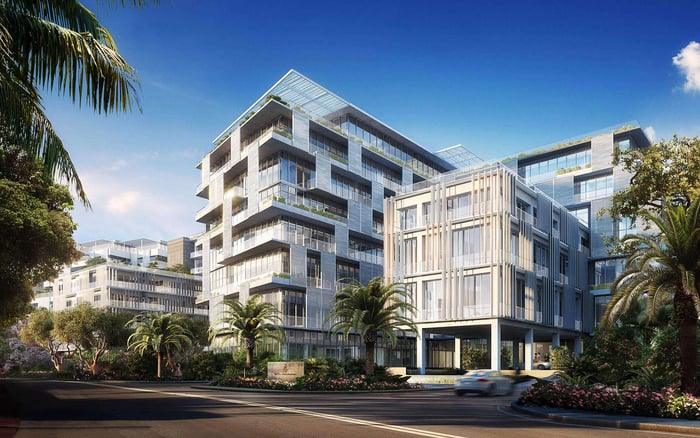
Located at 500 Alton Road, Miami Beach, Five Park has a documented private residents’ porte-cochère, drop-off area, and lobby. Its residential offering comprises 140 residences connected by private lobbies and elevator banks. These are meaningful arrival features, but they do not establish that household staff and vendors use an entirely separate circulation system.
The distinction is straightforward: private resident arrival and advertised service availability are documented; complete staff-resident circulation separation is not publicly verified. That is a disclosure gap, not evidence that separation is absent.
Arrival provisions include electric-vehicle car ports, a dedicated ride-share drop-off zone, and valet service. Twenty-four-hour valet and security are also advertised. For an owner returning with children, shopping, or luggage, these features have clear everyday relevance.
The next step is to establish where household personnel enter that sequence. A private residents’ lobby does not, by itself, identify a separate employee entrance, staff reception point, or vendor screening area. Nor do private elevator banks explain which cars are resident-only, service-only, or shared.
During a tour, ask management to trace three journeys: an owner arriving by car, a recurring cleaner arriving independently, and a technician bringing equipment. Identify where those paths intersect and who authorizes movement beyond each checkpoint. The objective is not to eliminate all shared space, but to establish precisely where privacy depends on architecture and where it depends on operating rules.
Some layouts label private elevators and service elevators. Those labels support the existence of service-elevator provision for certain residences, but do not establish direct service-elevator access for every home or a continuous building-wide service-corridor network.
Make the selected residence-not the building name-the focus of the review. Obtain current approved plans, compare them with recorded condominium plans, and inspect the actual route from the service arrival point to the residence. Treat published floor plans as preliminary rather than definitive for a purchase decision.
Ask whether personnel can reach a secondary residence entrance without crossing the principal foyer, whether any corridor is shared, and whether service access varies by floor or layout. Confirm that any door shown on a plan is usable under current building rules. A labeled elevator is useful evidence; an uninterrupted, authorized route is the practical requirement.
Apply the same unit-specific discipline when considering Apogee South Beach. Compare verified routes and permissions, not assumptions attached to a property's name.
Advertised services at Five Park include 24-hour concierge and butler service, alongside on-call housekeeping. In-residence dining and spa services are also advertised as à-la-carte offerings. These services make access to the private home an important part of ownership, but they do not explain how independently retained personnel are admitted.
On-call housekeeping, for example, does not establish whether cleaners are building employees, contractors, or owner-selected vendors. Nor does round-the-clock concierge availability establish unrestricted access for a nanny, chef, caregiver, trainer, or dog walker.
Request written rules covering recurring credentials, identification checks, permitted hours, escort requirements, and elevator permissions. Distinguish building-arranged providers from owner-employed staff and outside contractors. Ask whether each category follows the same entrance and authorization procedure.
For a primary residence, exceptions matter as much as ordinary hours. Confirm how an early caregiver visit, a delayed cleaner, or an urgent repair would be handled. Establish who can approve an exception when the owner is unavailable and how a former employee's permission is withdrawn.
The most revealing test is a realistic household schedule: a cleaner arrives while the owner is out, groceries follow shortly afterward, and a technician needs access to equipment inside the residence. Ask management to explain each step without assuming that concierge assistance substitutes for standing permission.
For every visit, establish who receives notice, where the visitor waits, which elevator is permitted, and whether someone must accompany the visitor upstairs. Confirm whether authorization covers a single appointment, a recurring schedule, or an ongoing employment relationship.
The Five Park app is marketed for amenities and at-home services. Its described functions do not confirm individual vendor authorization or access-permission controls. Wi-Fi coverage in garages and elevators likewise does not establish app-controlled access. Ask to see the relevant function demonstrated, or obtain confirmation that concierge approval is required instead.
A buyer also considering Faena House Miami Beach should request the same access demonstration there. This provides a consistent basis for comparison without presuming either property's procedures.
Furniture arrivals, equipment servicing, and recurring deliveries deserve attention before closing. Available information does not detail loading-dock dimensions, delivery-truck restrictions, package-room procedures, furniture-move policies, or service-elevator reservation requirements.
Request current rules for loading access, booking windows, after-hours deliveries, fees, deposits, and vendor insurance or approval requirements. Ask how oversized items reach the residence and whether the proposed furniture route accommodates them through the actual elevator and doorway dimensions.
Package handling warrants a separate conversation. Establish who accepts deliveries, how owners are notified, and what arrangements apply when immediate collection is impossible. These are questions to resolve, not services to assume.
When comparing Five Park with The Perigon Miami Beach, use the same household scenario and request equivalent written answers. An operational comparison is more useful than treating a service menu as a complete account of daily life.
Five Park's documented private arrival arrangements and advertised services give buyers a substantive starting point. The remaining question is whether the selected residence's physical route and current access rules support the household's actual routine.
Before committing, seek three things together: current plans for the home, a walkthrough of the service route, and written staff and vendor procedures. Where an arrangement is essential, have the appropriate advisers review its documentation rather than relying on a verbal expectation. The goal is clarity-not an assumption of either complete separation or inadequate access.
For a discreet review of primary-residence priorities across South Florida, connect with MILLION.
If branded residences are on your mind — as a home or as an allocation — we would be glad to share what we are seeing, privately.
Begin a quiet conversationFive Park is located at 500 Alton Road, Miami Beach.
The building documents a private residents’ porte-cochère, drop-off area, and lobby. Arrival features also include valet service, electric-vehicle car ports, and a dedicated ride-share drop-off zone.
Some published layouts label service elevators, but that does not establish direct service-elevator access for every residence. Buyers should verify the selected home's current approved plans and actual route.
Complete separation is not publicly verified in the reviewed materials. This does not mean the building necessarily lacks separate routes.
The reviewed disclosures do not confirm a separate employee entrance or dedicated staff lobby. Ask management to identify the current entrance and screening procedure.
Five Park advertises 24-hour concierge and butler service, on-call housekeeping, and à-la-carte in-residence dining and spa services. These offerings do not establish access rules for independently retained personnel.
The app is marketed for amenities and at-home services, but individual vendor authorization controls are not confirmed. Request a demonstration or written clarification of the approval process.
Request written requirements for credentials, identification, escorts, permitted hours, and elevator access. Confirm how recurring permissions are changed or withdrawn.
Confirm loading access, truck restrictions, service-elevator reservations, package handling, fees, deposits, and vendor insurance requirements. These details are not specified in the reviewed fact sheet.
Review current plans against recorded condominium plans, walk the actual service route, and obtain written staff and vendor access rules. Test those arrangements against the household's normal schedule.