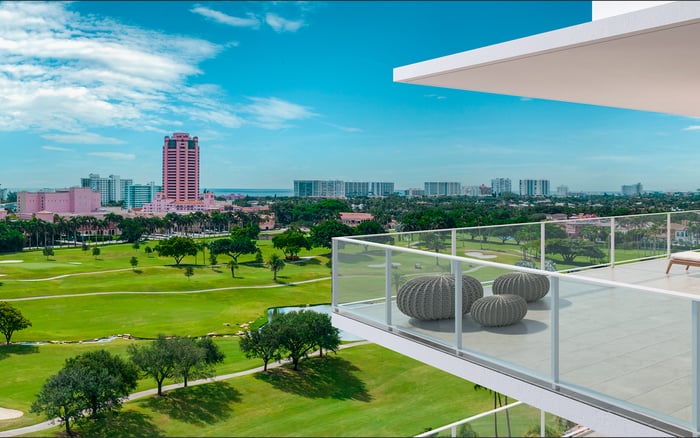
For a family office dividing its attention between Lisbon and Boca Raton, residence protection requires more than a thermostat setting. A disciplined absentee-owner plan connects humidity control, leak detection, local response and clearly delegated vendor authority.

For a family office establishing a Boca Raton residence while maintaining ties to Lisbon, the essential ownership question is not simply who holds the keys. It is who can recognize a moisture problem, enter the property and authorize a response while the principals are abroad. Second-home ownership deserves an operating plan as considered as the interiors themselves.
This is a framework for that transition, not an account of a particular family's move. The premise is straightforward: climate control, water management and vendor authority should function as one system. A sensor without a responder leaves an operational gap.
For buyers considering Alina Residences Boca Raton, due diligence should extend beyond the residence to access procedures, maintenance responsibilities and private management arrangements. These are questions to resolve, not services to assume.
Indoor relative humidity should remain below 60%, ideally within 30-50%, to help prevent mold growth. Temperature alone does not establish whether a residence is sufficiently dry. A comfortable thermostat reading should never substitute for humidity measurements.
An away setting of 75-77°F, or 78°F with a compatible humidistat set to 55% relative humidity, can serve as a starting point-not a guarantee. Have the HVAC team confirm that the selected arrangement controls moisture in the residence. The 55% setting is distinct from the preferred 30-50% range.
Use the fan's AUTO setting rather than ON to limit the return of condensate moisture to indoor air between cooling cycles. Before departure, service the air conditioner and inspect filters, condensate drains and drain pans. Dirty filters, clogged drains and deteriorated or overflowing pans warrant attention before the property is left unattended.
If air conditioning alone does not remove enough moisture, consider supplemental dehumidification. Leave interior room, bathroom and closet doors open to encourage conditioned-air circulation rather than creating isolated spaces.
A practical remote-monitoring plan pairs thermostat access with humidity sensors in vulnerable rooms. The family office should decide who reviews readings, who receives alerts and who acts when the primary contact is unavailable. Principals in Lisbon can retain visibility without becoming the only route to intervention.
A sustained reading in the 55-60% range can serve as an owner-selected investigation trigger. It is not a universal emergency threshold or a prescribed two- or three-hour response rule. Agree on the duration and escalation procedure with the local team, accounting for the home's normal performance.
For a buyer evaluating Glass House Boca Raton, useful questions include whether proposed private monitoring arrangements align with building procedures and how an authorized responder gains access. Do not infer that a residential project supplies a particular sensor system or monitoring service.
Test the notification chain before departure. The measure of success is an acknowledged alert and a clear next action, not merely a functioning dashboard.
Plan a domestic-water shutdown for extended absences to reduce potential damage from pipe or fixture failures. Before proceeding, have the plumber and, where applicable, building management confirm the appropriate valve and any property-specific constraints. The instruction should identify what is being isolated rather than simply saying “turn off the water.”
Connected leak detection and automatic shutoff equipment are also worth considering. Treat them as components of the protection plan, not substitutes for maintenance or a local response arrangement.
For a single-family residence, check that gutters, downspouts and grading direct water away from the foundation. Inside, repair known leaks and confirm that moisture from showering and cooking is exhausted outdoors.
If refrigerators or freezers will be switched off, empty and dry them, then leave their doors propped open. Document the property's condition at departure so the returning team knows which appliances and systems require reactivation.
Water should trigger immediate action, not wait for the next scheduled visit. Clean and dry spills within 24 hours, and arrange prompt drying of wet building materials. The first 24-48 hours after a leak, flood or condensate spill are important for reducing the likelihood of mold growth, but that window is not permission to delay.
The written response sequence should prioritize safe access, stopping the water where authorized, notifying the relevant parties and initiating appropriate emergency drying. In a condominium, coordinate with management where shared systems or neighboring residences may be involved.
Ask the drying team to keep written records, including twice-daily moisture readings to track progress. As an operational practice, photographs, action times and vendor communications should accompany that record.
Drying within 24-48 hours does not guarantee that mold cannot develop. Nor should a single material-moisture percentage serve as a universal clearance standard. Require the responsible professional to explain the drying criteria applicable to the affected materials.
The family office's written instructions should distinguish mitigation from restoration. A local team may need authority to stop water and begin emergency drying while permanent repairs remain subject to further approval. Without that distinction, a modest intervention can become entangled in a larger renovation decision.
Define entry triggers, permitted emergency actions, spending limits, escalation contacts and documentation requirements. Set limits appropriate to the property and ownership structure; this framework establishes no universal dollar cap. Identify a backup decision-maker in case the principal contact cannot be reached.
When considering The Residences at Mandarin Oriental Boca Raton, apply the same discipline: confirm building procedures separately from authority delegated to a private property manager. Neither should be assumed to replace the other.
Review the instructions with the relevant vendors before departure. Each should know which actions are preauthorized, which require consent and how completion must be documented.
Responsibility for condominium pipes depends on their classification and the governing documents. Common-element pipes are generally the association's responsibility, while pipes belonging solely to a unit are generally the owner's. The origin of a leak does not, by itself, answer every repair or insurance question.
Association property insurance does not cover every interior item. Personal property, floor, wall and ceiling coverings, appliances and other interior components can fall outside the association's responsibility. Owners may also owe uninsured repair costs when damage results from negligence, intentional conduct or failure to comply with association documents or rules.
Have the family office review governing documents, access procedures and applicable insurance terms together. Humidity logs and maintenance records support orderly management, but they do not guarantee coverage.
The objective is continuity: a residence monitored during absence, accessible when intervention is necessary and governed by instructions precise enough to act on.
Explore Boca Raton residences with an ownership plan tailored to your international calendar at MILLION.
If branded residences are on your mind — as a home or as an allocation — we would be glad to share what we are seeing, privately.
Begin a quiet conversationKeep indoor relative humidity below 60%, ideally within 30–50%. Measure humidity directly rather than relying on the thermostat's temperature reading.
An away setting of 75–77°F, or 78°F with a compatible humidistat set to 55% relative humidity, can be a starting point. Have the HVAC team verify actual moisture control rather than treating those settings as guarantees.
Use AUTO rather than ON to limit the return of condensate moisture to indoor air between cooling cycles.
Service the air conditioner and check filters, condensate drains and drain pans. Repair known leaks and leave interior room, bathroom and closet doors open to encourage conditioned-air circulation.
Route alerts to an authorized local responder, with a backup contact and visibility for the family office. A sustained 55–60% reading can be an owner-selected investigation trigger, not a universal response rule.
A planned shutdown can reduce damage from pipe or fixture failures. Confirm the correct valve and property-specific constraints with the plumber and, where applicable, building management.
Respond immediately, clean and dry spills within 24 hours, and dry wet building materials promptly. Drying within the first 24–48 hours reduces mold risk but does not guarantee prevention.
Request written records with twice-daily moisture readings to track drying progress. Photographs, action times and vendor communications can supplement the record.
Specify entry triggers, permitted emergency actions, spending limits, escalation contacts and documentation requirements. Separate authority for stopping water and emergency drying from approval for permanent repairs.
No; personal property, surface coverings, appliances and other interior components can fall outside the association's property-insurance responsibility. Review governing documents and applicable policies, since negligence or noncompliance can also affect who pays.