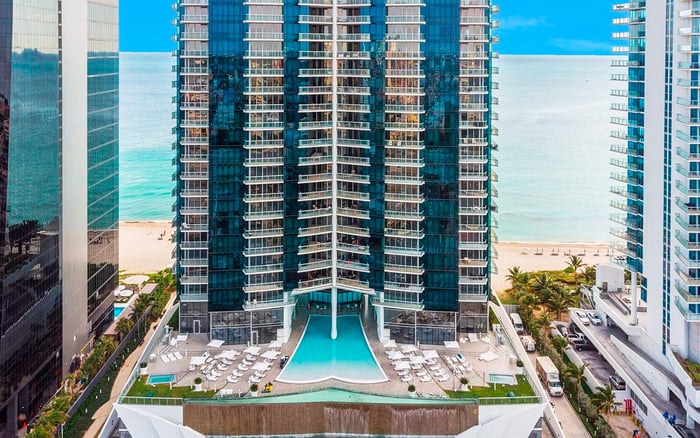
A buyer-focused comparison of leasing, guest access and resale considerations at two residence-only branded condominiums in Sunny Isles Beach.

For a buyer comparing The Estates at Acqualina Sunny Isles with The Ritz-Carlton Residences® Sunny Isles, the decisive differences may not be visible during a private showing. They reside in declarations, amendments, leasing policies, and the day-to-day administration of guests and tenants.
Both properties occupy the rarefied oceanfront market of Sunny Isles Beach, yet neither should be viewed as a hotel investment simply because it carries a hospitality-associated identity. The Ritz-Carlton is a residence-only branded condominium-not a condominium attached to an operating Ritz-Carlton hotel-and offers no on-site hotel rental pool. The Estates is likewise best evaluated as a residential condominium governed by association documents, not as a platform for hotel-style turnover.
At this level, the most consequential amenity may be clarity about how a residence can be used.
That distinction matters to purchasers balancing personal occupancy, family use, rental income, and a future sale. Branded residences can offer a highly serviced lifestyle, but the brand does not supersede the governing documents. Guest registration, tenant applications, amenity access, and enforcement remain association matters.
The Estates comprises two oceanfront residential towers at 17901 and 17975 Collins Avenue. Its leasing framework is comparatively clear: a six-month minimum lease term, no more than one lease per year, and no initial owner-occupancy waiting period before leasing.
In practical terms, a residence can be leased during the first year of ownership, but the property is not structured for conventional short-term turnover. Even a tenancy described as seasonal must satisfy the six-month minimum. This favors an owner seeking one stable, carefully selected tenant over an operator whose investment thesis depends on repeated bookings.
The long-duration model has not prevented an active luxury rental market. The median signed lease was $39,000 per month, while transactions included an 8,870-square-foot residence leased for $150,000 per month in October 2024. Other leases ranged from $40,000 to $75,000 per month. These figures establish market activity-not assured occupancy, rent, or return.
Residences may be used for personal occupancy ranging from year-round living to as little as 16 weeks annually. That positioning may suit a second-home buyer who wants substantial personal use and the option of one longer tenancy, provided the owner’s calendar aligns with the lease restrictions.
At The Ritz-Carlton Residences, owners may rent their residences, and the framework appears less stringent than at some ultra-luxury competitors. Unit 4701, a high-floor residence, was offered for rent at $35,000 per month, reflecting an active luxury leasing market within the property.
The available facts do not establish the exact minimum lease term or the number of leases permitted annually. A serious offer should therefore be conditioned on review of the current declaration, bylaws, rules, and leasing addenda. Buyers should also verify application timing, deposits, fees, approval procedures, and any restrictions that apply differently to furnished, seasonal, or occupied residences.
A broader Sunny Isles search might also include Bentley Residences Sunny Isles or St. Regis® Residences Sunny Isles. Those alternatives should not be presumed to share either subject property’s rules. Their relevance is a reminder that each condominium requires its own document-level review, even within the same branded oceanfront corridor.
A buyer should distinguish among three forms of occupancy: the owner’s own stays, visits by personal guests, and possession by a tenant. A friend or family member using a residence may face registration procedures and limits on unaccompanied access. A tenant may be subject to an application, screening, lease approval, and different amenity privileges. The exact treatment must be confirmed with the association, not inferred from the brand or front-desk experience.
This distinction becomes especially important for owners who expect adult children, staff, or extended family to use the home in their absence. Before closing, ask how overnight guests are registered, whether unaccompanied guests may receive credentials, which amenities they may use, and whether parking or service access changes when the owner is away.
Pets deserve the same precision. At The Estates, large pets are allowed for owners, and tenants may keep pets. At The Ritz-Carlton, pets are allowed subject to possible restrictions. Neither point substitutes for current confirmation of number, size, and breed limits-or for determining whether owner and tenant rules differ.
Association permission is only one part of the analysis. Sunny Isles Beach requires a Short-Term Vacation Rental License when a multifamily residence is offered for six months or less, regardless of whether the condominium permits the arrangement.
The wording is significant because it reaches a rental of six months or less. An Estates owner contemplating the six-month minimum should confirm whether the proposed lease triggers city licensing, then determine which filings, inspections, or other requirements apply. Condominium approval does not eliminate municipal obligations, and municipal permission does not override condominium restrictions.
Resale value is influenced not only by view, floor plan, and condition, but also by the next buyer’s usable options. The Estates’ six-month minimum and once-yearly limit define a long-term leasing strategy for future owners. At The Ritz-Carlton, the apparently lighter framework may support a wider blend of personal occupancy and leasing, but exact flexibility cannot be assumed until the current documents are examined.
Transferability should be investigated as a distinct legal and operational subject. The available facts do not establish whether either association has a right of first refusal, purchaser approval, transfer fees, or special treatment for a sale with a tenant in possession. Counsel should review those provisions alongside the contract and estoppel materials.
If a residence will be sold while leased, the buyer should understand whether the tenancy survives closing, how deposits transfer, who bears pending obligations, and when the incoming owner can recover personal use. These questions can affect the buyer pool, closing timeline, and negotiation of possession.
Before committing, request the current declaration and all amendments, bylaws, rules, leasing addenda, tenant and guest applications, fee schedules, pet policies, and available association disclosures. Confirm minimum duration, annual frequency, first-year eligibility, approval timing, city licensing, and amenity access in writing.
The better choice is ultimately the property whose rules fit the buyer’s real calendar. The Estates offers a documented framework oriented toward longer tenancy and controlled frequency. The Ritz-Carlton offers confirmed leasing permission and an active rental market, but its exact limits require direct verification. For either address, clarity before contract preserves flexibility after closing.
For discreet guidance on Sunny Isles Beach ownership, leasing and resale considerations, connect with MILLION.
If branded residences are on your mind — as a home or as an allocation — we would be glad to share what we are seeing, privately.
Begin a quiet conversationYes. The reported policy permits leasing with a six-month minimum and no more than one lease per year.
Yes. The reported framework does not impose an initial owner-occupancy waiting period.
No conventional short-term turnover is supported by the reported rules. Even seasonal leases must satisfy the six-month minimum.
Yes, leasing is permitted and owner-directed. The property does not provide an on-site hotel rental pool.
The exact current minimum is not established in the supplied facts. Buyers should confirm it in the declaration, bylaws, rules and leasing addenda.
Not necessarily. Registration, unaccompanied access and amenity use are controlled by each association’s current rules.
The city requires a Short-Term Vacation Rental License for multifamily residences offered for six months or less. Owners should confirm how that rule applies to a proposed lease.
Available information indicates pet accommodation at both, subject to rules. Buyers should verify current number, size and breed restrictions for owners and tenants.
Review purchaser approval, rights of first refusal, transfer fees and treatment of an existing tenant. The supplied facts do not establish those terms for either property.
No. Listings and recorded leases demonstrate market activity but do not guarantee occupancy, achievable rent or return.