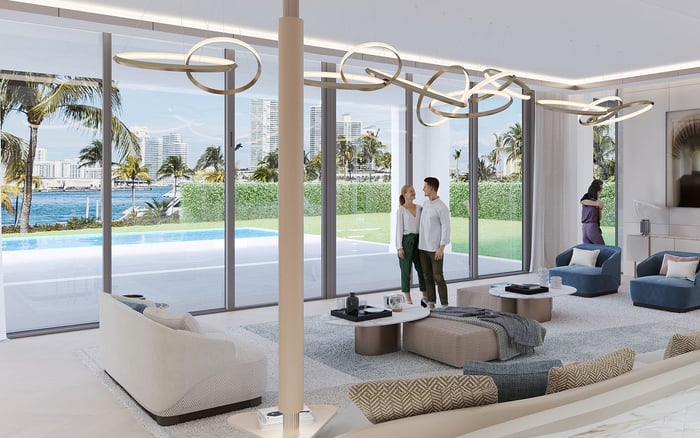
For families considering Six Fisher Island as a legacy holding, the central question is not simply whether to acquire an exceptional residence. It is how to preserve flexibility, govern multigenerational use, control capital exposure, and plan for an eventual transfer or sale within a specialized island market.

For a 2026 buyer, The Residences at Six Fisher Island is best understood as more than an ultra-luxury condominium. The proposition combines a private residence with controlled island access, maritime security, privacy, and club-oriented living. These attributes make the property compelling as a family retreat, but they also demand a more exacting ownership strategy.
The appropriate lens is long term. A family evaluating the residence as a legacy holding should begin with intended use, governance, capital concentration, and succession. Architecture and lifestyle remain important, but ownership discipline will determine whether the asset can serve multiple generations without becoming administratively cumbersome or financially restrictive.
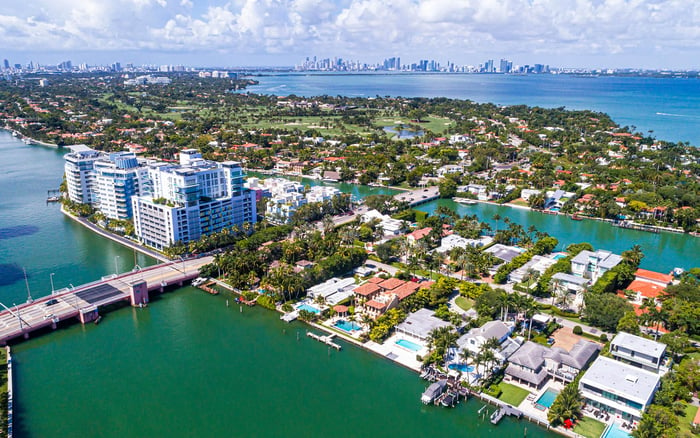
Fisher Island differs from a conventional Miami condominium neighborhood because its scarcity is rooted in physical separation and controlled access. Competing developments may offer waterfront settings, privacy, or service, but the island's access constraints are difficult to reproduce.
That separation also defines daily life. Owners can remain close to Miami Beach and Downtown Miami while maintaining distance from mainland congestion and nightlife. Marina, beach-club, golf, and concierge-oriented amenities further support a self-contained rhythm. For families seeking a retreat rather than a purely urban base, this combination can be central to the purchase rationale.
Scarcity, however, should not be mistaken for automatic liquidity. A rare property can remain highly desirable while appealing to a narrower group of future purchasers. A disciplined buyer values the island's distinctiveness without assuming that every exit will resemble a sale in Miami's broader condominium market.
Before selecting an ownership entity or financing approach, the family should define how the residence will function. Will it serve as a principal seasonal base, an occasional second home, or a gathering place shared across generations? Who may use it, invite guests, approve major expenditures, and make decisions if family priorities diverge?
The legal ownership structure should reflect those answers, the expected holding period, and the family's succession objectives. A structure that appears efficient at closing may prove inflexible when beneficial interests change, heirs reside in different jurisdictions, or one branch of the family seeks liquidity.
Qualified legal, tax, estate-planning, and financial professionals should coordinate these decisions. The objective is not complexity for its own sake, but a clear chain of authority, a workable transfer plan, and sufficient flexibility to accommodate foreseeable changes in family circumstances.
A trophy residence can represent a substantial, illiquid concentration of family capital. Leverage should therefore be tested conservatively against the household's wider balance sheet, not merely its ability to complete the purchase.
A prudent review encompasses recurring ownership costs, club obligations, insurance, staffing or household support, and reserves for future needs. No expense should be assessed in isolation. The relevant measure is the residence's total annual demand on capital and administration under realistic patterns of use.
The family should also determine who will fund ongoing expenses and how unequal usage will be addressed. Establishing these principles before acquisition can prevent a lifestyle asset from becoming a source of friction later.
The value of the island experience depends partly on rules beyond the residence itself. Due diligence should cover club governance, access procedures, guest privileges, recurring obligations, and any practical limits relevant to the family's expected routines.
This review should be concrete. Map how children, adult heirs, household staff, advisers, guests, and service providers will enter and use the property. Consider whether the family's preferred arrival patterns and entertaining style align with the island's controlled environment. Privacy is most valuable when its operating rules suit the household.
Cross-shopping can sharpen priorities, but each comparison should be carefully framed. Reviewing established Fisher Island names such as Palazzo del Sol and Palazzo della Luna keeps the analysis within the same specialized island context. Considering The Links Estates at Fisher Island can further clarify whether the family is primarily drawn to a particular residential format or to Fisher Island itself.
The purpose is not to create a superficial ranking. It is to distinguish three layers of value: the individual residence, the building or residential setting, and the island ecosystem. A buyer who understands which layer matters most can negotiate, structure ownership, and plan future use with greater precision.
Even a legacy acquisition requires an exit framework. Fisher Island has a specialized buyer pool and distinct micro-market dynamics, so a future sale should not be modeled on the presumed liquidity of Miami at large.
Families should identify likely decision triggers in advance, including generational transition, declining use, a change in capital priorities, or disagreement among beneficiaries. They should also establish who may authorize a sale and how competing family interests will be resolved. Exit planning does not weaken long-term conviction; it protects that conviction by preventing forced decisions under pressure.
The strongest acquisition case aligns five elements: a genuine need for controlled privacy, a multiyear or multigenerational use plan, an ownership structure designed for succession, conservative capital allocation, and a realistic view of resale.
When those elements are coherent, Six Fisher Island can be assessed as a durable family asset rather than a short-cycle investment. The buyer's advantage lies not in predicting every future outcome, but in preserving optionality while honoring the qualities that make the island distinctive.
Why should Six Fisher Island be viewed as a legacy holding? Its privacy, controlled access, limited island supply, and retreat-oriented lifestyle support a long-duration ownership perspective.
What is the first ownership question a family should answer? Define who will use the residence, how often they will use it, and who will control decisions, expenses, and future transfers.
Why is ownership structure important? It should support intended family use, succession planning, and the anticipated holding period without creating avoidable inflexibility.
Should a buyer use leverage? Any leverage should be assessed conservatively because the residence may represent a substantial, illiquid concentration of family capital.
Which recurring matters belong in due diligence? Review ownership costs, club obligations, governance, access rules, insurance, reserves, and the household's likely usage patterns.
Why do club rules matter to the purchase? Club governance and access procedures can materially influence how family members, guests, and staff experience the island.
Is Fisher Island comparable to the broader Miami condominium market? Not directly. Its controlled access, physical separation, and specialized buyer pool create distinct micro-market dynamics.
How should families approach future resale? Plan around a narrower buyer pool, define sale authority, and identify family or financial events that could trigger an exit.
What lifestyle elements support the ownership proposition? Security, privacy, island access, concierge-oriented living, and internal recreational infrastructure collectively shape the experience.
Who should advise on entity, tax, and succession decisions? Qualified legal, tax, estate-planning, and financial professionals should coordinate recommendations around the family's circumstances.
If you'd like a private walkthrough and a curated shortlist, connect with MILLION.
If branded residences are on your mind — as a home or as an allocation — we would be glad to share what we are seeing, privately.
Begin a quiet conversation