For buyers weighing Surfside against Sunny Isles Beach, the decisive question is not which address appears more luxurious. It is how each residence converts brand service into recurring expense, practical convenience, and limits on owner discretion. This framework separates the lifestyle promise from the legal and financial structure beneath it.
Surfside and Sunny Isles Beach can satisfy the same broad brief: an oceanfront residence, a recognized name, and a service environment designed to reduce friction. Yet their ownership experiences can differ materially. The better choice depends less on which lobby makes the stronger first impression than on how a buyer values discretion, staffing, scale, recurring costs, and control.
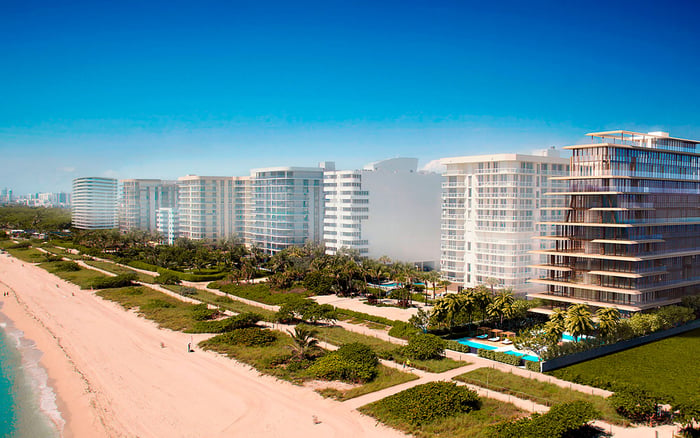
In Surfside, The Surf Club Four Seasons Surfside offers a useful case study. Completed in 2017, the 12-story oceanfront complex spans 9001 and 9111 Collins Avenue. In Sunny Isles Beach, Armani Casa Sunny Isles Beach provides a contrasting reference point at 18975 Collins Avenue, with 308 residences.
These are not interchangeable expressions of branded residences. A buyer should first define the desired relationship with service. Is the residence intended to operate as a highly managed retreat, a frequently used second home, or a property in which the owner wants broad latitude over guests, leasing, renovations, and vendors?
The right branded residence aligns its service promise with the owner’s actual pattern of use.
Brand affiliation has value only when its practical benefits match the buyer’s routine. Before assigning a premium to a name, request a precise schedule of services included in the association charge, those available for an additional fee, and those dependent on separate arrangements.
At Armani/Casa, association charges cover amenities, cable television, building maintenance, parking, pool access, security, and utilities. Unit 3205 identified beach rights, a clubhouse, fitness center, pool, sauna, spa, business center, and elevators among the association amenities. The list is informative, but buyers should still verify the current scope, availability, reservation rules, and any usage charges.
The same discipline applies in Surfside. A brand-led environment can create meaningful convenience, but the relevant question is what the owner is contractually entitled to receive. Buyers considering a broader Surfside comparison might also examine Arte Surfside, not as a substitute for document review, but as another reference for determining how much scale and service they genuinely want.
Association fees are the most visible recurring expense, but they are only one line in the ownership budget. At The Surf Club, typical monthly HOA charges range from approximately $3,500 to $8,000 or more, with about $5,200 as an illustrative average. A separate building-level figure places the average near $3.48 per square foot per month. At Surf Club South, 9001 Collins Avenue, the figure is approximately $2.80 per square foot monthly, demonstrating that even residences within the same complex can carry different cost profiles.
Unit-specific figures can sit far outside broad guidance. For Unit N421 at 9111 Collins Avenue, maintenance and HOA charges were $14,366 per month, with annual property taxes of approximately $188,434. These figures should not be generalized across the property, but they demonstrate why high-value buyers need an address-specific and unit-specific model.
Beachfront insurance is one identified reason association charges exceed $5,000 per month for many Surf Club residences. Buyers should therefore review the association’s insurance summary, deductibles, reserves, and potential exposure beyond the regular monthly fee.
At Armani/Casa, monthly HOA fees range from approximately $400 to $5,600, depending on the residence. Unit 3205 carried a $2,750 monthly association fee, equal to $33,000 annually, plus annual property taxes of approximately $20,443. Again, the point is not to infer a building-wide norm from one unit. It is to compare each candidate using the same annual template.
That template should include property tax, association charges, interior insurance, financing, utilities not included in dues, club or service charges, reserve contributions, and potential assessments. For readers following pricing and trends, cost per square foot is useful only after confirming what the fee buys and which obligations remain outside it.
Owner control is where an elegant purchase can become either effortless or restrictive. Definitive minimum lease terms, short-term rental permissions, leaseback rights, renovation controls, and access to hotel services at these properties remain to be established. Those answers belong in the governing documents, not in assumptions formed during a showing.
Ask counsel to review the current declaration, bylaws, rules, management agreement, brand agreement, and any rental addenda. The review should address minimum lease periods, annual leasing frequency, approval procedures, guest registration, pet and vendor rules, renovation windows, design approvals, elevator access, insurance requirements, and the brand’s enforcement rights.
A buyer comparing Sunny Isles options may place Jade Signature Sunny Isles Beach in the consideration set, but the same principle applies: building identity never answers a legal-control question. Current documents do.
The category belongs naturally within buyer’s guides because control has economic consequences. A restrictive rental policy may matter little to an owner who never leases, yet it can be decisive for a buyer seeking occasional income. Renovation protocols may appeal to an owner prioritizing aesthetic consistency but burden someone planning extensive customization.
A disciplined comparison uses three scenarios rather than one optimistic projection. The base case should reflect current disclosed expenses. The higher-cost case should allow for insurance pressure, reserve changes, assessments, and paid services. The lifestyle case should estimate the real value of time saved through staffing, security, amenities, and operational support.
Then test each scenario against expected use. A residence occupied for several months each year may justify a richer service platform differently from one used only for occasional weekends. Likewise, a larger association is not inherently better or worse. It may distribute certain costs across more residences while creating a different atmosphere and governance structure.
For The Surf Club Four Seasons Surfside, an asking-price reference of approximately $5,501 per square foot underscores the scale of capital involved. At that level, diligence on recurring costs and control is not an administrative detail. It is part of protecting the purchase thesis.
Surfside may appeal to a buyer drawn to a lower-rise setting and a highly specific service identity. Sunny Isles Beach may suit a buyer who prefers a larger residential environment and wants to compare a wider range of unit-level fee profiles. Neither conclusion should be automatic, and neither area label resolves the essential questions.
The final decision should rest on four aligned answers: what service is included, what ownership costs in a realistic annual model, which rights remain with the owner, and whether those terms fit the intended use. Brand, architecture, and ocean views establish desire. Budgets, insurance, reserves, and governing documents establish confidence.
For a discreet, residence-specific comparison of Surfside and Sunny Isles opportunities, consult MILLION.
If branded residences are on your mind — as a home or as an allocation — we would be glad to share what we are seeing, privately.
Begin a quiet conversationThe better fit depends on desired service, scale, annual carrying cost, and owner control. Buyers should compare specific residences rather than rely on neighborhood labels.
Published guidance places typical charges around $3,500 to $8,000 or more monthly, with about $5,200 used as an illustrative average. Unit-specific costs can vary substantially.
Beachfront insurance is one identified contributor. Residence size, tower, ownership share, service package, and association structure may also affect charges.
The listing disclosed maintenance and HOA charges of $14,366 per month. It also showed annual property taxes of approximately $188,434.
Publicly available building data has shown approximately $400 to $5,600 per month, depending on the residence. Buyers should verify the current unit-specific figure.
Unit 3205 disclosed a $2,750 monthly association fee, or $33,000 annually, and annual property taxes of approximately $20,443.
They have been described as covering amenities, cable television, maintenance, parking, pool access, security, and utilities. Current inclusions should be confirmed in writing.
Review the declaration, bylaws, rules, budget, reserves, estoppel, insurance summary, management agreement, brand agreement, and applicable rental addenda.
The available facts do not establish definitive short-term rental rights. Confirm lease terms, frequency limits, approvals, and rental addenda before contract deadlines.
Include association fees, property tax, interior insurance, financing, utilities, club or service charges, reserves, and potential assessments.