An editorial look at why camera placement matters in evaluating St. Regis® Residences Sunny Isles, from perceived scale and terrace usability to privacy, ocean views, and buyer confidence.
At St. Regis® Residences Sunny Isles, camera placement is more than a production detail. It shapes how a buyer reads scale, privacy, exposure, and the emotional rhythm of a residence before ever stepping inside. In a market where first impressions often begin with renderings, photography, and curated tours, the camera becomes a quiet interpreter of value.
That interpretation matters because ultra-luxury buyers are not simply asking whether an image is beautiful. They are asking whether it is trustworthy. Does the living room feel as expansive in person as it did on screen? Does the terrace feel usable, or merely photogenic? Does the bedroom preserve a sense of privacy? Does the ocean view read as uninterrupted, or does the actual perspective make neighboring towers more prominent?
For branded residences such as St. Regis® Residences Sunny Isles and St. Regis® Residences Brickell, the strongest visual strategy is not the most theatrical one. It is the most precise: truthful about scale, careful with perspective, and disciplined in how it frames the setting.
Camera height can dramatically affect how expansive a room feels in marketing imagery. A lens positioned too low may exaggerate ceiling height or stretch foreground elements. A camera set too high may flatten the room and reduce the sense of intimacy. In large living areas and bedrooms, these choices influence whether a residence feels graceful, oversized, compressed, or balanced.
For buyers studying St. Regis® Residences Sunny Isles remotely, that distinction is meaningful. A residence may be generous in person yet appear less compelling if photographed from a height that diminishes depth. Conversely, an aggressive viewpoint may make a room feel more dramatic than the in-person experience supports. Neither approach serves the buyer well.
The best placement lets the architecture breathe without distortion. It allows a room to feel composed rather than stretched. In a Sunny Isles market defined by oceanfront competition and highly visual decision-making, that balance can determine whether a buyer moves from curiosity to serious consideration.
Focal length is one of the least visible yet most consequential parts of real estate imagery. A very wide lens may capture more of a room, but it can also bend proportions and create an impression of space that feels different during a tour. A tighter lens may be more honest about volume, but it can omit context that helps a buyer understand flow.
This is especially important in expansive living rooms and bedrooms, where proportion is central to the perception of luxury. Buyers in this category are often attuned to subtle inconsistencies. If a primary bedroom appears serene and open in imagery but feels tighter in person, the issue is not simply aesthetic. It can create hesitation.
At the ultra-premium level, hesitation is expensive. Camera placement should reduce friction, not introduce it. The most effective imagery gives buyers enough information to understand the residence honestly while still allowing the space to feel aspirational.
Oceanfront buyers are highly sensitive to view quality. Camera location can determine whether the ocean appears uninterrupted or partially affected by neighboring towers. A small move to the left or right can change the composition significantly, especially in a vertical coastal environment where sightlines are layered.
For St. Regis® Residences Sunny Isles, view presentation should be handled with restraint. The goal is not to hide context. It is to frame the outlook from a position that reflects how a buyer will actually experience the residence. A view captured from an improbable corner or a highly selective angle may generate initial excitement, but it can also weaken confidence when the buyer visits.
Waterview imagery works best when it reveals both beauty and orientation. A buyer should understand where the ocean sits in relation to the living room, terrace, and bedroom. They should also understand whether the perspective feels open, protected, dramatic, or more urban in character.
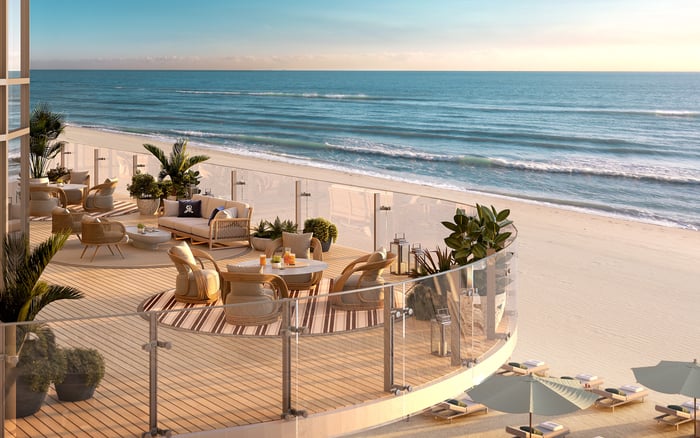
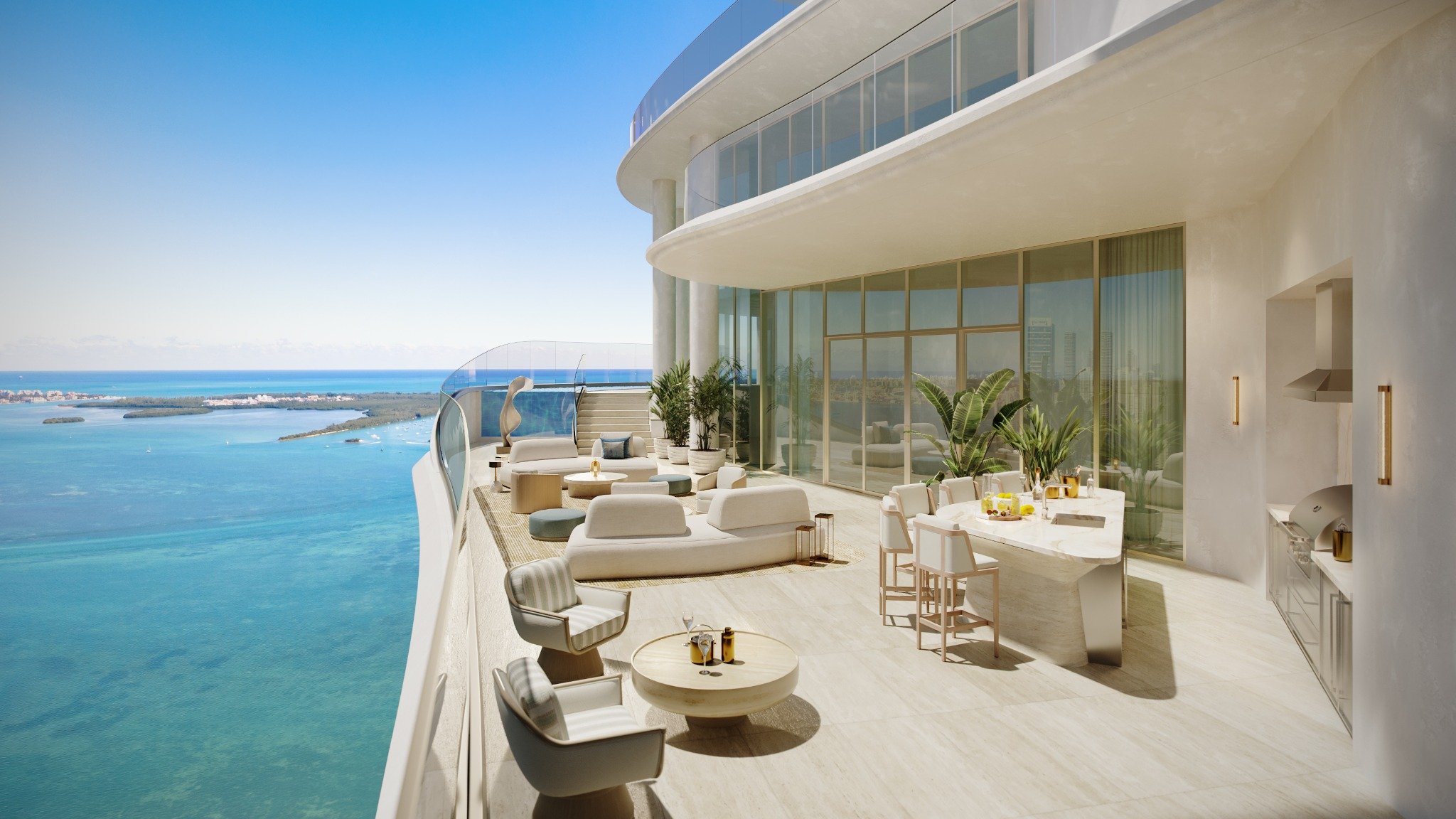
Terrace imagery can be especially persuasive in Sunny Isles because outdoor space is often part of the emotional purchase. Yet terrace perspective is easy to overstate. A camera placed at the far edge can make the outdoor area feel deeper than it is. A lens angled outward can emphasize the ocean while minimizing how the terrace connects to the interior. A viewpoint that avoids adjacent buildings may suggest more privacy than a buyer will feel in daily use.
The better approach is to show the terrace as a living space. That means acknowledging both its view and its usability. How does it relate to the main living area? Does it feel private when standing near the railing? Does the perspective make the outdoor space feel calm, exposed, expansive, or narrow?
For an ultra-luxury residence, outdoor imagery should help buyers imagine morning coffee, evening air, and quiet conversation without relying on visual exaggeration. The terrace is not simply a backdrop for the ocean. It is part of the home’s functional value.
Bedroom imagery requires a different kind of discipline. The camera should not only capture proportion and finish. It should also communicate privacy cues, including what is visible from inside the residence and what may be visible from surrounding buildings.
In a dense coastal skyline, privacy is not binary. It changes by angle, elevation, and sightline. High floors may alter the relationship between a bedroom and nearby towers, but the camera still has to be honest about what the resident will perceive. A beautiful bedroom image that ignores exposure can leave a buyer with unanswered questions.
The most persuasive bedroom photography is quiet. It shows the room’s scale, the relationship to the view, and the sense of retreat. It does not need to force drama. In fact, restraint often signals confidence.
The strongest camera strategy for St. Regis® Residences Sunny Isles is one that aligns expectation with experience. Buyers should feel that the residence they tour is the residence they already began to understand through imagery. When that happens, the showing becomes confirmatory rather than corrective.
Poorly chosen angles can create subtle dissonance. The buyer may not articulate the issue as a camera problem. They may simply feel that the residence is less open, less private, or less balanced than expected. That feeling can affect momentum.
For luxury real estate, visual trust is part of value. A polished image may get attention, but a truthful image can preserve confidence through the decision process. The camera should elevate the residence without making promises the physical space does not keep.
A discerning buyer should study more than the prettiest frame. Look at camera height in living areas. Notice whether vertical lines feel natural. Compare the view from multiple rooms. Pay attention to terrace depth and how the outdoor area connects to the interior. In bedrooms, consider both the view outward and the potential visibility inward.
The question is not whether the imagery is attractive. It should be. The question is whether it helps you understand the residence accurately enough to make a confident next move.
For St. Regis® Residences Sunny Isles, camera placement can influence the buyer decision because it sits at the intersection of emotion and evidence. It shapes how the residence feels, and how honestly that feeling is conveyed.
Why does camera placement matter for St. Regis® Residences Sunny Isles? It can influence how buyers perceive scale, privacy, terrace usability, and ocean views before an in-person visit.
Can camera height make a room look larger? Yes. Camera height can change the perceived openness of a room, either enhancing or diminishing its sense of volume.
Does focal length affect buyer perception? Yes. Focal length can alter perceived proportions, especially in large living areas and bedrooms.
Why are ocean views sensitive to camera location? A small change in camera position can affect whether views appear uninterrupted or partially shaped by neighboring towers.
Should terrace images be viewed critically? Yes. Perspective can change how private, deep, and usable an outdoor space feels.
What should buyers notice in bedroom imagery? Buyers should look for privacy cues, including sightlines from inside the residence and from nearby buildings.
Is dramatic photography always a problem? No. Drama can be effective when it still reflects the real experience of the residence.
What creates visual dissonance during a tour? Dissonance can occur when the residence feels meaningfully different from the imagery that shaped the buyer’s expectations.
What is the best visual strategy for an ultra-luxury oceanfront project? The strongest strategy emphasizes truthfulness, view quality, scale, and privacy rather than drama alone.
How should buyers use imagery before visiting? Buyers should compare rooms, views, terrace perspectives, and privacy cues to form a grounded expectation.
To compare the best-fit options with clarity, connect with MILLION.
If branded residences are on your mind — as a home or as an allocation — we would be glad to share what we are seeing, privately.
Begin a quiet conversation