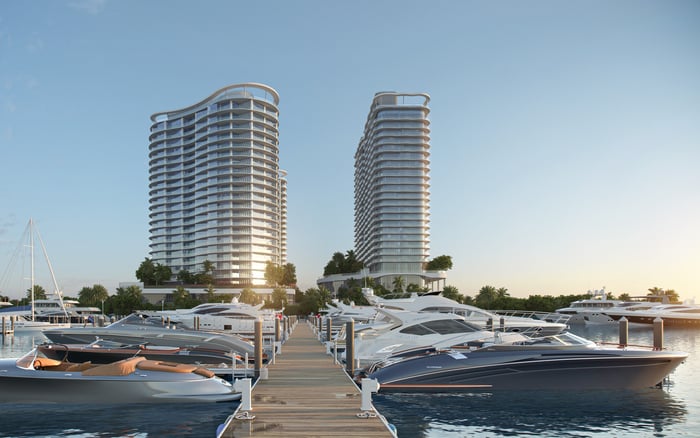
A discreet buyer’s framework for comparing two branded Fort Lauderdale residences through staff circulation, yachting logistics, bridge clearance questions, and hurricane readiness rather than social spectacle.

For a certain Fort Lauderdale buyer, the most revealing tour does not begin at the pool, the lounge, or the private dining room. It begins where staff, deliveries, pets, luggage, flowers, groceries, marine gear, and contractors move through the building. That is the right lens for comparing St. Regis® Residences Bahia Mar Fort Lauderdale with The Ritz-Carlton Residences® Fort Lauderdale.
The question is not which address feels more glamorous in a presentation. The sharper question is which one can support the buyer’s actual household: principals arriving separately from guests, crew moving without theater, packages handled without friction, and a captain or estate manager able to solve problems without turning the residence into a lobby conversation. In Broward waterfront living, privacy is often produced by circulation, not just square footage.
A serious walk-through should separate hospitality from operations. Ask how housekeeping enters, where vendors check in, how service elevators are scheduled, how oversized deliveries are staged, and whether staff can reach the residence without crossing the building’s most social areas. If the household includes a driver, nanny, chef, executive assistant, personal security, or rotating seasonal staff, the answer must be practical, not ceremonial.
This is where branded residences can look similar in a brochure but live very differently. One plan may feel elegant for entertaining yet awkward for back-of-house routines. Another may appear quieter socially but more disciplined operationally. Buyers should request diagrams, not adjectives: elevator banks, receiving areas, parking movements, pet paths, trash and recycling procedures, vendor insurance requirements, and after-hours access.
The same standard applies when considering nearby luxury references such as Four Seasons Hotel & Private Residences Fort Lauderdale or Auberge Beach Residences & Spa Fort Lauderdale. The most refined building is not always the one with the longest amenity menu. It is the one that lets private life remain private while complex daily logistics stay invisible.
For yachting households, a residence is part of a larger operating system. A true marina decision considers how owners, guests, crew, provisions, dock carts, luggage, and weather contingencies move between home, car, lobby, vessel, and open water. A boat slip, where applicable, is only one piece of the equation. The greater issue is whether the building supports the rhythm of boating without improvisation.
At St. Regis® Residences Bahia Mar Fort Lauderdale, the Bahia Mar name naturally brings the boating conversation forward. At The Ritz-Carlton Residences® Fort Lauderdale, buyers should still apply the same captain-led scrutiny. How long does it take to move from the residence to the vessel? Where are coolers and gear staged? Can provisioning happen discreetly? How are wet items, fishing equipment, tender supplies, and guest arrivals managed without forcing the household through the most visible public areas?
The right answer may differ by lifestyle. A buyer who day-cruises with family may care most about parking, guest drop-off, and simple weekend boarding. A larger-yacht owner may care more about crew access, route reliability, fuel planning, and the choreography of luggage and provisions. In both cases, the most important person in the due diligence meeting may be the captain.
Bridge clearance should never be reduced to a casual sales-office assumption. Air draft, tide, tender configuration, radar equipment, antennas, and seasonal cruising plans all matter. A vessel that works comfortably for one owner may be constrained for another. The only responsible comparison is route-specific and vessel-specific.
Before choosing between these two residences, buyers should ask their captain to map the expected route to the ocean, identify every bridge interaction, and model ordinary days as well as peak-weekend traffic. The captain should also evaluate backup plans, waiting tolerance, guest timing, and whether a preferred vessel profile may need to change over the ownership horizon.
This is not merely a boating question. It is a resale and lifestyle question. A residence that pairs elegantly with the current yacht may become less convenient if the owner upgrades vessels. Conversely, a buyer who does not need large-vessel flexibility may prefer the building that delivers better staff flow, calmer arrival sequences, or stronger hurricane procedures.
In South Florida, hurricane planning is not a footnote. It is part of the residence’s operating character. Buyers should examine how the building prepares before a storm, communicates during a threat, and reopens after conditions improve. The checklist should include glass and envelope protocols, backup power, garage procedures, water intrusion planning, elevator recovery, vendor access, marine coordination, and post-storm staffing.
For boating owners, the storm plan must extend beyond the apartment. Where does the vessel go? Who decides when it moves? How are dock lines, tenders, personal watercraft, deck furniture, and marine equipment handled? If the owner is away, who has authority to act? A polished amenity deck means little if the household’s hurricane plan depends on last-minute phone calls.
Comparable Fort Lauderdale residences such as Riva Residenze Fort Lauderdale also belong in this broader conversation because riverfront, oceanfront, and near-marina living each produce distinct operating questions. The sophisticated buyer treats hurricane readiness as a management system, not a marketing claim.
If social amenities are secondary, compare the two residences using a private-life scorecard. First, grade staff circulation. Second, grade arrival privacy for principals, guests, vendors, and crew. Third, grade boating logistics from residence to vessel and from vessel to open water. Fourth, grade bridge clearance against the actual boat or the likely next boat. Fifth, grade hurricane planning in writing.
The correct answer may not be the same for every buyer. St. Regis® Residences Bahia Mar Fort Lauderdale may appeal to the household that wants the boating discussion close to the center of the decision. The Ritz-Carlton Residences® Fort Lauderdale may appeal to the buyer who prioritizes a different expression of branded service and residential discretion. The point is to compare the residences as operating environments, not amenity catalogs.
For the ultra-private buyer, luxury is the absence of friction. Staff arrive without spectacle. Deliveries appear without conversation. Guests board cleanly. The boat plan survives weather, tides, and schedule changes. The residence feels effortless because every difficult movement has already been designed, tested, and assigned.
Should staff flow matter more than amenities for some buyers? Yes. For households with employees, crew, frequent deliveries, or high privacy needs, staff circulation can affect daily life more than social spaces.
Is boating convenience the same as being near the water? No. Convenience also includes loading, provisioning, route timing, parking, dock access, and how discreetly people and gear move.
Who should evaluate bridge clearance? A qualified captain should evaluate bridge clearance based on the specific vessel, equipment, tides, and intended cruising route.
Can a buyer compare these residences without choosing a boat first? Yes, but the buyer should model likely vessel profiles so the residence does not limit future boating plans.
What should be requested during a private tour? Ask to review service elevators, receiving areas, vendor procedures, parking flow, dock logistics, and emergency protocols.
Why does hurricane planning matter in a luxury comparison? It shows how the residence performs when conditions are difficult, especially for owners who travel frequently.
Should social amenities be ignored entirely? No. They matter, but they should not distract from operations if the buyer’s household is complex or privacy-driven.
Is a boat slip always the deciding factor? Not always. A boat slip can be valuable, but route, access, storm planning, and crew logistics may be equally important.
How should Broward buyers think about branded service? Branded service should be tested through daily routines, not only through hospitality language or amenity presentations.
What is the best next step before selecting a residence? Bring the estate manager, captain, and advisor into the comparison before finalizing the purchase.
When you're ready to tour or underwrite the options, connect with MILLION.
If branded residences are on your mind — as a home or as an allocation — we would be glad to share what we are seeing, privately.
Begin a quiet conversation