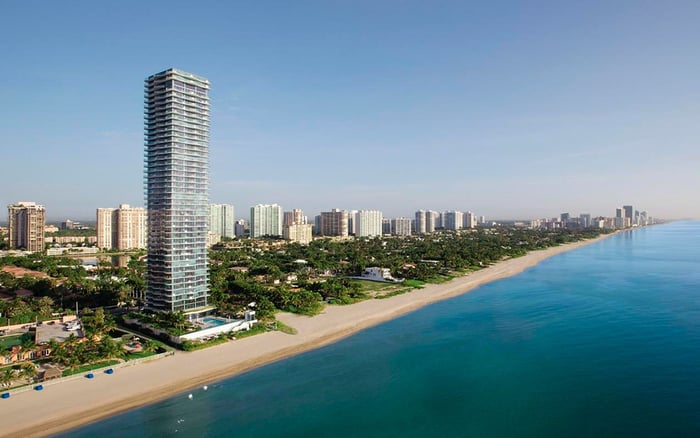
A practical framework for Shell Bay owners evaluating when to hold, sell, or wait for deeper resale clarity in Hallandale Beach.

For households considering Shell Bay by Auberge Hallandale, turnover timing is not simply a question of when a buyer appears. It is a question of when the residence, the service platform, and the broader resale market can be understood together. Shell Bay is positioned in Hallandale Beach, within South Florida’s coastal luxury corridor between Miami-Dade and Broward demand centers. That geography matters, but the more important issue is how the asset is designed to be lived in.
This is not a conventional condominium decision. Shell Bay’s Auberge-branded positioning places it in the high-service branded-residences segment, where buyers assess more than square footage, finish levels, and views. They also evaluate the credibility of the hospitality experience, the rhythm of service, and the sense of arrival once the property has moved from concept to functioning residential environment.
That distinction changes the household planning conversation. Owners should think about turnover in stages: purchase expectations, completion, first occupancy, operating stabilization, comparable-sales formation, and personal-use needs. The right answer may differ for a primary resident, a seasonal user, and a second-home household that values flexibility as much as liquidity.
Early turnover in a new-construction project often occurs during a transitional moment. The market moves from developer pricing to open-market resale pricing, and that shift can be uneven. In the first years after completion, resale comparables may be limited. A small number of transactions can have an outsized effect on perceived value, especially when residences differ meaningfully by size, position, or price point.
For an owner, the first wave can offer a clean opportunity if buyer demand is strong and competing inventory is limited. It can also be a more delicate window if several early owners attempt to sell around similar moments, such as completion, closing, or the first few years of occupancy. Resale competition does not need to be broad to matter at the luxury level. Even a small cluster of similar listings can influence the negotiation tone.
The key is to avoid treating the first resale as the market’s final verdict. Early sales can be informative, but they may not fully capture the value of a branded, amenity-driven property once residents and prospects can experience the finished environment. At Shell Bay, the service promise and lifestyle infrastructure are part of the product. Those elements often require lived evidence.
There is a meaningful difference between selling an expectation and selling an established residential experience. Before completion, buyers imagine the building. During early occupancy, they inspect it. After operations mature, they can judge how it works.
For Shell Bay, this matters because the Auberge association points buyers toward a high-touch hospitality and service orientation. A household considering turnover after operations are more established may be selling into a market with a clearer understanding of daily life, amenity value, and resident experience. The building’s identity may feel less theoretical and more tangible.
This does not mean waiting is always superior. Timing depends on a household’s objectives. A seller with changing life circumstances may prefer certainty over optionality. Another household may choose to hold through stabilization so prospective buyers can see the property as a complete residential proposition. The practical issue is not whether early or later selling is universally better. It is whether the chosen timing matches the asset’s maturity and the owner’s personal plan.
Shell Bay’s luxury positioning makes buyer liquidity an important timing factor, particularly for larger or higher-priced residences. At the upper end of the market, the buyer pool is often discerning and selective. A qualified prospect may be comparing lifestyle, service, privacy, and location as much as price. That can create powerful outcomes when the right match appears, but it can also require patience.
Households should therefore distinguish between value and velocity. A residence can be highly desirable and still require careful timing to reach the ideal buyer. The more specialized the asset, the more important it becomes to understand who the buyer is likely to be and what stage of the property’s life will be most persuasive to that buyer.
In Hallandale, Shell Bay benefits from its position between major South Florida demand centers. That location can support a range of ownership profiles, including local luxury buyers, seasonal users, and households seeking a coastal base with access to both Miami-Dade and Broward. Yet location alone is not the entire timing thesis. The project’s service identity and amenity-driven lifestyle should inform when, and how, an owner brings a residence back to market.
The most disciplined turnover strategy begins with household use. Luxury residences often function as both lifestyle assets and investment assets, and Shell Bay is a clear example of that overlap. If an owner expects to use the residence meaningfully, the decision to sell early should be weighed against the value of enjoying the completed property.
A purely financial lens can miss the point of a branded residence. Time in the residence, family usage, seasonal convenience, and the emotional utility of a finished home all belong in the calculation. For some households, the best timing may come after a period of personal use, when the property has also accumulated a stronger operational narrative. For others, a sale during the first wave may align with changed plans or capital priorities.
The question is not simply, “Can I sell?” It is, “What am I giving up by selling now, and what might be gained by waiting?” That answer should be revisited as the building transitions from delivery to daily life.
First, identify the owner profile. Is the residence intended as a primary home, seasonal retreat, or long-horizon holding? A primary user may prioritize continuity. A second-home owner may weigh usage windows against market timing. An investor-minded household may focus more closely on comparable formation and buyer depth.
Second, track the transition from developer pricing to resale activity. Early listings should be studied carefully, but not overinterpreted. A limited resale set can create noise, especially before the market has a broader record of completed transactions.
Third, separate the physical residence from the service platform. In a branded environment, long-term appeal depends on how the property operates. If the hospitality and amenity experience becomes a defining strength, later turnover may allow that value to be demonstrated more clearly.
Fourth, consider competitive timing. If multiple early owners sell simultaneously, even strong residences can face comparison pressure. A more patient strategy may reduce direct competition, provided the household’s own circumstances allow it.
Finally, maintain discretion. Luxury turnover is most effective when timing, presentation, and audience are aligned. Shell Bay’s positioning calls for a thoughtful exit strategy rather than a reactive listing decision.
What is the central turnover issue for Shell Bay owners? Owners should weigh personal-use plans, resale timing, and the maturity of the branded service platform before deciding when to sell.
Why does branded-residence positioning affect resale timing? Buyers evaluate both the real estate and the long-term appeal of the hospitality and service experience.
Is the first wave of resales always the best time to sell? Not necessarily. Early resales may benefit from scarcity, but they can also face limited comparables and competing early owners.
Why are comparable sales important after completion? They help establish open-market pricing after the transition from developer pricing to resale activity.
Can waiting improve buyer understanding of Shell Bay? Waiting may allow prospects to experience the finished amenities, services, and lifestyle more clearly.
Does Hallandale location matter for turnover strategy? Yes. Hallandale places Shell Bay within a coastal luxury corridor between Miami-Dade and Broward demand centers.
Should larger residences expect different liquidity? Larger or higher-priced homes may rely on a narrower buyer pool, making timing and presentation especially important.
How should a household balance lifestyle and investment goals? Owners should decide whether the value of using the residence outweighs the potential benefit of an earlier sale.
What is the main risk of selling soon after completion? The market may still be forming its resale benchmarks, and several early listings can shape buyer expectations.
What is the most practical planning step for owners? Create a timing plan that accounts for occupancy, amenity stabilization, comparable sales, and household needs.
For a tailored shortlist and next-step guidance, connect with MILLION.
If branded residences are on your mind — as a home or as an allocation — we would be glad to share what we are seeing, privately.
Begin a quiet conversation