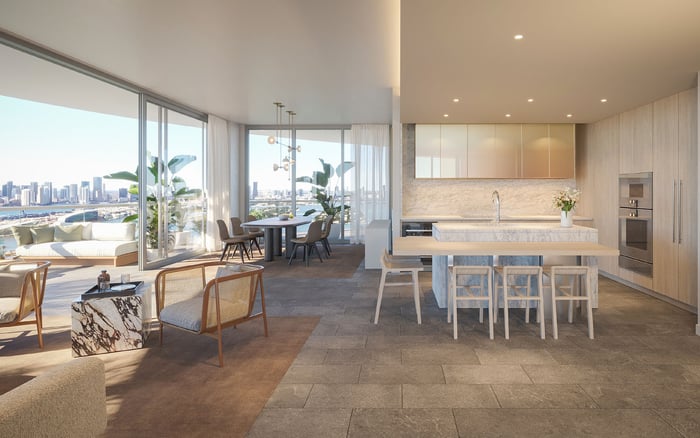
At an oceanfront condominium, resilience due diligence extends from parcel boundaries and shoreline responsibility to exposed amenities, critical systems, insurance, reserves, and association governance.

At Setai Residences Miami Beach, the ocean is central to the appeal. The Collins Avenue property has a direct relationship with the beach, creating an ownership experience defined by open water, sand, light, and immediate coastal access. Yet that same relationship makes the surrounding shoreline an essential part of a sophisticated buyer’s inquiry.
The first distinction is fundamental: this is an oceanfront setting, not a bayfront one. Beach conditions, dunes, waves, wind, salt spray, flooding, and public access all warrant attention. A buyer should evaluate the residence within the broader Miami Beach coastal environment rather than view the tower in isolation.
Labels such as Oceanfront, Waterfront, and Beach-access are useful starting points, not substitutes for property-level review. The objective is not to diminish the view, but to understand what supports the lifestyle behind it.
“Seawall” can become shorthand for coastal protection, but buyers should not assume that every oceanfront parcel relies on the same shoreline feature-or that the condominium controls every area between the tower and the water. The more precise questions concern boundaries, responsibilities, and maintenance.
Request documents establishing where the condominium parcel ends and where public beach or access areas begin. Clarify whether any shoreline structures, dunes, paths, landscaped coastal zones, or related features are maintained by the association, a government agency, or another party. The answer can shape both operational expectations and the scope of future owner costs.
A polished beach arrival may cross several zones governed by different decision-makers. Ownership, maintenance, and emergency responsibility should therefore be understood separately. Buyers comparing the Setai with The Perigon Miami Beach or 57 Ocean Miami Beach should apply the same questions to each property rather than assume nearby oceanfront buildings share identical arrangements.
A high-floor residence and an ocean-facing amenity deck occupy different risk positions. Buyers should examine the entire path from street arrival to private home, including lobbies, pools, landscaping, service areas, parking access, and other lower common spaces. Their elevation and protection can influence how quickly normal operations resume after severe weather.
This vertical review should also account for daily salt exposure. Ocean air can affect exterior components and amenity areas differently from interiors higher in the tower. The relevant question is not simply whether maintenance occurs, but whether the association’s inspection, repair, and replacement planning reflects the property’s coastal setting.
For a second home, access and continuity may matter as much as the unit’s condition. Ask how residents enter the property if the usual route is unavailable, which common areas receive priority, and what procedures govern reopening. These are questions of documentation and management, not conclusions that can be drawn from floor height or a tour.
Structural review is essential, but it is only one layer. A disciplined inquiry should extend to glazing, drainage, mechanical and electrical equipment, emergency power, and the connections among those systems. Buyers should ask where critical equipment is located, how it is protected, and whether maintenance records demonstrate a consistent approach to coastal wear.
Glazing merits attention because it forms the residence’s interface with wind and salt. Drainage matters because water must move away from terraces, roofs, amenity areas, and circulation routes. Emergency power should be understood in practical terms: which systems it serves, how it is tested, and what level of building operation it is intended to support.
None of these conditions should be inferred from the Setai’s prestige, age, architecture, or oceanfront position. They require a review of building-specific materials and, where appropriate, guidance from qualified legal, engineering, insurance, and inspection professionals.
Association records can indicate whether coastal maintenance and storm repairs may create future financial pressure. Review budgets, reserves, meeting minutes, insurance materials, maintenance history, pending projects, and any discussion of special assessments. The aim is to understand both the physical plan and the decision-making culture behind it.
Insurance warrants close reading, not a simple confirmation that coverage exists. A buyer should understand what belongs to the association, what belongs to the unit owner, and where deductibles or exclusions may affect personal planning. Counsel and insurance advisers can help reconcile governing documents with proposed individual coverage.
Governance is equally important. Minutes may reveal how promptly the board addresses maintenance, how projects are prioritized, and whether owners have debated coastal work or storm repairs. When considering other nearby luxury addresses, such as Shore Club Private Collections Miami Beach, use a consistent document checklist so lifestyle preferences do not obscure differences in responsibility and planning.
The strongest analysis brings the view, access, resilience, insurance, maintenance, and governance into a single decision. Buyers need not treat coastal exposure as a reason to retreat from the water. They should treat it as a reason to ask better questions.
At Setai Residences Miami Beach, the oceanfront experience is inseparable from the beach and the systems that make ownership comfortable. A careful buyer evaluates the private residence, common areas, shoreline relationships, financial structure, and recovery planning as a connected whole. That is how an extraordinary outlook becomes part of an informed acquisition rather than the sole reason for one.
Does an oceanfront condominium necessarily have a seawall? No assumption should be made. Confirm which shoreline structures or protective features exist, where they sit, and who maintains them.
Why does the parcel boundary matter? It distinguishes condominium property from public beach and access areas, clarifying control and potential maintenance responsibility.
Are high-floor residences insulated from storm concerns? Not entirely. Owners still depend on lower common areas, access routes, elevators, utilities, drainage, and building operations.
Which common areas deserve particular attention? Review the elevation and protection of lobbies, pools, landscaping, parking or service access, and other lower-level spaces.
What building systems should a buyer examine? Examine mechanical, electrical, emergency-power, glazing, and drainage systems alongside the structural frame.
How should salt exposure be evaluated? Ask how exterior components and ocean-facing amenities are inspected, maintained, repaired, and budgeted for over time.
Which association records are most useful? Budgets, reserves, minutes, insurance materials, maintenance history, project discussions, and assessment records can provide valuable context.
Can a buyer determine resilience from a property tour? No. A tour is valuable, but building-specific documents and qualified professional review are necessary for a fuller assessment.
How should insurance be approached? Clarify the division between association and owner coverage, then examine deductibles, exclusions, and personal coverage needs with advisers.
What is the central buying principle? Balance the ocean view and beach lifestyle with the property’s systems, financial planning, maintenance responsibilities, and governance.
To compare the best-fit options with clarity, connect with MILLION.
If branded residences are on your mind — as a home or as an allocation — we would be glad to share what we are seeing, privately.
Begin a quiet conversation