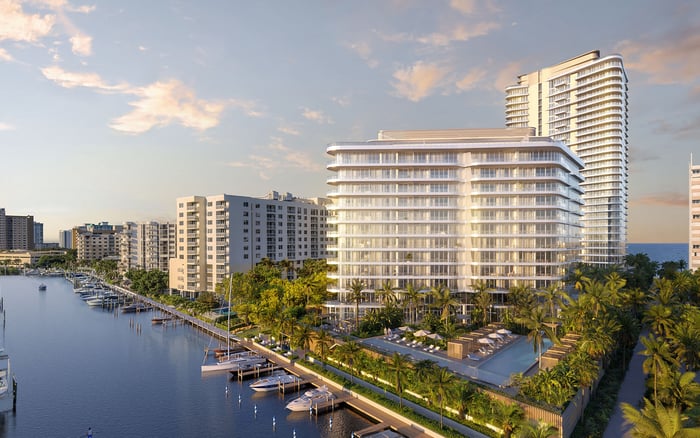
A seasonal buyer’s guide to evaluating Casamar’s unit-specific association fees, reviewing service contracts at The Ritz-Carlton Residences® Pompano Beach, and separating annual ownership obligations from optional conveniences.

A seasonal residence should feel effortless when its owner arrives. The financial structure behind that ease deserves equal attention. For buyers considering Casamar, at 900 N Ocean Boulevard, Pompano Beach, FL 33062, the question is not simply the size of the monthly association fee. It is what that fee funds, which obligations fall outside it, and how those obligations may change over a longer holding period.
The same discipline applies to The Ritz-Carlton Residences® Pompano Beach. Begin with the selected residence’s assessment and governing documents, then examine the service agreements behind the ownership experience. Neither a name nor an amenity description establishes how expenses are allocated.
For seasonal buyers, the objective is to distinguish the cost of holding the residence from the cost of using it. Do not assume that fewer nights in residence reduce association obligations. Establish the annual commitment first, then evaluate the conveniences that make each visit worthwhile.
Casamar’s available listing figures illustrate why the individual unit matters. UPH03 carries a stated monthly association fee of $3,854. Unit 106 lists $3,876, while Unit 1606 lists $2,839. These are unit-specific figures, not a verified uniform assessment across the building, and their reporting periods may differ.
At twelve unchanged monthly payments, those amounts translate to $46,248, $46,512 and $34,068 annually, respectively. The arithmetic helps with preliminary planning, but it is neither a forecast nor a complete ownership budget. Confirm the residence’s current charge before relying on any annual total.
A market benchmark places Casamar association fees at $1.14 per square foot per month. Separately, a September 18, 2026 snapshot of 12 active listings with usable fee data shows a median monthly-equivalent fee of $2,906. The middle half falls between approximately $2,838 and $3,401.
Treat these figures as orientation, not an adopted budget. They help frame questions about a particular residence; they do not explain its assessment allocation, reserve contribution or service coverage. A higher stated fee does not, by itself, demonstrate better funding, nor does a lower fee establish superior value.
The inclusions attached to Casamar’s listings matter as much as the headline amounts. UPH03 lists common areas, cable television, hot water, insurance, grounds maintenance, sewer, security, trash and water. Unit 106 lists landscaping, security, common areas, trash removal, elevators, hot water, water and internet/Wi-Fi.
Unit 1606 expressly lists a reserve fund, insurance, building exterior maintenance, pool service, roof repairs, elevators, management, parking, utilities and other amenities. These differences call for clarification, not a conclusion that one residence necessarily receives fundamentally different services.
Request a written reconciliation of the listing description with the association’s current documentation. Identify which utilities are included, what insurance the assessment funds, how parking is treated, and whether reserve contributions are embedded in the quoted payment. An item absent from a listing should not automatically be treated as excluded.
The same discipline matters when comparing alternatives such as Ocean 580 Pompano Beach. Apply the same questions to each candidate without transferring Casamar’s figures or inclusions to another property. Comparable budgets require comparable expense categories.
At The Ritz-Carlton Residences® Pompano Beach, request a unit-specific assessment, the current budget and the documents explaining service-cost allocation. Do not assume a fixed annual increase, CPI adjustment or hospitality surcharge without the relevant agreement.
The essential distinction is between an association budget that can change and a contract with a defined escalation mechanism. Ask whether each material service agreement includes scheduled increases, an index-linked adjustment, renewal provisions or a minimum payment. Establish who approves changes and which ownership group bears the expense. These are review questions, not assertions that any particular clause exists at either project.
If an escalation clause is present, have counsel identify its starting amount, adjustment date, calculation method, any cap or floor, and termination provisions. A percentage alone reveals little without the expense base to which it applies.
Finally, separate mandatory services from optional purchases. Request a written explanation of which charges belong in the assessment and which arise only when an owner orders a service. The practical luxury is knowing the difference before arrival.
Before going under contract, obtain the current association budget, reserve schedule, insurance certificates, and disclosures concerning pending special assessments or association loans. Read them together. A monthly payment is only one expression of the association’s financial position.
Ask how the budget separates operating expenses from reserves, which expenditures are supported by long-term contracts, and whether proposed changes remain outside the adopted figures. Where earlier budgets are available, compare line items rather than assuming every increase reflects the same underlying pressure.
Reserve review deserves particular care. Request the applicable Structural Integrity Reserve Study, confirm its status with qualified advisers, and understand how its recommendations connect to the reserve schedule. Applicability and deadlines require property-specific legal review; a general rule is no substitute.
Insurance also requires reconciliation. An assessment that includes building insurance does not, by itself, establish the owner’s separate coverage needs. Have an insurance adviser distinguish association coverage, any relevant deductibles and the protection appropriate for the residence and its contents.
Begin the annual model with twelve months of the verified assessment. Add only expenses confirmed to fall outside it, including applicable taxes, owner insurance, utilities, separately charged parking and optional services. Keep known assessments or loan-related obligations distinct from ordinary monthly charges.
For time away, ask about access procedures, residence checks and any separately contracted care. Budget for those arrangements only after confirming their scope and price. Do not assume that a staffed building or a service-oriented identity includes every task an absent owner may want performed.
For longer-term planning, distinguish documented contract changes from hypothetical stress tests. A buyer may model higher future expenses, but those assumptions should remain clearly labeled, not presented as either project’s forecast. Review exposure by category rather than applying an unsupported increase to everything.
The strongest comparison is not a contest between two monthly numbers. It is a reconciliation of obligations, inclusions, reserves and contractual flexibility. For the seasonal owner, predictable administration can be as valuable as a beautiful arrival, provided its cost is understood in advance.
Explore your next South Florida residence with MILLION.
If branded residences are on your mind — as a home or as an allocation — we would be glad to share what we are seeing, privately.
Begin a quiet conversationCasamar is located at 900 N Ocean Boulevard, Pompano Beach, FL 33062.
UPH03 lists $3,854, Unit 106 lists $3,876 and Unit 1606 lists $2,839 monthly. These are unit-specific listing figures, not verified uniform building-wide assessments.
Twelve unchanged payments of $3,854 total $46,248. That calculation excludes expenses outside the assessment and is not a forecast.
It is a monthly association-fee market benchmark. It is not an adopted association budget or confirmation of a particular unit’s current charge.
It shows a $2,906 median monthly-equivalent fee across 12 active listings with usable fee data. The middle half falls between approximately $2,838 and $3,401.
The listing descriptions differ, including their references to insurance, internet, parking and reserves. Confirm actual coverage through current association documentation rather than treating an omitted item as excluded.
No fixed increase, CPI adjustment or hospitality surcharge should be assumed without supporting contract documents. Review any applicable clause’s expense base, timing and calculation method.
Request the current budget, reserve schedule, insurance certificates, and disclosures concerning pending special assessments or association loans.
Review the reserve schedule and applicable Structural Integrity Reserve Study with qualified advisers. Confirm property-specific requirements and how study recommendations connect to funding.
Confirm which insurance, reserves, parking and utilities are already included in the assessment. Add only verified separate obligations and optional services to the annual model.