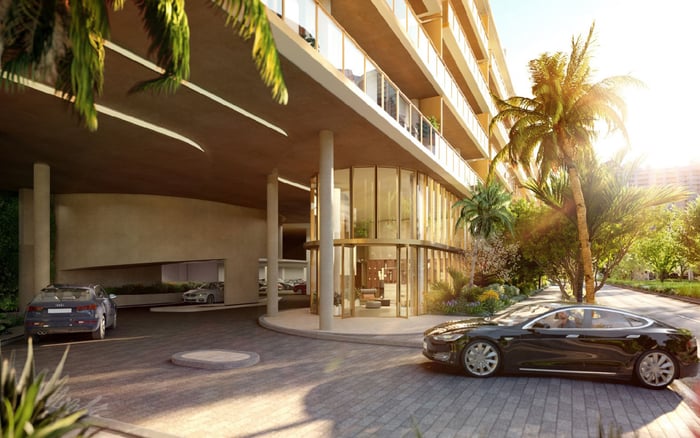
A practical framework for evaluating a Brickell residence through complete journeys, from the apartment door to the aircraft, classroom, office, or vessel, rather than relying on neighborhood-level driving estimates.

For a household balancing private aviation, school schedules, office commitments and time aboard a yacht, a Brickell address should function as an operating base. The question is not simply how close the apartment is to each destination, but how reliably the household can move between them-with passengers, luggage and competing appointments accounted for.
A short drive can still complicate a morning if departure involves an uncertain elevator wait, vehicle retrieval and several loading steps. A longer, more predictable journey may serve the household better. The most useful luxury is control over the day.
For buyers considering The Residences at 1428 Brickell, the exercise is to connect the proposed residence to actual destinations and departure windows. A neighborhood-level estimate cannot establish how a particular home will perform.
Miami International Airport is approximately eight miles from Brickell and downtown Miami, making it the closer of the two aviation gateways considered here. Road-transfer estimates span 15-35 minutes. Those figures cover the drive, not the full interval between leaving a residence and reaching an aircraft.
MIA also offers a general-aviation facility separate from its airline terminals, with customs capability and accommodation for large aircraft. Private travelers should identify the relevant facility rather than calculate a route to an airline departure terminal.
Miami-Opa-locka Executive Airport, or OPF, is approximately 11 miles north of central Miami. Its 8,002-foot runway accommodates aircraft up to ultra-long-range jets. Multiple fixed-base operators, or FBOs, and direct ramp access for charter travelers support a private-aviation-oriented experience. OPF operates around the clock, offers customs clearance and has no scheduled airline traffic.
These distinctions matter, but none alone establishes the fastest complete journey to a Brickell residence.
OPF transfer estimates vary considerably: 20-30 minutes to downtown Miami and Brickell, and 25-40 minutes to central Miami. Approximately 30 minutes is also a planning figure for many Brickell transfers, subject to local traffic. A wider estimate reaches 35-65 minutes or more.
Do not average these figures into a single reassuring number. They are planning estimates, not measured residence-to-aircraft benchmarks. Their spread is a reason to test the household's actual journey.
Before comparing MIA and OPF, confirm the aircraft, chosen FBO, customs needs and operating requirements. Then compare equivalent journeys using the same residence entrance and realistic travel windows. Include any additional stops. Dedicated private-aviation facilities can make the airport experience attractive without necessarily shortening the drive home.
Start the residential clock when the household is ready to leave the apartment. Record elevator waiting and travel, vehicle retrieval, passenger loading and luggage handling separately from road time. On return, keep timing until everyone and their belongings are back inside the residence.
When evaluating Cipriani Residences Brickell, ask how the proposed departure sequence would work in practice. Where would the driver wait? How would luggage reach the vehicle? Which entrance would be used on return? Resolve these questions rather than making assumptions about a building's services.
For a residence that cannot yet be tested directly, distinguish route observations from untested building operations. A drive from the site can inform the decision, but it cannot demonstrate future elevator or vehicle-retrieval performance. Keep those components provisional until they can be observed.
School travel requires an exact campus and its actual drop-off and collection points. An address alone is insufficient if the household must follow a particular arrival sequence. Test morning drop-off and afternoon pickup separately, including waiting and the return journey.
Office travel deserves the same precision. Specify the building entrance, parking arrangement and final destination within the property. Measure the journey to the office door; do not stop the clock when the vehicle reaches the block.
For a family considering 2200 Brickell, compare how each candidate residence supports the same recurring obligations. Keep destinations and departure windows consistent. If one adult handles school drop-off while another leaves for work, test those movements as parallel requirements rather than assuming a single vehicle can accommodate both.
A marina journey does not end at the street address. Identify the exact gate, parking or drop-off point, and intended slip. Include access arrangements, unloading and the walk to the vessel. The finish line is being aboard with the items required for departure.
A buyer considering Una Residences Brickell should apply the same discipline without assuming a particular marina arrangement or commute time. Specify the residence, marina and travel window before evaluating the trip.
Test both an outbound boating departure and the return home. Determine whether equipment will remain aboard, travel with the household or require a separate delivery. Settle those choices before comparing properties; otherwise, the journeys are not equivalent.
Use seven days of outbound and return journeys to capture morning school runs, afternoon collection, office peaks, airport arrivals and marina departures. Record the date, intended departure, actual departure, exact endpoints, intermediate stops and completion time. Separate building access, road travel and destination access so delays remain visible.
The purpose is not to select the fastest isolated trip. Look for repeatability, the longest observed journeys and the consequences of arriving late. A seven-day record is a practical starting point, not a guarantee of future conditions.
Where commitments overlap, record that explicitly. A school pickup and airport arrival may require separate vehicles or different staff assignments. Residence selection should reflect the household's real operating pattern, not a sequence that works only when every appointment is conveniently spaced.
Translate the travel record into departure windows, vehicle assignments, luggage instructions and confirmed destination contacts. Ask drivers to work from the final building entrance, accounting for I-95, surface-road conditions and additional stops, rather than treating Brickell as a single destination.
The strongest choice is not necessarily the residence with the shortest advertised drive. It is the home whose complete journeys fit the household's priorities with manageable uncertainty. Maintain a clear distinction between observed performance and untested assumptions, and revisit the plan when schools, offices, aircraft arrangements or marina access change.
Explore Brickell residences through the lens of your household's daily movements with MILLION.
If branded residences are on your mind — as a home or as an allocation — we would be glad to share what we are seeing, privately.
Begin a quiet conversationMIA is approximately eight miles from Brickell and downtown Miami. OPF is approximately 11 miles north of central Miami, but proximity alone does not determine the complete journey.
Road-transfer planning estimates range from 15–35 minutes. They do not include the complete journey between a residence and an aircraft.
No; planning estimates vary, including a wider range of 35–65 minutes or more. The actual entrance and travel window matter.
MIA has a separate general-aviation facility with customs capability and accommodation for large aircraft.
OPF offers multiple FBOs, direct ramp access for charter travelers, customs clearance and 24-hour operation. It has no scheduled airline traffic.
Include elevator waiting and travel, vehicle retrieval, passenger and luggage loading, road travel and destination access. Measure the return through arrival inside the residence as well.
Use the exact campus and designated drop-off and collection points. Test morning and afternoon journeys separately at the household's intended times.
End at the office door rather than the surrounding block. Include parking or drop-off and access within the destination building.
End aboard the vessel with the required belongings. Include the exact marina gate, unloading, access arrangements and walk to the slip.
Begin with seven days of outbound and return journeys across the household's recurring commitments. Treat the observations as a starting point rather than a guarantee of future conditions.
.jpg&width=700&height=438&fit=cover)