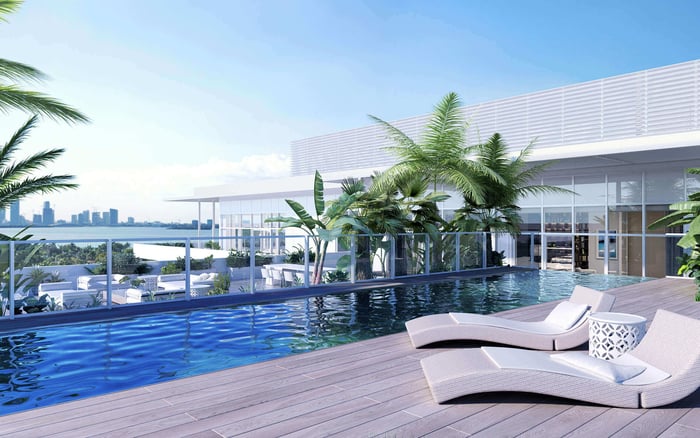
A buyer-focused analysis of how reserve exposure, shared hospitality infrastructure, branded service standards, and future capital obligations should shape 2026 offer strategy at Four Seasons Hotel & Private Residences Fort Lauderdale.

For 2026 buyers, the central question at Four Seasons Hotel & Private Residences Fort Lauderdale is not simply whether the residence earns its brand premium. It is whether the offer price properly reflects the building’s long-term capital structure. The property pairs a hotel component with private residences, making it materially different from a conventional standalone condominium.
That distinction matters. A buyer is not only acquiring an oceanfront home in Fort Lauderdale Beach. The buyer is entering a high-service environment where private residential areas, shared amenities, hotel-facing spaces, back-of-house operations, and building systems may each carry distinct financial responsibilities. Reserve exposure, in this context, is not a single line item. It is the process of mapping how future upkeep may move through the ownership structure.
The appeal of Four Seasons Hotel & Private Residences Fort Lauderdale is inseparable from Four Seasons branding, service standards, and resort-style residential living. That is exactly why valuation should be more layered. In a branded, hospitality-adjacent environment, amenities are central to the value proposition, but they are also part of the operating and capital equation.
Concierge areas, dining environments, spa spaces, pool decks, beach service, mechanical systems, and hospitality-related service corridors can all influence future cost exposure. A buyer should distinguish between association-funded reserves and any separate shared-cost obligations tied to hotel or mixed-use functions. The objective is not to presume a deficiency. It is to understand what the documents actually require before converting prestige into price.
This is especially important in a market where buyers compare Fort Lauderdale assets with other branded residences across South Florida. A purchaser weighing Four Seasons against Auberge Beach Residences & Spa Fort Lauderdale, for example, should evaluate more than view lines, finishes, and service culture. Underwriting should also account for how each property organizes shared amenities, future maintenance, and reserve planning.
Before finalizing valuation, buyers should review the condominium declarations, association budgets, reserve schedules, and shared-services agreements. These documents connect lifestyle language to financial obligation. They help clarify which areas are residential, which are shared, which are hotel-facing, and how expenses may be allocated.
The most useful review is practical. Which building systems are shared? How are amenity decks maintained? What responsibilities exist for back-of-house areas? Are hospitality interfaces funded through association reserves, separate agreements, or another cost-sharing method? Does the budget show a maintenance-fee trajectory that should be modeled into the offer?
A disciplined buyer should answer these questions before treating comparable sales as the sole pricing anchor. Recent transactions can establish market tone, but they do not always reveal future capital obligations. In a luxury building with brand-driven presentation standards, the cost of remaining impeccable may be part of the long-term ownership profile.
The Four Seasons name carries expectations for service, finish quality, and visual consistency. Those expectations support demand, yet they can also influence future upgrades to finishes, service areas, FF&E, and amenity presentation. In an ultra-premium environment, deferred presentation is rarely compatible with the brand promise.
This is where reserve analysis becomes strategic. If a building’s appeal depends in part on immaculate common areas and hospitality-grade service zones, a buyer should understand how those areas are refreshed over time. The question is not whether the brand adds value. It supports the property’s identity. The question is how future capital needs are funded when the market expects the experience to remain elevated.
The same logic applies when comparing other branded or service-rich properties, including St. Regis® Residences Bahia Mar Fort Lauderdale and The Ritz-Carlton Residences® Fort Lauderdale. Brand premium and embedded operating risk should be evaluated together, not in separate silos.
Oceanfront positioning is central to the Fort Lauderdale luxury thesis. It supports scarcity, lifestyle, and long-term desirability. It also heightens the need to scrutinize coastal-condition maintenance. Salt air, exterior exposure, amenity decks, pool environments, glazing, waterproofing, and shared mechanical areas can be material considerations in any oceanfront ownership model.
For Fort Lauderdale buyers, the question is not whether oceanfront living is worth a premium. It is how that premium is protected. Long-term building upkeep is part of the value defense. A beautifully presented residence can lose negotiating strength if the buyer has not modeled the building’s broader capital profile.
That is why reserve exposure should be integrated into pricing conversations rather than left to the closing checklist. Buyers who wait until late diligence may find that a headline price becomes less compelling once maintenance-fee trajectory, potential special assessments, and shared-service obligations are considered.
A 2026 offer should convert uncertainty into one of three things: a price adjustment, a contingency, or a documentation request. The cleanest offers are not necessarily the highest offers. They are the offers that understand the asset.
If documents are complete and reserves appear aligned with the buyer’s risk tolerance, the price can more confidently reflect the brand premium. If documents are incomplete, ambiguous, or reveal layered shared-cost exposure, the offer should account for that uncertainty. The adjustment may be subtle in a competitive environment, but it should be deliberate.
Buyers should also avoid treating maintenance fees as static. In a high-service condo-hotel style setting, operating costs and reserve needs can evolve with service expectations, coastal upkeep, and amenity renewal. A residence that appears correctly priced today may require a different bid if future obligations are not adequately accounted for.
The most sophisticated buyers do not ask whether one brand is more glamorous than another. They ask whether the ownership structure is legible. For a buyer considering Fort Lauderdale alongside Miami, Surfside, Coconut Grove, or Palm Beach, the key comparison is not just prestige. It is the relationship between brand promise, physical asset, service model, and reserve exposure.
A buyer looking at Four Seasons Residences Coconut Grove may be drawn to another expression of the Four Seasons residential identity, while a buyer considering The Surf Club Four Seasons Surfside may focus on the cachet of a historic coastal setting. In each case, the underwriting principle remains consistent: branded living should be priced with both lifestyle value and embedded capital obligations in view.
For Four Seasons Hotel & Private Residences Fort Lauderdale, that means studying the full ecosystem around the residence. The home, hotel interface, amenity experience, and building systems all contribute to the ownership proposition. The best offer captures the allure without ignoring the infrastructure that sustains it.
What is reserve exposure at Four Seasons Hotel & Private Residences Fort Lauderdale? It refers to the buyer’s potential share of future capital obligations connected to residential areas, shared amenities, hotel-facing spaces, and building systems.
Is reserve exposure the same as a current problem at the property? No. It should be treated as a due diligence and pricing framework, not as an assumption of any present deficiency.
Why is this property different from a conventional condominium? It combines a hotel component with private residences, which can create layered obligations that require closer review.
Which documents should a buyer review before pricing an offer? Buyers should review declarations, budgets, reserve schedules, and shared-services agreements before finalizing valuation.
Can brand standards affect future costs? Yes. High brand expectations can influence future upgrades to finishes, service areas, FF&E, and amenity presentation.
Should comparable sales be the only pricing guide? No. Comparable sales matter, but future capital obligations and maintenance-fee trajectory should also be modeled.
How should buyers handle unclear reserve information? They can address uncertainty through price adjustments, contingencies, or specific documentation requests.
Does the oceanfront setting change the analysis? Yes. Oceanfront positioning supports luxury appeal but also warrants scrutiny of coastal-condition maintenance.
Are hotel-related costs always included in association reserves? Not necessarily. Buyers should distinguish association-funded reserves from any separate hotel-related or shared-cost obligations.
What is the best 2026 offer strategy? The strongest strategy prices the brand premium while accounting for documented and potential future capital exposure.
To compare the best-fit options with clarity, connect with MILLION.
If branded residences are on your mind — as a home or as an allocation — we would be glad to share what we are seeing, privately.
Begin a quiet conversation