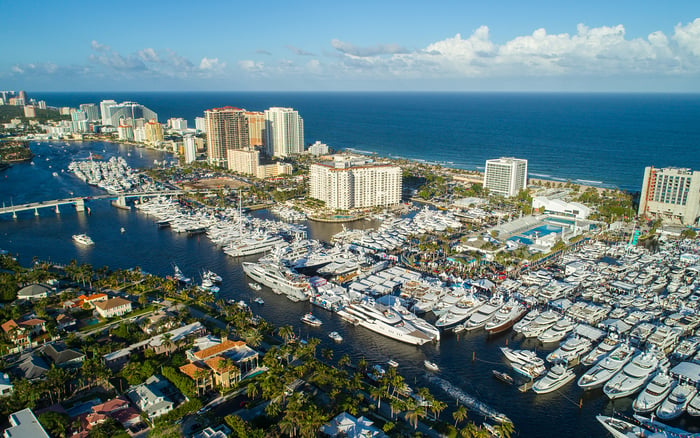
For Silicon Valley households relocating to Fort Lauderdale, the yacht deserves its own transition plan. Berth suitability, transport scope, crew arrangements and storm readiness should inform the residential search, not follow it.

A move from Silicon Valley to Fort Lauderdale may begin with a residential shortlist, but for a yacht-owning household, the vessel needs a separate relocation plan. The home may be ready before the berth. The yacht may arrive before its captain, service appointments or storm arrangements are settled. Treating both arrivals as a single deadline creates avoidable dependencies.
Establish the yacht's operating requirements while evaluating where the household wants to live. A compelling residence and a suitable berth are distinct decisions, even when they seem to promise the same waterfront lifestyle.
For buyers considering Andare Residences Fort Lauderdale, the practical question is not simply where to live, but how the home will connect with the eventual berth, crew arrangements and service routine. Test that relationship before committing to an address.
Fort Lauderdale's marina dimensions provide useful screening criteria. Pier Sixty-Six Marina has 164 deep-water slips for vessels from 40 to 400 feet, with 5,000 linear feet of dockage. Bahia Mar Yachting Center has more than 250 wet slips and accommodates yachts up to 300 feet.
Those figures describe capacity, not current availability or compatibility. Before scheduling delivery, obtain written confirmation covering the vessel's length, beam, draft, utilities, arrival window and intended stay. Have the captain evaluate the approach and berth; a maximum vessel length is not approval.
The distinction is particularly clear at the 17th Street Yacht Basin. Its 30 interior slips accommodate boats up to 89 feet overall, with a maximum beam of 22 feet, while an 850-foot superyacht face dock sits directly on the Intracoastal Waterway. These are different berthing configurations, not interchangeable promises of space.
Assess waterfront ownership as a daily routine, not just a view. Consider how often the owner expects to board, who receives contractors and whether crew movements should remain separate from household life. Walk through an ordinary provisioning day, not only an ideal weekend departure.
Bahia Mar sits at 801 Seabreeze Boulevard, near Fort Lauderdale Beach. Its infrastructure includes a 3,000-foot parallel dock and more than 5,000 feet of floating dockage. Buyers evaluating St. Regis® Residences Bahia Mar Fort Lauderdale should independently confirm any residential dockage rights, reservation process and vessel restrictions. Marina capacity alone establishes none of those entitlements.
Likewise, a shortlist that includes Four Seasons Hotel & Private Residences Fort Lauderdale should be tested against the actual berth-to-home journey. Do not infer marina access, crew accommodation or yacht services from a residential name.
A California-to-Florida vessel move requires a vessel-specific proposal. Distance is only one variable. Size, trailer configuration, route complexity, height restrictions, oversized-load escorts and marina access fees can all affect transport pricing.
For a larger or non-trailerable yacht, generic boat-hauling estimates are not a sound basis for a relocation budget. Establish the appropriate transport method with qualified operators, then request a written scope identifying inclusions, exclusions, delivery arrangements and responsibility at each handoff.
Keep the household moving calendar separate. A delayed yacht arrival should not force a residential decision, and a closing date should not force an unsuitable berth. Build the schedule around confirmed receiving arrangements, with a contingency for changes to transport or commissioning. Distinguish the cost of moving the vessel from the cost of making it ready for use after arrival.
Plan crew logistics around defined assignments, not assumed availability. Identify who accepts the vessel, inventories equipment, coordinates contractors, supervises commissioning and authorizes spending. If the owner is still traveling between coasts, designate a local decision-maker and an alternate.
Confirm where crew will stay, how they will reach the berth and what access permissions the marina requires. Obtain current housing and labor quotations rather than importing assumptions from California. Keep those arrangements separate from the household's residential amenities and building policies.
When evaluating Sixth & Rio Fort Lauderdale, apply the same discipline: verify the home's suitability independently from the yacht's operating needs. A residence need not accommodate every marine function, but the division of responsibilities should be explicit before move-in.
The first year should include a defined commissioning and maintenance plan. PORT 32 Fort Lauderdale offers wet berthing for vessels up to 180 feet, a 150-metric-ton Travelift, dry storage and specialist marine contractors. Those capabilities make it a potential service option, not an automatic fit for every yacht.
Lifting capacity alone does not establish compatibility with a particular hull or configuration. Have the captain and facility confirm the intended work, vessel dimensions, lifting requirements and appointment availability before relying on that option.
Keep routine service planning distinct from hurricane storage. A facility's repair capabilities do not guarantee storm space, and an ordinary service reservation is not a storm commitment.
A useful hurricane plan answers three questions in advance: where the yacht will go, what preparation is required and when action begins. It should also identify who can authorize movement if the owner is unavailable.
Obtain the selected Fort Lauderdale marina's hurricane requirements, including relocation deadlines, closure triggers and vessel-access restrictions. Align the plan with the insurer before relying on any timetable, rather than treating a regional benchmark as a local rule.
Have the captain develop a vessel-specific preparation checklist. Address bimini tops, dinghies, outboards, sails, roller furling, outriggers and loose chairs. The checklist should also cover closing sea cocks and plugging or capping unvalved through-hull fittings, including sink drains, as appropriate to the vessel.
Before departure, confirm the berth, transport scope, receiving captain, crew arrangements and storm plan. After arrival, complete commissioning and test the household-to-marina routine. Revisit any arrangement that depends on the owner's continuous availability.
The goal is not simply to move a yacht east. It is to create a residential life in which time aboard feels effortless because the operational decisions have already been made.
Explore a Fort Lauderdale residence that complements your household and yachting priorities with MILLION.
If branded residences are on your mind — as a home or as an allocation — we would be glad to share what we are seeing, privately.
Begin a quiet conversationPlan their arrivals separately so a berth or transport delay does not dictate the household's move. Coordinate them only after receiving arrangements are confirmed.
No. Capacity limits do not establish availability or suitability for a particular yacht; confirm dimensions, utilities and arrival arrangements directly.
Its vessel range is 40 to 400 feet across 164 deep-water slips, with 5,000 linear feet of dockage. A suitable berth still requires confirmation.
Bahia Mar has more than 250 wet slips for yachts up to 300 feet, a 3,000-foot parallel dock and more than 5,000 feet of floating dockage.
The 30 interior slips accommodate boats up to 89 feet overall with a maximum beam of 22 feet. The basin also has an 850-foot superyacht face dock on the Intracoastal Waterway.
Not reliably, especially for a large or non-trailerable yacht. Obtain a vessel-specific proposal addressing transport method, dimensions, route requirements and receiving arrangements.
Assign vessel acceptance, contractor coordination, commissioning oversight and spending authority. Confirm accommodation, transport to the berth and marina access permissions separately.
No. The facility must confirm that the specific vessel's dimensions, hull configuration and lifting requirements are compatible.
Obtain the selected marina's relocation deadlines, closure triggers and vessel-access restrictions. Align the vessel's plan with the insurer rather than relying on regional benchmarks.
Do not assume it does. Confirm any dockage entitlement, reservation process, vessel restriction and separate contractual obligation before purchasing.