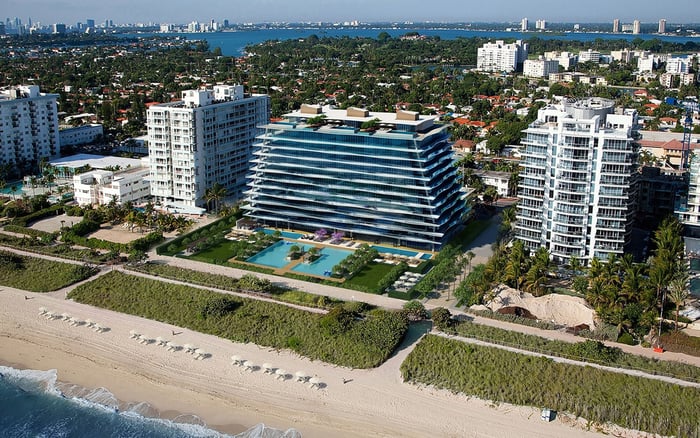
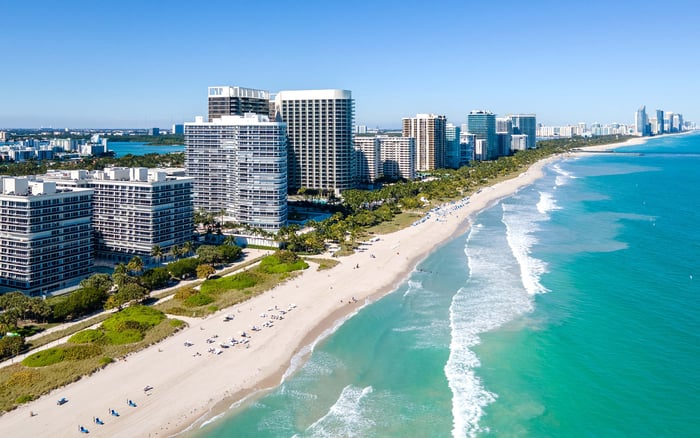
For Surfside buyers, hotel service and residential privacy require separate scrutiny. This guide distinguishes accommodation categories, amenity access, rental participation and furnishing obligations, with a practical framework for reviewing a specific residence before purchase.

In Surfside, the appeal of hotel-connected ownership is clear: beachfront service, polished hospitality and a residence that feels ready whenever you arrive. The more consequential purchase decision is about boundaries. Which spaces belong to residential life, which accommodate hotel activity, and which obligations attach to the particular home?
The original development at The Surf Club Four Seasons Surfside comprised a 77-room hotel, 119 private residences and 31 hotel residences, with residences in two 12-storey towers. Those figures provide background, not current inventory. The hotel is at 9101 Collins Avenue, Surfside, Florida 33154.
For a buyer, the distinction between a private residence and a hotel residence should come before any discussion of rental income or privacy. Begin with the unit’s legal classification and governing documents. A common address or hospitality brand is not evidence of identical ownership rights, rental eligibility or access privileges.
The Surf Club’s residential amenities include pool and beach service, the Four Seasons Spa and a fitness center. That offering does not establish who may use each facility, at what times or under which conditions. A hotel guest, an owner’s visitor and someone arriving for a hospitality reservation should not be assumed to have equivalent access.
Request a current access schedule distinguishing residential-only areas, hotel-guest areas, shared facilities and any spaces open to outside patrons. Ask management to identify the rules for visiting family, overnight guests, service providers and private events. Where access depends on reservations, charges or guest limits, obtain the conditions in writing.
If Arte Surfside is also on the shortlist, ask the same questions rather than assuming an equivalent arrangement. The useful comparison is not simply the number of amenities, but whether the access rules support the quiet, sociability and spontaneity the household wants.
The Surf Club’s private residences have private elevator entrances served by a dedicated residential elevator core. This provides meaningful physical separation from hotel circulation. It does not, by itself, establish every visitor-registration, delivery-routing or security-screening procedure.
During a viewing, trace the route from arrival to the residence, then from the residence to the beach, pool and fitness facilities. Ask where residential and hotel routes intersect, if they do. Clarify how visitors, household staff, deliveries and contractors reach the home, and who authorizes access.
Privacy is both architectural and operational. A dedicated elevator addresses one part of the experience; current written procedures clarify the rest. Owners who entertain frequently or travel for extended periods should ask how guest access and service appointments are handled in their absence. Evaluate the answer against the household’s actual routines, not an abstract promise of discretion.
The Surf Club’s hotel-residence offering includes freedom over how and when owners participate in the Four Seasons rental program. That flexibility matters, but it is not a complete operating agreement. It does not establish a particular resale unit’s eligibility, management fees, owner-use limits, blackout dates or expected income.
Before assigning financial value to rental participation, request the current rental-management agreement and written confirmation that the specific residence qualifies. Have counsel review participation and withdrawal provisions, booking control, owner-use procedures, expense deductions and any furnishing requirements. Ask whether an existing arrangement transfers with the sale or requires a new agreement.
Keep private leasing separate from hotel-program participation. Surf Club unit S-406 was previously offered for six-month or annual leasing with hotel-amenity access. That is an individual-unit example, not a building-wide rule or confirmation of present availability. Neither that example nor the hotel program establishes nightly-rental rights for private residences or town-wide rental permissions.
Residential-style hospitality can resemble a home without clarifying its ownership structure. At The Surf Club, Villa & Residence Rentals offer serviced beachfront accommodations. Residential Suites are designed for extended stays and private entertaining, with fully equipped kitchens, living areas and private balconies overlooking the ocean or city. The Beach Villa was introduced on March 27, 2026, as a fully serviced shoreline retreat available through hotel reservations.
None of these booking categories, by itself, establishes individual ownership or rental rights for a private residence.
Grand Beach Hotel Surfside offers another useful distinction. Its oversized hotel suites include separate living and sleeping areas, private balconies and two full bathrooms. Guest amenities include beach service, multiple pools, dining, fitness facilities and social spaces, alongside direct beach access, yoga and fitness training. These are hospitality features, not evidence of condominium-owner privileges or residential rental-program terms.
The Surf Club’s hotel-residence offering includes custom Joseph Dirand furniture. For a furnished purchase, design quality is only the beginning of the inquiry. FF&E-furniture, fixtures and equipment-also raises questions about ownership, condition, replacement and who pays.
Do not assume a reserve percentage, contribution formula or replacement schedule. Request the current condominium budget, reserve schedules, rental-management agreement and applicable shared-facility agreements. Ask which obligations concern furnishings inside the residence, which relate to shared areas and how responsibility is allocated.
Have the seller identify the included inventory and disclose any applicable replacement requirements or outstanding charges. Where a rental program requires a furnishing standard, ask who approves replacements and whether participation creates separate funding obligations. Treat projected rental receipts and potential furnishing costs as distinct lines in the purchase analysis.
When comparing Fendi Château Residences Surfside, apply the same document-led approach without carrying over The Surf Club’s furniture offering or presumed cost structure.
The sold-out status of The Surf Club’s private residences, with prospective purchasers directed to inquire about purchase opportunities, should not be confused with live resale inventory. Confirm the availability, classification and contractual position of the actual home under consideration.
A buyer also considering Ocean House Surfside should compare answers to the same questions: who can enter, what can be rented, which expenses are mandatory and how the residence functions while the owner is away. Do not transfer one property’s answers to another.
Before committing, assemble a unit-specific file containing the governing documents, current access policies, rental terms where applicable, budget, reserve schedules and shared-facility agreements. Resolve inconsistencies between sales descriptions and written obligations with the appropriate advisers. The strongest purchase is one in which the service experience and ownership terms support the same way of living.
For a considered approach to your Surfside residence search, connect with MILLION.
If branded residences are on your mind — as a home or as an allocation — we would be glad to share what we are seeing, privately.
Begin a quiet conversationThe hotel is at 9101 Collins Avenue, Surfside, Florida 33154.
The original development description distinguishes 119 private residences from 31 hotel residences, alongside a 77-room hotel. Buyers should confirm the specific unit’s legal classification and governing terms.
The amenity offering does not establish universal hotel-guest access. Request a current schedule identifying residential-only, hotel, shared and any publicly accessible areas.
Dedicated residential elevators provide physical separation from hotel circulation. Visitor screening, deliveries and access to other areas still require review of current procedures.
The hotel-residence offering describes freedom over how and when to participate. Confirm eligibility and participation terms for the specific unit in the current rental-management agreement.
No. The participation language does not establish income, management fees, owner-use limits or blackout dates.
No. The historical six-month or annual leasing advertisement concerns an individual unit and does not establish current building-wide permissions.
No. Hotel booking categories do not establish a private residence’s ownership structure or permitted rental duration.
No specific percentage is established here. Review current budgets, reserve schedules and applicable agreements to determine contribution and replacement obligations.
The Surf Club’s hotel residences are marketed with custom Joseph Dirand furniture. Confirm the specific sale inventory, condition, replacement requirements and responsibility for future costs.