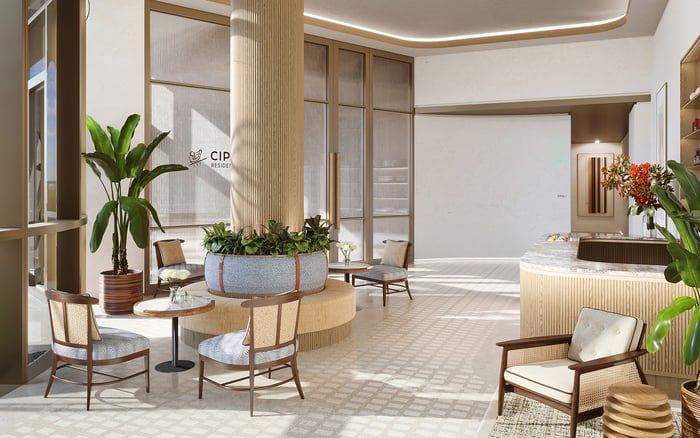
A buyer-focused comparison of advertised private arrivals, elevator access and resident services at Cipriani and Waldorf Astoria, with the questions that distinguish elegant entryways from documented circulation controls.

For a luxury residence, discretion is more than the impression created by a landscaped drive or a beautifully composed lobby. It is the experience of moving from car to home, receiving friends and arranging service without unnecessary overlap. That distinction matters when comparing Cipriani in Brickell with Waldorf Astoria in Downtown Miami: both advertise private residential arrival features, but each calls for different follow-up questions.
Cipriani emphasizes resident-exclusive dining and private arrival. Waldorf Astoria presents private residential access within a hotel-and-residential development. Neither proposition, on its own, establishes a fully separate route for every resident, guest, employee and delivery. These are advertised offerings, not confirmation of current operations or independently verified access procedures.
For buyers, the useful comparison is not which entrance looks more exclusive. It is what the plans and written rules establish between the curb and the residence door.
Marketed at 1420 S. Miami Avenue, Cipriani Residences Brickell advertises an exclusive private entrance with landscaping and a porte-cochère. Its lobby is described as leading to two banks of high-speed, touchless elevators. The amenity offering also specifies 24-hour security guards and controlled building access.
These features address different aspects of arrival. The entrance describes the approach; staffing and controlled access describe advertised oversight; touchless elevators describe an interface. None, alone or in combination, specifies whether credentials restrict each passenger to particular floors or how a visitor is authorized to enter.
The garage deserves equal scrutiny. Cipriani advertises a secure, covered garage, complimentary 24-hour valet and optional self-parking in assigned spaces. Ask to trace both parking routes to the residential elevators, including every point where access is checked. A sheltered arrival and an assigned space are useful conveniences, but they do not explain the full route upstairs.
Direct elevator entry is marketed for select residences. Keep that qualification attached to the feature throughout the purchase discussion. Confirm the arrangement for the particular home rather than assuming it applies to every residence in the building.
Waldorf Astoria Residences Downtown Miami is a mixed hotel-and-residential development, with a 205-key hotel in the tower’s lower portions. Its advertised residential arrival includes a private porte-cochère, 24-hour valet service, private residential entry and a private residential lobby.
The hotel component makes the boundary between uses an important point of due diligence. It does not establish that hotel guests can enter residential lobbies or reach residential floors. Nor does a private residential lobby, by itself, explain every connection to amenities, parking or service areas.
The elevator language warrants particular attention: Waldorf Astoria advertises private and semi-private elevators. Establish which arrangement serves the residence under consideration, what sharing means for that landing and how access is authorized. The terms are not interchangeable and should not be read as a promise of universally private elevator access.
Request a plan that distinguishes residential routes from hotel routes and identifies any connections. Then ask for the written permissions governing those connections. A clear physical layout and a clear access policy answer different questions; a thorough purchase review considers both.
Cipriani’s in-home dining and 24-hour catering are marketed as exclusive to residents. It also advertises reservable private dining rooms for residents entertaining guests. This is a meaningful service distinction, but resident-exclusive dining does not make every space or circulation route in the broader development residents-only.
For an owner who entertains, the practical question is how an invited guest reaches the reserved room and what happens afterward. Ask whether authorization is destination-specific, whether an escort is required and when any temporary credential expires. These are questions to resolve, not established procedures at Cipriani.
Waldorf Astoria’s advertised residential services include concierge support, valet, house-car service, spa access and a residential service app. These offerings describe hospitality and convenience. They do not establish guest-verification procedures, digital access permissions or separate staff routes. An app’s existence, in particular, is not confirmation that it manages entry credentials.
Private entry, direct entry, touchless operation and controlled access answer different questions. Direct entry concerns where an elevator opens. Touchless operation concerns how it is called or used. Neither phrase alone specifies who can reach a floor.
For Cipriani, the residence-specific question is whether the selected home has the advertised direct-entry arrangement. For Waldorf Astoria, it is whether the home is served by private or semi-private elevators and what that means on the relevant plan. In both cases, request written clarification of resident credentials, guest permissions and service access.
A buyer also considering The Residences at 1428 Brickell can apply the same residence-by-residence questions without assuming equivalent elevator arrangements. Base the comparison on documented features, not a shared neighborhood or expectations created by branding.
A useful review follows everyday situations rather than stopping at the principal entrance. Ask the sales team to demonstrate the proposed route and applicable rules for each scenario:
An evening arrival: Trace valet and self-parking routes where offered, including access checkpoints and peak-period vehicle handling.
An invited guest: Establish who approves entry, which destinations are permitted and how temporary permissions end.
A delivery or service visit: Identify loading areas, service elevators and any points where vendor and resident routes intersect.
A private gathering: Clarify how multiple guests are received and directed without assuming unrestricted residential access.
For a Downtown Miami shortlist that also includes Aston Martin Residences Downtown Miami, these questions provide a consistent review framework-not a claim that the buildings share access systems.
Ask which controls appear in condominium rules or purchase documents and which remain marketing descriptions. Have counsel review how the relevant provisions apply to the selected residence. Written detail is especially valuable when an attractive phrase could carry several meanings.
Cipriani’s resident-exclusive dining and Waldorf Astoria’s private residential access within a hotel-residence development offer distinct propositions. Their advertised features do not support ranking one as more secure.
The better decision turns on the home’s actual elevator arrangement, the documented boundary between uses and the rules for guests, staff and deliveries. A discreet arrival is most persuasive when the route beyond it is equally clear.
For a considered approach to South Florida’s luxury residences, explore MILLION.
If branded residences are on your mind — as a home or as an allocation — we would be glad to share what we are seeing, privately.
Begin a quiet conversationCipriani Residences Brickell is marketed at 1420 S. Miami Avenue in Brickell, Miami.
Cipriani advertises an exclusive private entrance with landscaping and a porte-cochère, along with 24-hour security guards and controlled building access.
No universal promise is established. Direct elevator entry is marketed for select residences, so buyers should confirm the arrangement for their chosen home.
Touchless operation does not establish floor-restricted credentials. Buyers should request written details on elevator permissions and guest authorization.
The advertised offering includes a secure, covered garage, complimentary 24-hour valet and optional self-parking in assigned spaces.
No. Resident-exclusive in-home dining and 24-hour catering do not establish that every space or circulation route is reserved exclusively for residents.
No. It is a mixed hotel-and-residential development with a 205-key hotel in the tower’s lower portions.
The advertised hotel component does not establish that hotel guests can reach residential floors or enter residential lobbies. Buyers should confirm the applicable boundaries and permissions in plans and written rules.
Waldorf Astoria advertises private and semi-private elevators, not universally private access. Confirm which arrangement serves the selected residence.
The advertised features do not support a security ranking. Compare circulation plans and written rules covering guests, credentials, deliveries, service elevators and valet operations.