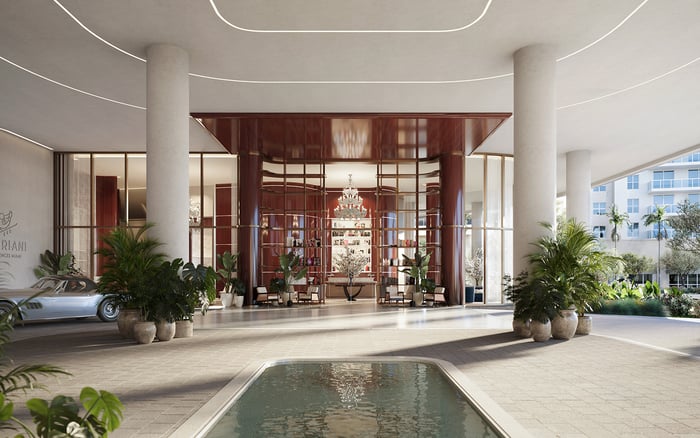
Baccarat Residences Brickell advertises private elevator access and smart-home prewiring, not a confirmed biometric system. For buyers, the next layer of due diligence concerns visitor credentials, app permissions, data retention, and meaningful access alternatives.

A private elevator can make the journey home feel exceptionally discreet. But physical separation and information privacy are different promises. For a buyer evaluating Baccarat Residences Brickell, the question is not simply who can reach the residence. It is also what information an access system might require, who could see it, and whether residents would have a meaningful choice about participation.
Marketed at 444 Brickell Avenue, Miami, FL 33131, Baccarat advertises elevator security and residences prewired for smart-home technology. Those descriptions do not establish a particular building app, biometric installation, or visitor-data policy. Facial recognition, fingerprint enrollment, movement logging, and data sharing remain due-diligence questions-not established Baccarat practices.
The distinction matters: effortless arrival does not explain how identity is established or records are handled. A thorough purchase review should address both the physical experience and the information rules behind it.
Advertised features include a “high-tech key activated elevator access security system.” That wording identifies key-activated security, not a biometric method or software provider. Buyers should not infer facial authentication from a description that does not specify it.
The amenities description also includes three banks of double private elevators serving residences. Separately, residences are advertised as beginning on the 15th floor with dual private elevator access. These details describe the planned arrival experience, not the full credential or data architecture supporting it.
Request a written explanation of how access would work for an owner, an overnight guest, a household employee, and a contractor. Ask who authorizes each credential, which destinations it permits, when it expires, and whether permissions can change without altering the resident's own access.
Apply the same discipline when comparing Cipriani Residences Brickell. The aim is not to assume equivalent systems, but to ask equivalent questions-and assess attractive arrival descriptions against operating details.
Baccarat's advertised “interactive unit connection to the hotel amenities and building services” suggests a service interface but does not name its platform. Smart-home prewiring likewise does not establish which systems or software will be installed. Wiring, service connectivity, and app permissions are separate subjects.
If a building app is proposed, ask which functions require it. Opening a door, inviting a visitor, requesting service, and reserving an amenity need not be bundled into one permission. Ask whether declining an optional feature would affect essential access or ordinary building service.
The privacy terms should also distinguish the residence, building management, and any outside service provider. Who holds account information? Who can retrieve service requests? Would information move between a residential interface and a hospitality system? At Baccarat, these remain unresolved questions, not established database connections.
For an owner who values discreet service, an assurance that information is secure is not enough. The answer should explain which people and organizations can see which information, for what purpose, and under whose authority.
Visitor access warrants a separate review because it involves people who may never become residents or app users. Before accepting a proposed guest workflow, request a demonstration from invitation through departure, including any information the visitor must submit.
Ask whether an invitation would require a name, telephone number, identity document, photograph, or account. Distinguish mandatory information from optional information. A dinner guest, a recurring caregiver, and a delivery professional may need different permissions; ask whether the proposed system can accommodate those differences.
Retention is a separate question. If invitations, entry events, or elevator permissions are recorded, how long would each record remain available? Who could search it, export it, or connect it to a residence? Would an expired guest credential trigger deletion, or would the underlying record remain?
None of these collection or logging practices is established for Baccarat. The purpose of asking is to avoid mistaking credential expiration for a complete privacy answer. The right to enter and the lifespan of a record should be explained separately.
Biometric access is not confirmed for Baccarat. If it becomes part of a proposed specification, the buyer's review should begin with enrollment and extend through withdrawal, system replacement, and departure from the building.
Ask what would be collected, where it would be stored, who could administer it, and how deletion would be handled. Request an explanation of whether enrollment would take place at a staffed station or through a personal device, and which terms would apply at that point.
The alternative deserves equal scrutiny. Could a resident choose a physical credential or another non-biometric method? Would that option reach the same permitted destinations during the same hours? Would guests or household staff face different requirements?
A nominal opt-out is not the same as a comparable daily experience. Buyers should test the alternative as carefully as the preferred method, including scenarios involving a lost credential, a phone without power, and a temporary system interruption. These are proposed demonstrations, not claims about Baccarat's equipment or reliability.
For a purchaser also considering The Residences at 1428 Brickell, a consistent written checklist can bring privacy into the broader comparison without assuming either property's technology configuration.
Request four categories of material: system specifications, vendor privacy terms, guest-credential rules, and available non-app or non-biometric access options. Ask which details are fixed and which remain subject to selection or change. Where an answer is preliminary, seek clarity on when the final operating policy will be available.
Governance matters as much as the interface. Who would approve changes to data retention or access permissions? How would owners learn about a new provider? What would happen to existing records when a platform is replaced? A polished demonstration is no substitute for these answers.
Baccarat's advertised elevator access and smart-home readiness offer a starting point for evaluating convenience. They do not resolve the privacy questions that may accompany a future building interface or access system.
The buyer's objective should be precise: understand the required information, the available choices, the people with access, and the rules for keeping or deleting records. Discretion is strongest when it can be explained in writing, not merely suggested by a private arrival.
For a considered approach to South Florida residential ownership, explore MILLION.
If branded residences are on your mind — as a home or as an allocation — we would be glad to share what we are seeing, privately.
Begin a quiet conversationNo. Advertised key-activated elevator security does not establish facial recognition, fingerprint recognition, or another biometric method.
The project is marketed at 444 Brickell Avenue, Miami, FL 33131.
Advertised features include three banks of double private elevators serving residences and dual private elevator access. These descriptions are not verified as-built specifications.
No. Prewiring does not establish which systems, software, or app provider will be installed.
It describes an interactive unit connection to hotel amenities and building services. It does not identify the interface, platform, or associated data-sharing rules.
The advertised features do not establish visitor-data collection or retention practices. Buyers should request written rules covering any records collected and their deletion.
Ask what information is required, who approves access, which destinations a credential permits, and when it expires. Separately ask how long any associated records remain available.
Ask about physical credentials and other non-biometric options, including whether they provide comparable access. Non-app access should also be addressed.
Request written system specifications, vendor privacy terms, guest-credential rules, and available non-app or non-biometric access options.
A purchase review should clarify who can change providers, permissions, and retention rules. Buyers should also ask how owners would be notified and how existing records would be handled.