A buyer’s guide to the planned arrival experience at EDITION Edgewater, with practical questions on event-week guest access, valet operations, guest suites, and the documents that should govern each service.
For a buyer considering EDITION Edgewater, the purchase conversation should extend beyond the residence itself. During an event week, the questions become practical: how a guest reaches the lobby, where a driver waits, and whether a resident can retrieve a car without reorganizing the evening. Discretion depends as much on operating rules as on architecture.
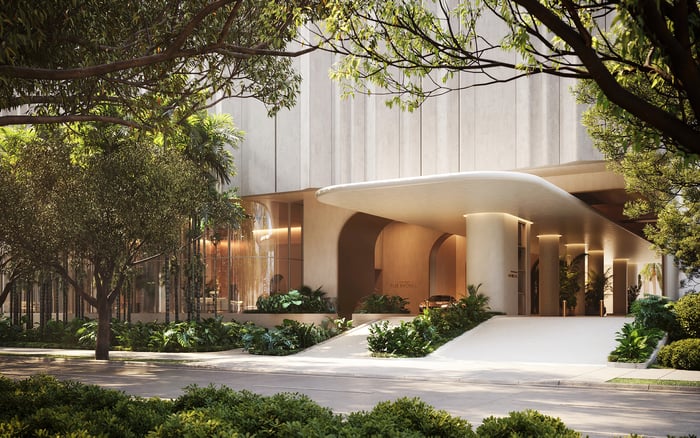
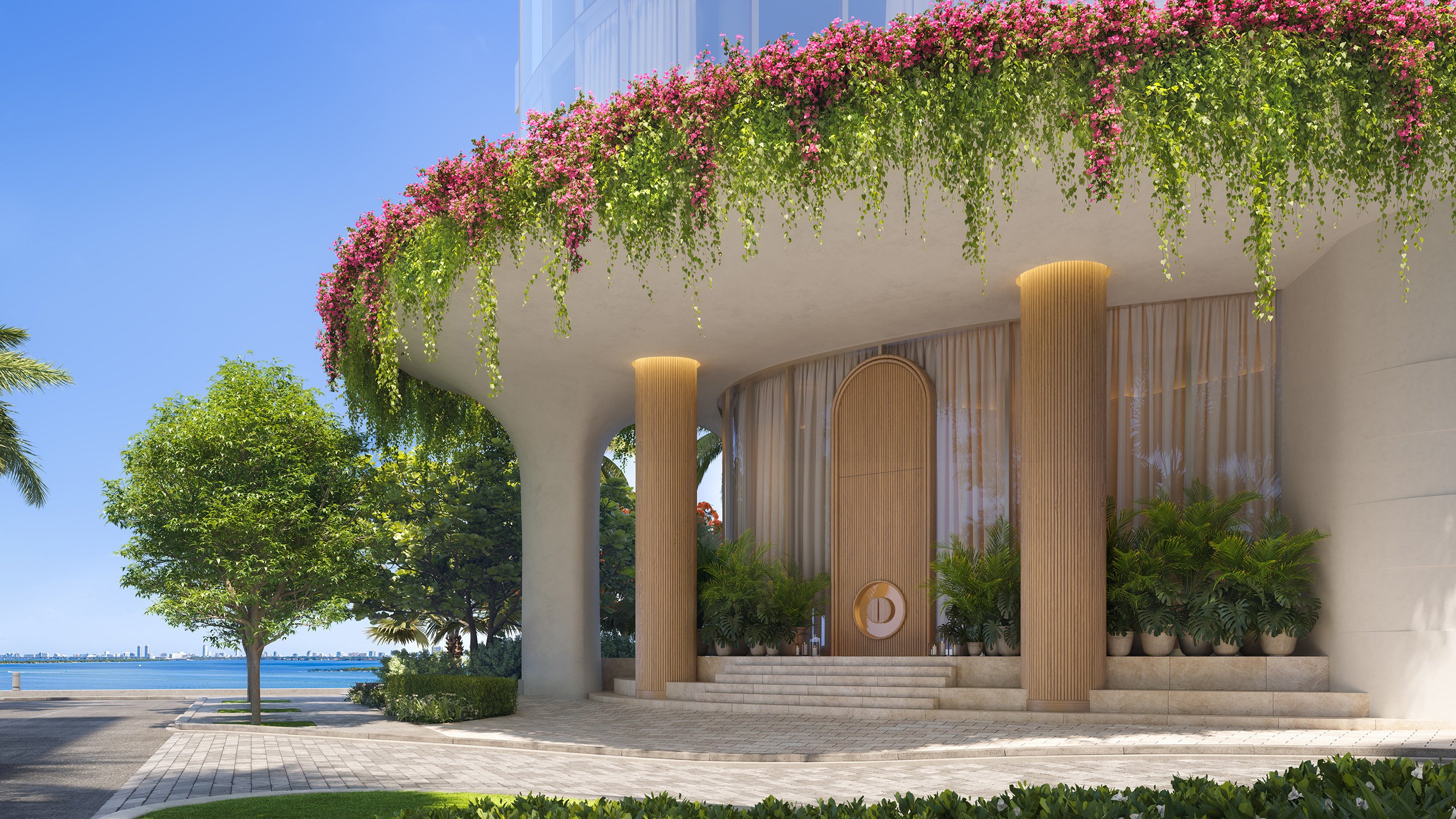
The development is planned at 2121 N. Bayshore Drive in Miami’s Edgewater neighborhood. The planned arrival sequence includes a covered porte-cochère leading to a three-story lobby with valet, security, and a reception desk. The advertised service package includes 24-hour security and valet parking. These are meaningful elements of the proposed experience, but they do not establish peak staffing, queue times, or guaranteed arrival capacity.
The distinction is essential: an elegant entrance is infrastructure; a predictable arrival is an operating commitment. Buyers should evaluate both before treating event-week hospitality as a settled benefit of ownership.
EDITION Edgewater is planned as a residential development with no hotel units, rather than a conventional EDITION hotel. Nearly 45,000 square feet of advertised amenities draw inspiration from the EDITION hotel experience, while the listed residences range from 1,922 to 3,760 square feet. That positioning should not be mistaken for unrestricted guest access or hotel-style booking rights.
A residential service model needs its own rules for visitors, overnight occupants, amenity use, and private functions. Ask whether a host must be present, whether an approved overnight guest can enter independently, and whether access permissions differ among the lobby, residential elevators, and shared spaces. None of those privileges should be inferred from the brand alone.
For buyers also considering Cipriani Residences Brickell, the useful comparison is documentary rather than atmospheric: request the same written answers from each property instead of assuming that branded service packages operate alike.
EDITION Edgewater’s future guest-preclearance protocol is not established here. Treat it as a purchase-planning question, not an existing policy. Request a written sequence covering registration, verification, arrival, and access to the residence.
Begin with the information required before arrival. Ask whether management will need a guest’s full name, identification, vehicle plate, host authorization, and intended arrival window. Establish the submission deadline, if any, and who can update an invitation when plans change. A policy that works for a scheduled dinner may be less convenient when a guest changes vehicles or arrives with an additional companion.
Then address exceptions. Who authorizes an unregistered arrival? What happens if the host cannot answer immediately? Can an assistant submit or amend a guest list on the owner’s behalf? Ask whether elevator access is escorted, time-limited, or otherwise restricted, without assuming that a particular system has been selected.
Finally, ask whether Art Week, conventions, holidays, or resident functions can trigger temporary guest limits or advance-registration requirements. Obtain the notice procedure and identify who is responsible for resolving an arrival dispute.
Twenty-four-hour valet availability describes service coverage, not throughput. A purchase review should distinguish operating hours from the number of attendants assigned during concentrated arrivals and departures. No verified event-week staffing schedule, maximum queue length, or retrieval guarantee is established here.
Request the proposed peak staffing plan, vehicle-retrieval targets, queue limits, and overflow arrangements. Clarify whether each target is contractual, an internal objective, or an estimate. Ask where vehicles wait when the covered arrival area is occupied, and how accessible drop-off and adverse weather will be accommodated.
Separate vehicle types deserve separate questions. Residents, overnight guests, ride-share vehicles, private drivers, deliveries, and vendors may have different needs. Ask whether each has designated staging and whether a driver waiting for an owner can remain without obstructing arriving vehicles. Dedicated parking with an additional valet option does not, by itself, clarify allocations among residents, guests, and service vehicles.
Buyers comparing Aria Reserve Miami can apply the same operational questions. The purpose is not to presume equivalent facilities, but to assess each proposed arrival experience against a consistent standard.
The guest-suite count requires resolution: six luxury guest suites are advertised, but four are also listed. Neither figure should anchor a hosting plan until the latest governing documents establish the intended provision.
Second-home buyers should also look beyond the count. Request reservation windows, minimum stays, peak-period restrictions, fees, cancellation terms, and occupant access privileges. Ask whether booking priority exists and whether a suite reservation includes parking or amenity access. These are terms to confirm, not established benefits.
A meeting/function room with conferencing technology is also planned, but its capacity and guest-access rules are not established. Before envisioning a private reception, confirm permitted uses, occupancy limits, booking procedures, vendor access, and any additional staffing charges.
When weighing Villa Miami alongside EDITION, use the same hosting scenario for each inquiry. A visiting family, a dinner with outside guests, and an overnight stay may reveal different restrictions. The comparison becomes useful only when those permissions are explicit.
Request the declaration, bylaws, rules, operating budget, management and valet agreements, and amenity-use policies. Have counsel identify which service commitments are enforceable, which remain discretionary, and which may change. A marketing description of security, concierge service, or valet should not substitute for that review.
The budget discussion should address how peak-period staffing and any additional operating costs would be funded. Ask whether special-event charges could fall on a host, whether valet fees differ by user, and who has authority to impose temporary restrictions. Where agreements are not final, request a clear explanation of their status rather than accepting a projected arrangement as settled.
Keep the sales visit separate from this operational assessment. The Sales and Design Gallery is at 2060 N. Bayshore Drive, Unit B101, a different address from the planned residential building. Private tours are by appointment, and gallery valet is available. Neither establishes future residential guest-preclearance rules or event-week valet performance.
The strongest purchase plan distinguishes the proposed setting, the advertised services, and the written operating obligations. EDITION Edgewater’s planned arrival infrastructure provides a starting point, but event-week access controls and queue performance remain matters to clarify. Seek written answers, identify unresolved terms, and decide whether those uncertainties fit your intended use before relying on them for hosting.
For a discreet discussion of residential options and purchase priorities, connect with MILLION.
If branded residences are on your mind — as a home or as an allocation — we would be glad to share what we are seeing, privately.
Begin a quiet conversationThe planned residential address is 2121 N. Bayshore Drive in Miami’s Edgewater neighborhood.
The planned entrance includes a covered porte-cochère leading to a three-story lobby with valet, security, and a reception desk.
No. The advertised service hours do not establish peak staffing, queue limits, or vehicle-retrieval guarantees.
It is described as a residential development with no hotel units. Hotel-inspired amenities do not establish unrestricted visitor or booking privileges.
Request written requirements for identification, host approval, registration deadlines, vehicle details, last-minute changes, unregistered arrivals, and elevator access.
The available details do not establish such restrictions. Ask whether Art Week, conventions, holidays, or resident functions can trigger temporary limits and how residents would be notified.
Descriptions differ between six and four guest suites. Buyers should resolve the count against the latest governing documents and confirm reservation terms.
A meeting/function room with conferencing technology is described. Its capacity, booking terms, and guest-access rules are not established.
Request the declaration, bylaws, rules, operating budget, management and valet agreements, and amenity-use policies. Have counsel distinguish enforceable obligations from discretionary services.
No. The appointment-only gallery at 2060 N. Bayshore Drive, Unit B101 has valet, but its operations do not establish future residential access or queue performance.