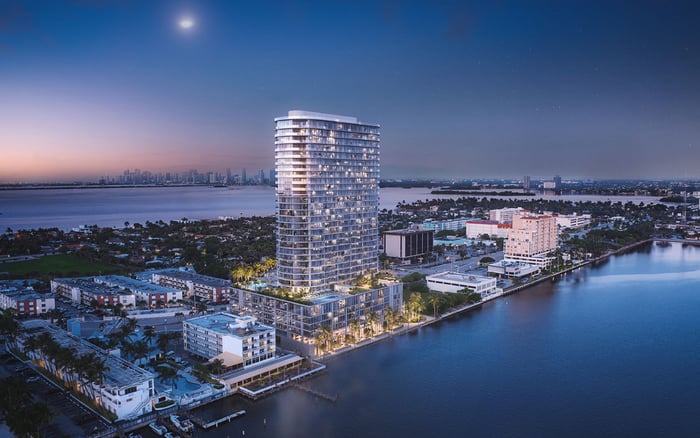
A buyer-focused guide to reviewing Shoma Bay’s insurance documents, separating replacement-cost appraisals from claim-dispute clauses, and evaluating named-storm deductible exposure alongside HO-6 loss-assessment coverage.

For a buyer considering Shoma Bay North Bay Village, located at 1850 John F. Kennedy Causeway, North Bay Village, FL 33141, insurance deserves the same scrutiny as the residence itself. The question is not simply whether the association carries coverage. It is how that coverage responds, what falls outside it, and how a loss could become an owner’s financial obligation.
Investment discipline begins with separating three issues that can sound interchangeable: the appraisal used to establish replacement cost, the contractual appraisal process used to resolve disputed claim amounts, and the unit owner’s protection against qualifying loss assessments. Each requires a distinct document review. Shoma Bay’s actual limits, named-storm deductible, appraisal wording, and allocation provisions must be established from the applicable documents-not inferred from Florida-wide requirements.
Florida condominium associations must maintain adequate property insurance regardless of the insurance requirements in their governing declaration. Replacement cost must be determined through an independent insurance appraisal, or an update of an earlier appraisal, at least once every three years.
That valuation requirement is distinct from an insurance policy’s appraisal clause. A replacement-cost appraisal supports the determination of insurance values. A contractual appraisal clause addresses disagreements over claim amounts under the policy’s terms.
For Shoma Bay, request the latest replacement-cost appraisal and any update, then compare their dates and values with the current master-policy declarations. Ask the association’s insurance adviser to explain how the insured values relate to the appraisal. A recent valuation and a policy document answer different questions; neither substitutes for the other.
Apply the same distinction when comparing Continuum Club & Residences North Bay Village. Evaluate each association’s documents independently rather than treating a shared location as evidence of equivalent coverage.
An appraisal process can determine actual cash value or the amount of loss without resolving the entire insurance dispute. One appraisal structure uses two party-selected appraisers and an umpire, with agreement by two participants determining the award. Do not assume that structure describes Shoma Bay’s policy without reading its wording.
Ask who may demand appraisal, which disagreements qualify, how participants are selected, and what obligations or costs accompany the process. Have an adviser distinguish disputes over the amount of damage from disputes over coverage or policy interpretation.
The practical distinction is narrow but important: appraisal is not a universal route to resolving disagreements with an insurer. Before relying on it as a safeguard, understand the mechanism available under the actual contract-and its limits.
Florida law permits associations to consider deductibles when determining adequate property insurance. Adequate coverage therefore does not mean owners have no deductible exposure.
Start with the master policy’s declarations, endorsements, and deductible schedule. Ask whether hurricane, named-storm, and other windstorm provisions differ. If a percentage deductible applies, establish whether it is calculated against total insured value, each building, each location, or another basis. Also confirm whether it applies per occurrence.
A percentage is not a usable budgeting figure until its calculation basis is known. Request a written calculation using the applicable insured values, followed by an explanation of how any resulting association obligation would be allocated under the governing documents. Keep the association’s deductible separate from the proposed unit-owner policy’s hurricane, windstorm, other-perils, and loss-assessment deductibles.
For a buyer also considering Onda Bay Harbor, the same comparison method applies: examine each property’s calculation basis and allocation rules rather than ranking policies by deductible percentage alone.
Florida condominium unit-owner policies issued or renewed on or after July 1, 2010, must include at least $2,000 in property loss-assessment coverage. That minimum is a starting point, not a recommendation for a particular Shoma Bay residence.
The required coverage concerns direct loss to property collectively owned by association members. It applies only when the underlying loss is of a type covered by the owner’s policy. It is not blanket protection against every special assessment.
The deductible for this required coverage cannot exceed $250 per direct property loss. If a deductible applies to other property damage caused by the same direct loss, the loss-assessment deductible does not apply.
Timing matters as well. For one direct loss, the insurer’s obligation is limited to the loss-assessment limit effective one day before the event, regardless of how many assessments follow. Multiple assessments arising from that single loss do not create a fresh limit each time. Selecting coverage after an event cannot be treated as a way to increase the applicable limit for that event.
A substantial headline loss-assessment limit can still leave a critical question unanswered: does the HO-6 policy cover an assessment attributable to the association’s master-policy deductible?
Policy wording can restrict that protection. Before selecting a limit, ask the broker to identify the provisions governing assessments arising from an association’s hurricane or named-storm deductible. Request a written explanation of any exclusions, restrictions, or separate limits, including how they interact with the proposed coverage amount.
This distinction also applies when evaluating a Miami Beach residence such as Five Park Miami Beach. Keep the comparison contractual: which underlying losses qualify, which deductible-related assessments are covered, and what limit applies. Project identity does not answer those questions.
Request the current master-policy declarations, endorsements, deductible schedules, certificates, evidence of premium payment, and latest replacement-cost appraisal. Together, these documents provide a basis for reviewing insured values, policy terms, and deductible exposure.
Also request five years of loss runs, open-claim information, insurance-related board minutes, current and proposed assessments, budgets, and relevant declaration and bylaw provisions. If the association has a shorter operating history, request the available history. Do not assume an absence of records means an absence of exposure.
Have a knowledgeable insurance broker or Florida condominium-insurance attorney review the association documents alongside the proposed HO-6 policy before closing. Seek written answers on the deductible calculation, owner allocation, appraisal mechanism, qualifying loss assessments, and master-deductible restrictions. Treat any unresolved answer as an open decision point, not an assurance.
For Shoma Bay, the objective is not a promise of zero exposure. It is a clear understanding of which risks are insured, which obligations may reach the owner, and whether the proposed personal coverage responds to those obligations.
For a considered approach to South Florida luxury ownership, explore MILLION.
If branded residences are on your mind — as a home or as an allocation — we would be glad to share what we are seeing, privately.
Begin a quiet conversationShoma Bay is located at 1850 John F. Kennedy Causeway, North Bay Village, FL 33141.
No. Florida law allows associations to consider deductibles when determining adequate property insurance, so owners may still face deductible-related obligations.
An independent insurance appraisal or an update of a previous appraisal must determine replacement cost at least once every three years.
No. The first establishes replacement-cost values, while the second addresses disputed claim amounts under the insurance contract.
No. Appraisal is not a substitute for resolving every coverage or policy-interpretation dispute, so the actual policy wording matters.
Confirm its calculation basis, including whether it applies to total insured value, each building, each location, or another basis. Also establish whether it applies per occurrence and how obligations are allocated to owners.
Florida condominium unit-owner policies issued or renewed on or after July 1, 2010, must include at least $2,000. Coverage depends on the underlying loss being of a type covered by the owner’s policy.
It cannot exceed $250 per direct property loss. If a deductible applies to other property damage caused by the same direct loss, the loss-assessment deductible does not apply.
No. For one direct loss, the insurer’s obligation is limited to the loss-assessment limit effective one day before the event, regardless of how many assessments follow.
No. Policy wording can restrict assessments attributable to a master-policy deductible, so obtain written review of the proposed policy’s hurricane and named-storm assessment provisions before selecting a limit.