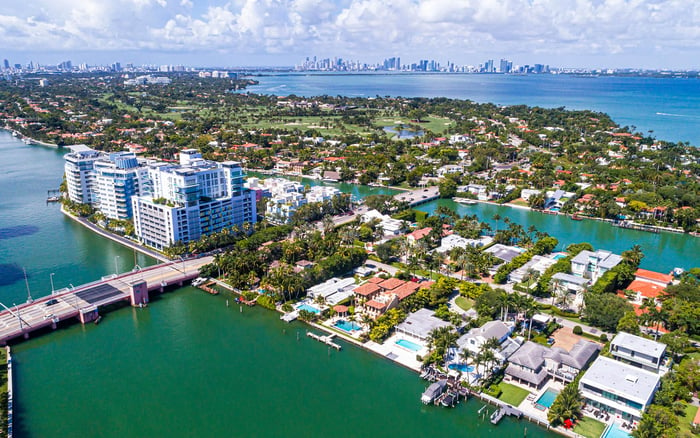
Fisher Island appeals to New Jersey buyers seeking a controlled South Florida residence, but the decision extends well beyond flight time. Ferry logistics, condominium diligence, Florida domicile evidence, aircraft tax treatment, and substantial carrying costs should be coordinated as distinct workstreams.

For a New Jersey principal accustomed to private aviation, South Florida’s appeal is not measured by flight time alone. The more consequential question is whether the entire journey-from departure through ground transfer and island arrival-supports the way the family intends to live.
Fisher Island is a private island club and residential community off Miami Beach. Its controlled setting distinguishes it from a typical mainland condominium, particularly for buyers who value managed access and separation from the surrounding city. In the vocabulary of luxury search, it occupies the intersection of second-home planning, waterfront living, and gated-community expectations.
That positioning also demands operational discipline. Property visits may require the listing agent to arrange ferry clearance, while certain showings or new-development opportunities may require financial prequalification or an invitation before tours or documents are provided. The central point is simple: access is part of the asset, but it must also be tested as part of the purchase.
Private aviation and luxury real estate are increasingly presented as a unified experience, with private-airfield access, helipads, VIP transfers, and on-demand helicopter services appearing across the broader market. A Fisher Island buyer should not assume that this wider trend resolves the specific logistics of an island residence.
Instead, test an actual door-to-door itinerary. Begin with the preferred New Jersey departure airport, then examine arrival procedures, ground transfer, ferry clearance, luggage handling, family requirements, and contingency plans. The final segment matters as much as the airborne one.
This exercise should extend beyond the owner’s arrival. Movers, contractors, vendors, and deliveries must be coordinated around ferry schedules and vehicle-size restrictions. A residence that feels effortless during a curated showing may operate differently during a renovation, a large delivery, or a tightly timed family arrival.
The most sophisticated approach treats three matters as coordinated but independent workstreams: purchasing the residence, establishing Florida domicile, and reviewing aircraft tax exposure.
Buying a Florida home does not, by itself, terminate New Jersey domicile. Domicile turns on physical ties and the intent to remain in, or return to, a state. An existing domicile is generally presumed to continue until sufficient evidence establishes a new one. Residence records, personal ties, and actual conduct must therefore align with the claimed move rather than rely on a deed alone.
Aircraft ownership adds another layer. New Jersey maintains a unit dedicated to aircraft transactions, and Form ST-10-A requires a purchaser claiming the nonresident aircraft exemption to certify, among other conditions, that the purchaser is not a New Jersey resident and maintains no permanent place of abode there. The form also addresses New Jersey employment, trade, business, or professional activity in which the aircraft will be used.
These questions should be reviewed with qualified legal and tax advisers before a transaction or operating pattern is established. A residence strategy that supports domicile planning does not automatically resolve the aircraft analysis.
The island offers several residential reference points for a shortlist. Buyers exploring current and emerging options may compare The Residences at Six Fisher Island with The Links Estates at Fisher Island, then consider established addresses such as Palazzo del Sol and Palazzo della Luna. The objective is not simply to compare finishes or views, but to understand the governing, financial, access, and club framework attached to each opportunity.
In 2025, the island’s median home price was placed at approximately $9.5 million. Estimated annual ownership costs have ranged from roughly $215,000 to nearly $1 million, depending on the residence and its association, community, club, tax, insurance, and maintenance obligations. These are broad estimates rather than appraisals, so buyers should build a residence-specific model.
Limited developable land reinforces the island’s scarcity. In 2025, an entity led by HRP Group agreed to pay $180 million for a 9.6-acre development site. For an end user, that transaction is less a pricing guide than an illustration of how highly constrained island land can be valued.
Due diligence should encompass condominium governing documents, financial statements, reserves, insurance, assessments, rental restrictions, and club-transfer terms. Many transactions are completed in cash, while financed acquisitions may face lender requirements specific to the condominium project.
The practical sequence matters. Establish proof of funds or financing readiness, clarify showing access, review the residence’s complete annual cost structure, and map the family’s arrival and service routines. Only then can a buyer determine whether Fisher Island’s controlled environment is merely attractive or genuinely compatible with daily life.
Does buying on Fisher Island establish Florida domicile? No. A property purchase alone does not terminate New Jersey domicile or establish a new one.
Why does Fisher Island appeal to private-aviation buyers? Its controlled private-island setting can complement a buyer’s preference for discretion, provided the full ground and ferry journey works well.
Is flight time the main travel consideration? No. Buyers should evaluate departure, arrival, ground transfer, ferry clearance, luggage, and contingency planning.
Do property tours require advance arrangements? They may. Ferry clearance, financial prequalification, or an invitation can be required for certain opportunities.
What should condominium diligence include? Review governing documents, financials, reserves, insurance, assessments, rental restrictions, and club-transfer terms.
Are Fisher Island purchases commonly financed? Many transactions are completed in cash, while financed purchases may encounter project-specific lender requirements.
What annual ownership costs should buyers expect? Broad estimates range from about $215,000 to nearly $1 million, but the actual figure must be modeled for the specific residence.
Does Florida domicile settle aircraft tax treatment? No. Aircraft ownership and use require a separate analysis, including any continuing New Jersey connections.
Why do ferry rules matter after closing? Ferry schedules and vehicle-size restrictions can affect movers, contractors, vendors, deliveries, and everyday household operations.
What is the best way to organize the purchase? Coordinate real estate, domicile, tax, aircraft, financing, and logistics advisers while keeping each workstream analytically distinct.
When you're ready to tour or underwrite the options, connect with MILLION.
If branded residences are on your mind — as a home or as an allocation — we would be glad to share what we are seeing, privately.
Begin a quiet conversation