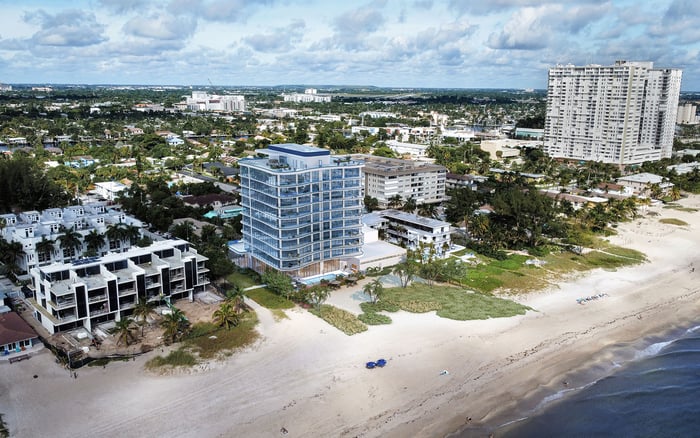
For London buyers, a Pompano Beach shortlist is best shaped by three separate reviews: aviation practicality, counsel-led domicile planning, and residence fit.

For a London buyer considering a South Florida base, the most effective shortlist is not built around a single promise. It rests on several decisions that must work in concert: how the household expects to travel, how ownership will be structured, what role the residence will play, and whether daily life feels suitably effortless.
Pompano Beach can enter that conversation as a focused coastal option. Its appeal should not be reduced to a tax slogan or a broad claim of convenience. A sophisticated buyer will instead ask whether a particular home supports a credible pattern of use, whether aviation arrangements remain practical under real conditions, and whether legal advisers are comfortable with the proposed domicile strategy.
This is especially relevant in a second-home search. A property may be emotionally compelling yet operationally wrong. Conversely, a disciplined brief can reveal why a quieter coastal address deserves consideration alongside more familiar South Florida names.
Private aviation and domicile may support the same lifestyle, but they are not the same decision. Aviation is an operational matter involving preferred aircraft, ground transfers, scheduling, security, luggage, pets, and contingency planning. Domicile is a legal and personal matter that should be assessed by qualified advisers in every relevant jurisdiction.
Property selection is the third workstream. It encompasses privacy, service, layout, storage, management, resilience, carrying costs, and the ease of leaving a residence unattended. Keeping these workstreams separate prevents an attractive apartment from becoming a substitute for legal analysis-or a convenient journey from being treated as proof of domicile.
For a cross-border household, the strongest brief assigns an adviser or decision-maker to each workstream, then brings the conclusions together before any commitment.
Aviation due diligence should begin with the journeys the owner actually expects to make. Rather than relying on an ideal itinerary, buyers can ask their flight department or aviation adviser to model arrival and departure scenarios, ground-transfer expectations, preferred handling arrangements, seasonal pressures, and alternatives when the first plan is unavailable.
The relevant question is not whether Pompano Beach sounds accessible. It is whether the complete door-to-door journey remains acceptable to the household across several plausible scenarios. That assessment may differ for an owner arriving from London, a family member connecting elsewhere, and staff travelling ahead with luggage or household requirements.
This practical review belongs early in the search. It can establish a realistic geographic radius and prevent property tours from becoming detached from the owner’s travel habits.
Domicile should never be inferred from a property purchase, travel pattern, or marketing statement. London buyers should coordinate legal and tax advice before deciding how a South Florida residence will be owned or used. The appropriate analysis may involve more than one jurisdiction and more than one household member.
The buyer’s role is to give advisers an accurate picture of intended occupancy, family circumstances, business commitments, existing homes, and long-term plans. Advisers can then identify the appropriate actions, records, and ownership choices. If the intended lifestyle changes, that advice should be revisited rather than treated as permanent.
Discretion matters here. A well-run process limits sensitive information to the professionals who need it and keeps property negotiations distinct from personal legal planning.
A Pompano Beach review can include both branded residences and alternatives, but brand recognition should never replace document review. Buyers can place Armani Casa Residences Pompano Beach and The Ritz-Carlton Residences® Pompano Beach within the same evaluation framework, then compare the details that matter to their household.
The same discipline applies to W Pompano Beach Hotel & Residences and Waldorf Astoria Residences Pompano Beach. The project name is the beginning of the inquiry, not its conclusion. Governance, services, use restrictions, financial obligations, delivery considerations, and resale priorities all require project-specific review.
An oceanfront preference also requires refinement. The buyer should define the desired outlook, exposure, privacy, arrival sequence, terrace use, and tolerance for building activity. These criteria turn an abstract lifestyle aspiration into a residence brief that can be tested.
For a regional search across Broward, the decision matrix should be concise enough to complete after every viewing. Useful headings include aviation fit, legal readiness, residence fit, operating model, privacy, service expectations, and exit flexibility. Each category can be scored, but written observations are more valuable than a single total.
A project such as Ocean 580 Pompano Beach can be considered within that matrix without assuming it serves the same buyer profile as every branded option. The objective is not to crown a universal winner. It is to identify the residence that best supports one household’s intended use.
That is why Pompano Beach can merit a place on a London buyer’s shortlist: not as an automatic answer, but as a market to examine through a disciplined, adviser-led process.
Does buying in Pompano Beach establish domicile? A purchase should not be treated as establishing domicile. Seek advice from qualified legal and tax professionals in every relevant jurisdiction.
Should aviation access be assessed before property tours? Yes. Testing real travel scenarios early can help define the geographic search and clarify acceptable ground-transfer expectations.
Is a branded residence automatically the best choice? No. Brand identity is only one consideration alongside governance, services, restrictions, costs, privacy, and the buyer’s intended use.
What should a London buyer give advisers? Provide an accurate account of intended occupancy, family circumstances, existing homes, business ties, and long-term plans.
How should projects be compared? Apply the same written criteria to every candidate, then record both a score and the reasoning behind it.
What belongs in the aviation review? Consider aircraft needs, scheduling, handling preferences, luggage, pets, security, ground transfers, and contingency plans.
Should ownership structure be decided after signing? Ownership questions are better addressed before commitment, with advice tailored to the buyer and every relevant jurisdiction.
What makes a residence suitable for part-time use? Focus on management, security, storage, maintenance, service expectations, and the practicalities of leaving the home unattended.
How important is privacy in the selection process? Privacy should be evaluated across arrival, residence access, staffing, amenity use, document handling, and information sharing.
Why keep Pompano Beach on the shortlist? It gives buyers a defined coastal market to test against their aviation, advisory, property, and lifestyle criteria.
When you're ready to tour or underwrite the options, connect with MILLION.
If branded residences are on your mind — as a home or as an allocation — we would be glad to share what we are seeing, privately.
Begin a quiet conversation