A practical examination of advertised services, privacy protocols and ownership-cost diligence at Ritz-Carlton West Palm Beach and Faena Miami, distinguishing indicative fee figures from contractual obligations.

The most valuable luxury service is often the least conspicuous: an arrival handled quietly, a guest welcomed correctly, a residence cared for without unnecessary intrusion. For buyers considering The Ritz-Carlton Residences® West Palm Beach and Faena Residences Miami Downtown Miami, the practical question is not simply what is advertised. It is what the association funds, what the owner purchases separately and how those obligations may change.
A service menu is not an association budget. An elevator vestibule is not a complete privacy protocol. And a monthly fee displayed for one residence is no substitute for its contractual assessment allocation. These distinctions should guide the purchase, especially when a buyer expects a second home to function seamlessly during long absences.
Marketed at 1717 N. Flagler Drive, The Ritz-Carlton Residences® West Palm Beach advertises butler, doorman and porter services, alongside common-area housekeeping and maintenance. Advertised offerings also include 24/7 valet parking and hotel and guest-suite reservations.
These offerings describe the intended experience; they do not establish how every service is treated within the assessment. Buyers should request a written schedule identifying which functions are funded collectively, which require separate payment and whether parking or particular requests carry additional charges.
The à la carte distinction is clearer for in-residence dining, catering and grocery shopping. Vacant-home care, housekeeping-related work, pet grooming, personal training, spa treatments and travel planning also appear as optional services. Minor electrical and plumbing work belongs on that menu as well and should not be conflated with common-area maintenance.
For a seasonal owner, the useful budget is both personal and communal: the association assessment plus the services the household actually expects to use. Any comparison with The Ritz-Carlton Residences® Miami Beach should use that project's own documents rather than assume the same brand means identical service obligations.
Monthly association fee figures under review include $2,768 for Unit 2105 and $4,769 for Unit 207. Insurance, cable TV, sewer and water are identified among the included expenses for Unit 207. Another monthly HOA figure under review is $4,540 or more.
These are distinct figures, not a verified final project-wide assessment schedule. They should neither be averaged nor treated as interchangeable. The available information does not establish why they differ; attributing the variation to residence size, phase or service packages would be premature.
Request the exact assessment allocation for the residence under consideration, matched to the latest projected annual budget and the adopted budget when available. Confirm which stated inclusions apply to that residence and what remains outside the assessment.
Buyers also considering Mr. C Residences West Palm Beach should apply the same discipline: compare documented obligations, not headline monthly amounts. That is a diligence principle, not evidence that the projects share a fee structure.
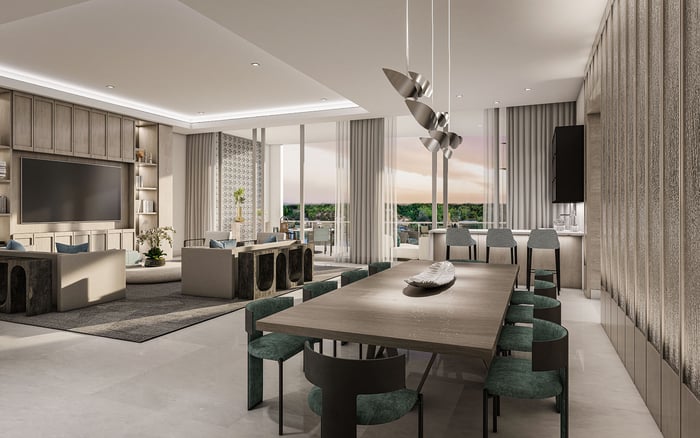
At Faena Residences Miami Downtown Miami, marketed at 24 SW 4th Street with approximately 440 residences, advertised privacy features include private and semi-private elevator vestibules. Advertised features also include separate elevator lobbies for each tower and a residential lobby with dedicated 24-hour concierge service.
These features make circulation and arrival important subjects for review. They do not establish who can access a residential floor, how deliveries reach an apartment or when staff may enter an unoccupied home.
Ask for written procedures covering guest registration, delivery access, staff and service elevators, housekeeping entry and valet handoffs. Confirm rental restrictions and amenity access as well. A buyer seeking discretion should understand both the physical arrangement and the rules governing its use.
The distinction is particularly important for semi-private vestibules: clarify the access arrangement for the chosen residence rather than assuming uniform privacy conditions throughout the development.
The available information does not establish a final Faena assessment or fully define its expense coverage. Maintenance inclusions remain unspecified. That should not be read as either comprehensive inclusion or the absence of maintenance charges.
For a planning exercise, an assumed $1.00 to $1.50 per square foot per month applied to a 2,000-square-foot residence yields an illustrative $2,000 to $3,000 monthly amount. This assumption is not a contractual Faena rate, a quoted Faena budget or an all-in ownership forecast.
Do not assume that approximately 440 residences guarantees a lower cost for each owner. The relevant questions are which expenses must be funded and how the contracts allocate them among owners.
For a Downtown Miami search that also includes Waldorf Astoria Residences Downtown Miami, keep estimates separate from documented assessments. A comparison becomes useful only when its cost categories are aligned.
The available information establishes no verified contractual annual escalator for either project. Buyers should not assume a fixed increase, an inflation-linked formula or a ceiling on future charges.
Instead, obtain the applicable brand, management and shared-facility agreements. Have counsel identify any escalation formula, its starting point, adjustment frequency and scope. Ask whether a provision affects a particular contract payment or a broader expense category; those are different exposures.
Review pass-through expenses and termination provisions alongside the escalator language. The objective is to understand who can change a charge, under what conditions and what options the association retains. Read each current service promise alongside the agreement governing its continuing delivery.
Start with the latest projected annual budget, unit-level allocation, reserve schedule and insurance assumptions. Obtain the adopted budget when available. Keep association-funded expenses separate from à la carte charges, valet or parking costs, membership fees and utilities unless the documents explicitly place them together.
Then test three cases: the developer’s estimate, a moderate-cost-increase scenario and a high-insurance/high-reserve scenario. These are planning exercises, not predictions. State the assumptions clearly rather than presenting an invented growth rate as a project term.
Finally, add the household’s expected service use. For one owner, vacant-home care may be central; for another, dining or housekeeping may dominate. The right comparison is the cost of the intended lifestyle, not simply the smallest advertised assessment.
Neither project can be judged on a service menu or fee estimate alone. Privacy, service and financial predictability become meaningful when residence-specific documents and operating protocols support the experience the buyer wants.
Explore South Florida residences with a sharper view of service and ownership costs at MILLION.
If branded residences are on your mind — as a home or as an allocation — we would be glad to share what we are seeing, privately.
Begin a quiet conversationThe service menu advertises butler, doorman and porter services, common-area housekeeping and maintenance, and hotel and guest-suite reservations. Advertised offerings also include 24/7 valet parking.
No. Dining, catering, grocery shopping and several other personal services appear on the à la carte menu; buyers should obtain written pricing and inclusion schedules.
Figures under review include $2,768 monthly for Unit 2105 and $4,769 for Unit 207, alongside another figure of $4,540 or more. These figures do not establish a verified final project-wide assessment.
The available information does not establish the reason. Buyers should reconcile each figure with the chosen residence’s allocation and the association budget.
Advertised features include private and semi-private elevator vestibules and separate elevator lobbies for each tower. A residential lobby with dedicated 24-hour concierge service is also described.
No. Guest registration, deliveries, staff access, housekeeping entry and amenity access require separate confirmation through written operating protocols.
The available information does not establish a final assessment or complete expense coverage. Buyers should request the residence-specific allocation and supporting budget.
An assumed $1.00 to $1.50 per square foot produces $2,000 to $3,000 monthly for a 2,000-square-foot residence. It is a planning exercise, not a contractual Faena assessment or an all-in ownership forecast.
No verified contractual annual escalator is established in the available information. Review applicable brand, management and shared-facility agreements for adjustment formulas, pass-through expenses and termination provisions.
Compare the developer’s estimate with moderate-cost-increase and high-insurance/high-reserve scenarios using explicit assumptions. Add expected personal service spending separately from association-funded expenses.