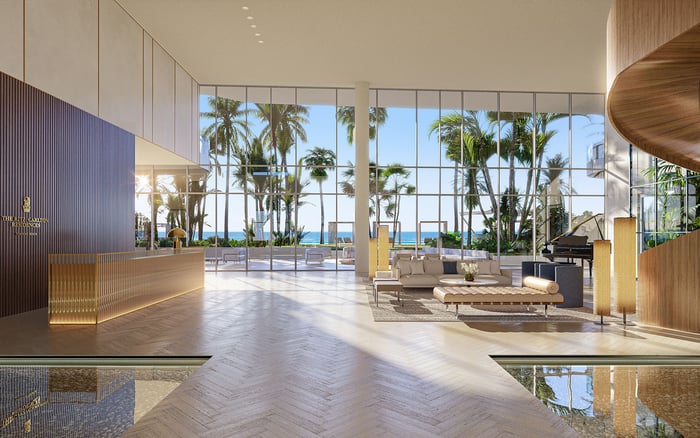
A buyer-focused comparison of advertised privacy and service at Faena House and Waldorf Astoria Residences Pompano Beach, with a practical framework for assessing reserves, refurbishment planning and renovation authority.

The most persuasive luxury residence offers more than a beautifully staffed arrival. Its privacy, upkeep and future costs remain clear after the purchase. At Faena House Miami Beach and Waldorf Astoria Residences Pompano Beach, the practical questions concern both the experience promised today and the decisions that will preserve it tomorrow.
These are distinct buying propositions: an existing residential property in Miami Beach and a new-construction, hotel-branded residential project in Pompano Beach. Comparing them requires more than matching service descriptions. Buyers should separate access features from operating protocols, maintenance estimates from dedicated replacement funding, and brand identity from enforceable renovation obligations.
The central principle is simple: a polished service offering is not a substitute for a documented funding plan.
At 3315 Collins Avenue, Miami Beach, FL 33140, Faena House Miami Beach offers advertised features that include private elevator entry, 24-hour concierge and security, and valet parking. These provide a starting point for evaluating arrival and residential access. They do not, by themselves, establish how visitors, deliveries or contractors move through the property.
A buyer seeking discretion should ask management to explain the full arrival sequence. Who authorizes a guest? How are household employees credentialed? What happens when a delivery arrives while the owner is away? Ask how elevator access is controlled and which procedures apply when a contractor needs entry to an unoccupied residence.
The distinction matters during refurbishment as much as in daily life. A private entrance does not resolve questions about service access, work scheduling, temporary protection or supervision. Request the applicable alteration rules and ask how common-area work would affect residential circulation. These are diligence requests, not assumptions about Faena’s existing procedures.
Waldorf Astoria Residences Pompano Beach has the residential address 1350 South Ocean Boulevard, Pompano Beach, FL 33062. Its advertised offering includes 24-hour reception, doorman and bellman services-a hospitality-style approach to arrival.
The recorded January 2026 top-off milestone marks a construction event, not completion or occupancy. Buyers should confirm the current delivery status separately rather than treating that milestone as evidence that services are operating.
For an owner, the important distinction is between the advertised service and its written scope. Request the staffing commitments, service inclusions and any separate charges. Ask which provisions govern opening operations and whether quoted expenses are preliminary estimates or part of an adopted operating budget.
Hotel branding alone does not establish an on-site hotel, shared hotel facilities, guaranteed hotel access or brand-funded renovations. Each entitlement and cost allocation requires its own written confirmation.
Waldorf’s quoted estimated maintenance is $1.61 per square foot without reserves and $1.74 per square foot with reserves-a difference of $0.13 per square foot. That difference is not identified specifically as a furniture, fixtures and equipment contribution.
Before applying either estimate to a residence, confirm the billing interval, assessable area and allocation method. Without those definitions, multiplying the figure by an advertised floor area can produce a misleading monthly or annual ownership estimate. Request the current figures rather than assuming the quoted estimates remain unchanged.
For diligence purposes, distinguish three questions:
What does the operating budget pay for during ordinary service delivery?
Which future expenditures are covered by the general reserve allowance?
Is there a separately identified FF&E inventory and funding schedule?
A general reserve allowance is neither a dedicated FF&E fund nor proof that future replacements are adequately funded. Ask for the relevant reserve study, available account balances, contribution assumptions and replacement inventory. The objective is to connect a budget line to identifiable assets and anticipated expenditure, not merely to confirm that the word “reserves” appears.
Neither property should be assigned a fixed refurbishment cycle on the strength of its branding or advertised amenities. A binding replacement calendar and an audited FF&E reserve schedule require document confirmation; they are not assumptions to build into a purchase decision.
Request an inventory identifying which furnishings, fixtures and equipment belong to the association, which belong to individual owners and whether another party has responsibility. Then ask for each covered asset’s condition, expected replacement timing, estimated cost and funding source. These are requested planning details, not confirmed obligations at either property.
Keep cosmetic refreshes separate from equipment replacement and other capital work when reviewing the answers. A visually compelling lobby proposal does not explain how every other future expenditure will be funded. Equally, a reserve balance says little about replacement adequacy without a corresponding scope and cost estimate.
Timing also has a personal cost. Ask about notice periods, work hours, access restrictions and any planned service interruptions. For a second-home owner, the ability to coordinate occupancy around disruptive work may matter almost as much as the assessment itself.
A brand-standard renovation review should begin with authority, not aesthetics. Request any applicable agreements that explain who may require a change, who approves its scope, who selects the specification and who pays. Do not presume that the brand bears financial responsibility simply because its identity shapes the residential offering.
Clarify whether any requirements apply to shared spaces, individual residences or both. Ask whether owners have approval rights, whether substitutions are permitted and what happens when a requested upgrade exceeds the budget. The applicable documents should answer these questions; a presentation is not a substitute.
The same discipline applies to a buyer also considering The Ritz-Carlton Residences® Pompano Beach: compare the written allocation of authority and expense rather than assuming a common model across brands. For Waldorf, too, obtain the controlling written terms rather than relying on oral representations.
For an existing property such as Faena House, request available adopted budgets, financial statements, reserve materials, completed-work records and minutes addressing proposed expenditure. The aim is to understand actual spending decisions and pending work without presuming what those records contain.
For Waldorf, request the current estimated budget, reserve assumptions, delivery documentation and agreements defining future service and renovation responsibilities. Ask which figures are estimates and which commitments are binding.
The practical preference is not automatically the older property or the newer brand. It is the residence whose documents best align privacy expectations, service scope and future financial responsibility with the buyer’s intended use.
For a discreet discussion of South Florida residential choices and ownership priorities, connect with MILLION.
If branded residences are on your mind — as a home or as an allocation — we would be glad to share what we are seeing, privately.
Begin a quiet conversationFaena House is an existing residential property at 3315 Collins Avenue, Miami Beach, FL 33140.
Faena House advertises private elevator entry, 24-hour concierge and security, and valet parking. Those features do not establish its specific visitor, delivery or contractor protocols.
Its residential address is 1350 South Ocean Boulevard, Pompano Beach, FL 33062.
The project advertises 24-hour reception, doorman and bellman services. Buyers should confirm the written scope, inclusions and current operating status separately.
No. Top-off is a construction milestone and should not be treated as evidence of completion or occupancy.
The quoted estimates are $1.61 per square foot without reserves and $1.74 per square foot with reserves. Confirm the billing interval, assessable area, allocation method and current figures before calculating ownership costs.
The difference is not identified specifically as an FF&E contribution. A general reserve allowance does not establish a dedicated furniture, fixtures and equipment fund or adequate future funding.
A binding refurbishment cycle is not established for either property here. Buyers should request applicable replacement schedules, inventories and funding plans rather than assume a customary interval.
No such responsibility should be inferred from branding alone. Applicable agreements should establish who can require renovations, who approves them and who bears the expense.
Request applicable budgets, reserve studies, replacement inventories, alteration rules and cost-allocation agreements. For an existing property, also seek available financial statements, completed-work records and minutes addressing proposed expenditure.