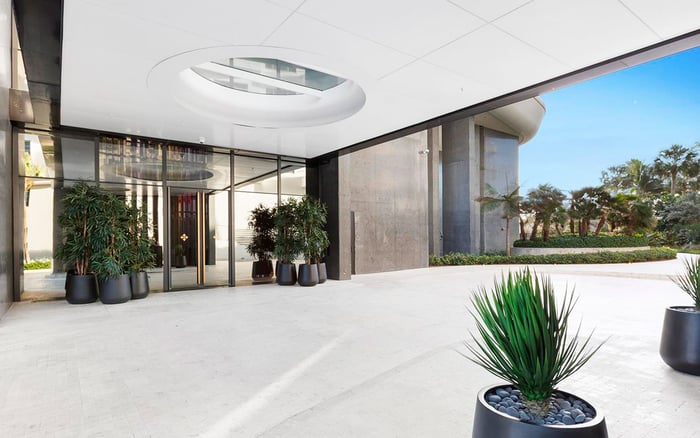
At Faena House, the ownership proposition combines a substantial private residential amenity program with preferred access to services at the neighboring hotel. Buyers should separate those two layers before assigning value to privacy, availability, maintenance exposure, and monthly costs.

At 3315 Collins Avenue, Faena House Miami Beach sits beside Faena Hotel Miami Beach, creating a residential proposition with two distinct amenity layers. Owners have private facilities within the condominium, along with preferred status and access to services at the neighboring hotel. For a buyer, those benefits should not be treated as one seamless package.
The private residential program includes a fitness center, in-house spa, children’s playroom, pool, and attended beach club. The beach club is private and residential, while the pool is reserved for residents. Those distinctions matter: exclusivity gives the condominium greater control over entry, traffic, and atmosphere during periods of high hotel occupancy.
Hotel-linked privileges add another dimension. They place dining, wellness, cultural, and entertainment experiences within the wider Faena District, but inside an active hospitality environment serving overnight guests and outside visitors. The operative language is typically “preferred status,” “access,” or “priority access”-not an unconditional promise that every facility will be immediately available at every hour.
The value lies not simply in access, but in knowing which access is exclusive, prioritized, or conditional.
Privacy in Miami Beach is often discussed in terms of elevators, arrival courts, and residential lobbies. At Faena House, the more useful question is where the residential boundary begins and ends. A 24-hour doorman, concierge, security surveillance, valet, and secure underground parking support a controlled residential arrival. An underground service corridor also connects the residence and hotel, underscoring the operational integration behind the scenes.
That integration can be highly convenient without making every space residential. A buyer should map the daily journey from residence to pool, beach, spa, dining, and events, noting where hotel guests or outside patrons may appear. The experience of a residents-only pool is structurally different from access to a guest-facing wellness or hospitality venue, even when an owner receives priority treatment.
This distinction is useful when comparing other branded residences and hospitality-oriented properties. Buyers considering Setai Residences Miami Beach or Shore Club Private Collections Miami Beach should apply the same discipline: identify which spaces are legally reserved for residents and which benefits operate through a hotel or broader campus.
Preferred access can be valuable, particularly when it includes private reservation channels, event privileges, preferred seating, or priority treatment. Yet priority is a position within an operating system, not necessarily an exemption from it. Hotel occupancy, public events, capacity limits, seasonal demand, blackout dates, and operating policies may all influence availability.
Before contract, request the current rules governing each hotel-linked benefit. Confirm whether reservations are required, how far in advance owners may book, whether preferred windows exist, and whether walk-in access is accommodated. Ask how owner guests are treated and whether the owner must be present. Dining, wellness, pool, beach, and event access may each be governed differently, so a single assurance of “hotel access” is not sufficiently precise.
A careful beach-lifestyle purchase also accounts for change. Buyers should establish whether preferred status is contained in condominium documents, a separate agreement, or a revocable operating policy. The review should address what happens if the hotel operator, branding, ownership, or governing agreement changes. The durability of the privilege can be as important as its present-day appeal.
Higher traffic can produce greater wear in hospitality spaces, but no public usage split quantifies resident activity against hotel-guest activity. The appropriate approach is therefore observational and documentary rather than speculative. If access permits, inspect finishes, furniture, wet areas, fitness equipment, treatment spaces, elevators, and circulation routes at more than one time of day.
For residential facilities, request maintenance records and replacement schedules for the pool, spa equipment, beach furniture, fitness equipment, and elevators. The in-house spa includes separate men’s and women’s sauna and steam rooms, dressing rooms, showers, and bathrooms. These are service-intensive spaces where maintenance quality can shape the ownership experience as much as the original specification.
For hotel-linked facilities, clarify who maintains each component and whether condominium funds contribute directly, indirectly, or not at all. Ask how damage, accelerated replacement, staffing, and consumables are allocated. A beautifully operated shared environment may justify its cost, but the buyer should understand which entity bears that cost and how much control the association has over standards.
Monthly HOA fees have been estimated at approximately $2.70 per square foot, with campus and adjacent-hotel access associated with that figure. It should be treated only as a reference point, not a current quote. Official association records should confirm current common charges, special assessments, reserves, and expense allocations.
Estimated HOA coverage has included lobby-attended security, elevator maintenance, parking, building insurance, and landscaping. Buyers should verify every included item in the current budget and condominium documents. They should also determine whether hotel privileges carry separate usage charges, minimum spends, gratuities, booking fees, membership costs, or owner-guest charges. None should be assumed without written confirmation.
Simplified buyer guidance can obscure the proposition. An amenity is not merely “included” or “excluded.” It may be included for entry but charged by service, available by reservation but not on demand, or prioritized for owners while remaining open to hotel guests. Each formulation carries a different practical and financial value.
The due-diligence file should include the condominium declaration, current rules and regulations, budget, reserve information, recent maintenance records, and every agreement governing access to hotel facilities. Counsel should identify which rights belong to the unit, which belong to the current owner, and which depend on an operating relationship outside the condominium declaration.
Create a written amenity matrix with four columns: facility, permitted users, reservation terms, and payer. Include owner guests, renters if applicable, and household staff where relevant. Add operating hours, capacity restrictions, blackout dates, charges, cancellation rules, and recourse when a facility is unavailable. This converts elegant marketing language into an ownership framework that can be compared across properties.
For context, buyers may also examine the governance and access structures presented at The Perigon Miami Beach. The objective is not to assume equivalence, but to compare privacy boundaries, service delivery, and the permanence of promised benefits on consistent terms.
Faena House offers a compelling combination: private residential amenities can preserve a meaningful privacy buffer, while neighboring hotel services broaden the daily experience. The sophistication lies in keeping those advantages conceptually separate. Resident-only facilities generally provide more control over traffic and atmosphere. Hotel-linked privileges can provide exceptional convenience, yet may remain subject to reservations, capacity, events, and policies.
For a second-home or primary-residence buyer, the decision should turn on documented rights rather than the mere number of amenities. Confirm the boundary, observe the traffic, inspect the wear, test the reservation process, and reconcile every benefit with the budget. That is the clearest way to value access without mistaking priority for exclusivity.
For discreet guidance on evaluating South Florida’s finest residences, connect with MILLION.
If branded residences are on your mind — as a home or as an allocation — we would be glad to share what we are seeing, privately.
Begin a quiet conversationThe residential program includes a fitness center, in-house spa, children’s playroom, pool, and attended beach club. The pool and beach club are described as resident-focused facilities.
Owners are marketed as receiving preferred status and access to services at the neighboring hotel. The precise scope and current terms should be confirmed in writing.
Not necessarily. Priority or preferred access may still involve reservations, capacity limits, blackout dates, events, and operating policies.
A residents-only pool provides greater control over traffic and atmosphere than a facility broadly used by hotel guests. Buyers should confirm the current governing rules.
The scope of owner-guest rights should be confirmed in writing. Buyers should verify whether guests are permitted, whether the owner must attend, and what charges apply.
Request the condominium declaration, current rules, budget, reserve information, maintenance records, and all agreements governing hotel-facility access.
Review maintenance records and replacement schedules for pools, spa systems, fitness equipment, beach furniture, elevators, and shared circulation areas.
That figure has appeared as a market-facing estimate, but it may not reflect current charges or assessments. Confirm all amounts directly in official association records.
They could depend on the controlling documents and agreements. Buyers should verify whether benefits survive changes in operator, branding, ownership, or association arrangements.
Evaluate permitted users, reservation terms, operating hours, charges, maintenance responsibility, and the durability of each right. This separates exclusive ownership benefits from conditional privileges.