A buyer-oriented diligence framework for separating Faena’s hospitality offerings from Faena House owner entitlements, with practical checks for dining privileges, deliveries, private entertaining, and hotel banquet charges.
For a family office considering Faena House Miami Beach, the central diligence question is not whether the surrounding hospitality offering is compelling. It is which services accompany ownership, which require separate payment, and which remain subject to hotel or condominium approval. That distinction matters most when everyday dining becomes residential delivery or a private dinner becomes a catered event.
Hospitality access and condominium entitlement are different propositions. A restaurant reservation, beach service, and permission to host a chef inside a residence each require separate confirmation. Faena House-specific dining discounts, reservation priority, delivery procedures, resident-order fees, and private-event surcharges remain unconfirmed. They belong in the acquisition file as questions to resolve, not benefits to assume.
Faena’s dining portfolio includes Los Fuegos by Francis Mallmann and Pao by Paul Qui. Campo is at Casa Faena, a distinct venue within the broader Miami Beach hospitality offering. These names help a household identify where it might dine or entertain; they do not establish preferred pricing or guaranteed tables for condominium owners.
The hospitality address is 3201 Collins Avenue, Miami Beach, FL 33140, and the Miami Beach reservations contact is +1 305-534-8800. Do not enter that address into the diligence file as Faena House’s condominium address. Likewise, a reservations contact is a starting point for hospitality inquiries, not proof of a residential service arrangement.
Project identity deserves equal care. Faena Residences Miami Downtown Miami is a different project name. Its amenity descriptions should not be used to establish privileges at Faena House without explicit confirmation. A shared brand does not substitute for the documents governing the residence being acquired.
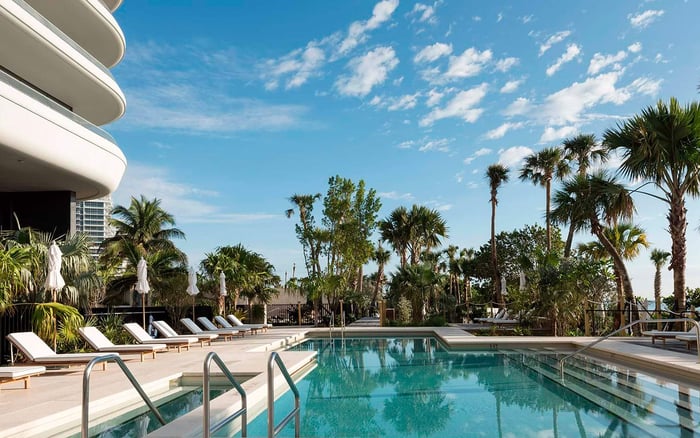
The pool-and-beach offering includes complimentary chaise lounges and umbrellas, along with food-and-beverage service. Complimentary seating does not mean complimentary meals or drinks, nor does the offering establish a Faena House owner’s contractual entitlement.
Food-and-beverage service hours are noon-6:30 p.m. These are service hours, not necessarily the operating hours of the pool or beach amenities. For a household that entertains late or expects breakfast service, that distinction belongs in operational planning.
Request a written privilege schedule identifying eligible users, access conditions, reservation procedures, charges, exclusions, and any blackout periods. Ask whether owners, tenants, household guests, and hotel guests receive different treatment. If a benefit is described as preferred access, obtain a practical definition: what receives priority, how requests are handled, and whether any guarantee exists. Treat every unresolved benefit as unconfirmed until the governing terms are supplied.
A useful delivery policy begins before a courier reaches the lobby and ends when the order reaches the household. Obtain written answers covering third-party delivery, lobby handoff, unit access, service elevators, permitted hours, minimum orders, fees, and gratuities. These are diligence questions, not established Faena House rules.
Separate restaurant-to-residence service from outside delivery. Ask who accepts an order, whether staff may bring it upstairs, how access is authorized, and what happens when the resident is unavailable. Clarify whether household staff may place orders or sign charges on an owner’s behalf.
Request an itemized example showing any delivery charge, service charge, tax, and optional gratuity. The purpose is not to predict a fee without evidence, but to eliminate ambiguity before repeated orders create a recurring expense. A family office should understand both how the service works and how it is billed.
Underwrite entertaining in three settings: inside the residence, within residential common areas, and at a hotel or district venue. Do not assume permission or charges transfer between them.
For an in-residence dinner, verify outside-caterer and private-chef permissions, guest limits, alcohol rules, insurance requirements, security, noise restrictions, elevator reservations, and deposits. For a common-area gathering, ask which space may be reserved, who approves it, and whether hotel-event charges apply. Those residential terms remain unconfirmed.
Hospitality event venues include Faena Forum and Faena Theater. Faena Forum offers on-site catering and dining services supported by the district’s restaurants and bars. Casa Faena offers designers, chefs, and professional event planners for tailored private celebrations. These offerings identify potential event settings; they do not establish a universal residential event package.
Hotel wedding-banquet terms require food and beverages served in public meeting rooms to be supplied and prepared by Faena Hotel Miami Beach. They also prohibit removing food and beverages from the hotel banquet premises. Those restrictions concern hotel banquet operations, not an established rule for gatherings inside Faena House residences.
The banquet terms require a minimum food-and-beverage spend but do not establish a universal minimum for every venue or event. They specify a 25% service charge on total food-and-beverage revenue, in addition to applicable taxes: 7% sales tax and 2% city tax. The service charge is also taxable at 7%.
Treat these figures as banquet terms, not independently verified current rates or a current quote. Before committing, obtain a venue-specific proposal confirming minimum spend, service charge, tax treatment, gratuity treatment, administrative fees, and overtime. Ask whether the service charge satisfies any gratuity expectation and how additional charges are calculated. Do not apply the hotel’s banquet percentage to residential entertaining without written confirmation.
When comparing Faena House with Setai Residences Miami Beach, use the same questions rather than assuming equivalent services. The useful comparison rests on documentation: access, eligibility, delivery logistics, entertaining permissions, and the total cost of using each offering. This is a comparison framework, not a claim about either property’s unconfirmed benefits.
Request the condominium declaration, bylaws, current rules, residential services agreement, and written owner-privilege and fee schedules. Have counsel reconcile inconsistencies and identify which terms govern, which can change, and who has authority to confirm them.
The finished file should let a household answer four practical questions: where it may dine, how meals reach the residence, where it may entertain, and what each activity costs. That clarity preserves the pleasure of ownership while keeping hospitality expectations aligned with enforceable arrangements.
For a discreet perspective on South Florida residential ownership, explore MILLION.
If branded residences are on your mind — as a home or as an allocation — we would be glad to share what we are seeing, privately.
Begin a quiet conversationThe supplied information does not establish owner-specific dining discounts or reservation priority. Obtain a written owner-privilege schedule before treating either as an ownership benefit.
The portfolio includes Los Fuegos by Francis Mallmann and Pao by Paul Qui. Campo is at Casa Faena, a distinct venue within the broader hospitality offering.
Food-and-beverage service is offered, but complimentary meals or drinks are not established. Complimentary chaise lounges and umbrellas do not establish a Faena House owner’s contractual entitlement.
Published food-and-beverage service hours are noon–6:30 p.m. They do not necessarily describe the operating hours of the amenities themselves.
Request written rules for third-party delivery, lobby handoff, unit access, service elevators, delivery hours, minimum orders, fees, and gratuities. Separate outside delivery from any restaurant-to-residence service.
Faena House-specific permissions are not established in the supplied information. Confirm permissions, insurance, access, guest limits, and related restrictions in writing.
The cited 25% charge concerns hotel banquet operations. Its application to gatherings inside residences or residential common areas is not established.
The document identifies 7% sales tax and 2% city tax, with the service charge taxable at 7%. These are published document terms, not independently verified current rates.
The hotel banquet document requires a minimum food-and-beverage spend but does not establish a universal amount. Obtain a current proposal for the specific venue and event.
Request the condominium declaration, bylaws, current rules, residential services agreement, and written owner-privilege and fee schedules. Obtain separate current proposals for hotel events.