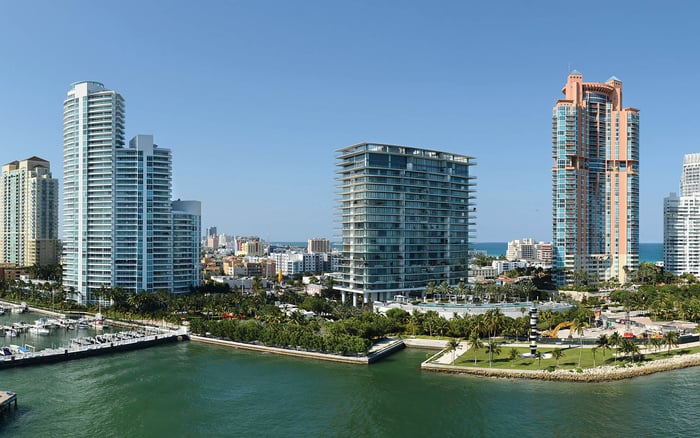
Continuum offers an Oceanfront residential lifestyle, but public materials do not establish an automatic deeded yacht slip with every home. Yacht-owning buyers should separate residential ownership, dockage contracts and charter privileges, then verify each right before closing.
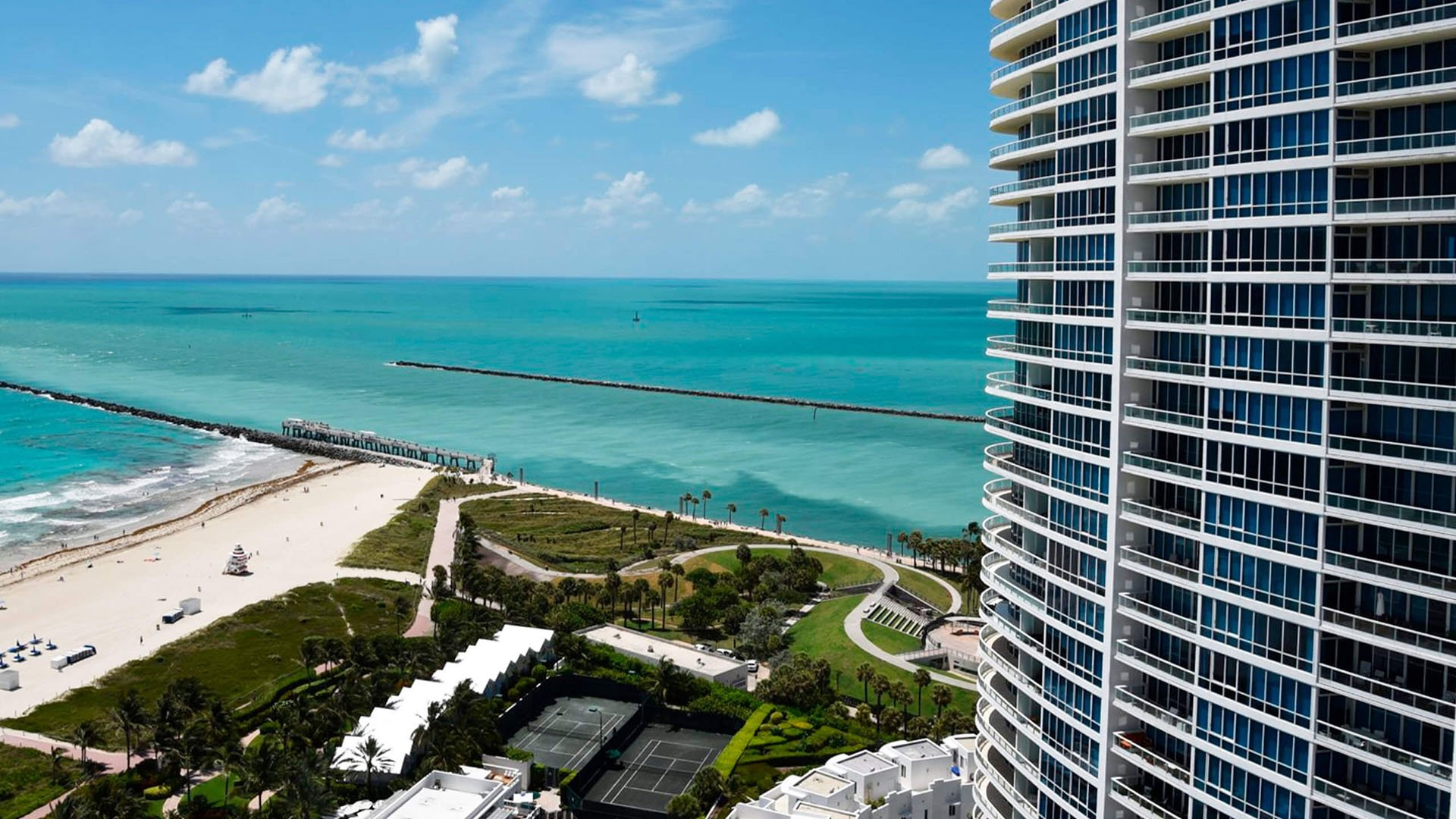
Continuum on South Beach comprises two luxury condominium towers at 50 and 100 South Pointe Drive in Miami Beach's South of Fifth neighborhood. Its identity is fundamentally beachfront and residential, with amenities that emphasize beach access, swimming pools, tennis, spa and sporting facilities. The property is not presented as a marina condominium.
That distinction should shape a yacht owner's negotiations from the outset. Nothing reviewed here establishes that every residence automatically includes a deeded or assigned yacht slip. The South Tower is identified as a condominium parcel, initially comprising 314 units and later reduced to 311, with no identified marina component.
A buyer can value the oceanfront setting, resort services and residential privacy while arranging dockage elsewhere. The priority is to avoid assuming that proximity to the water creates a transferable berthing right.
Water access, charter access and permanent slip ownership are distinct assets.
Condominium-related dockage generally takes one of three forms, each creating a different legal and financial position.
A deeded slip is separately owned real property. Subject to governing restrictions, it may be transferable independently of the residence. The recorded deed, legal description, title status and restrictions therefore carry more weight than sales language. A buyer should confirm whether the slip must remain paired with a particular unit and whether association or marina approval is required.
An exclusive-use assigned slip grants use rather than separate ownership. Its durability depends on the condominium declaration, rules and assignment instrument. The association may retain authority over allocation, vessel qualifications or reassignment. The central question is whether the right follows the unit automatically, can transfer with approval or ends when the seller leaves.
A leased slip is contractual. Renewal, assignment, subletting, termination and pricing depend on the lease and operator policies. Even a long-standing arrangement may not survive a sale unless the contract expressly permits assignment and the operator accepts the buyer.
For waterfront purchasers, these categories should never be treated as interchangeable. A deed is an asset; an assignment is a governed use right; a lease is a contract.
One Continuum residence has been marketed with “Boat Access” described as “Common Dock, Fishing Pier,” alongside separate references to deeded beach access and unrestricted saltwater access. The wording is meaningful, but it does not establish ownership of a privately deeded slip.
“Common dock” can describe a shared amenity governed by condominium rules. “Boat access” can signify access to the water without guaranteeing overnight berthing, exclusivity or space for a particular vessel. Before assigning value to either phrase, require the instrument that creates the claimed right.
This discipline is especially relevant when comparing nearby residences. A buyer considering Apogee South Beach or The Ritz-Carlton Residences® South Beach should apply the same document-first standard rather than infer boating rights from geography, views or branding.
Continuum's homeowners association became a founding member of a Residence Yacht Club program that offered residents a recommended luxury charter experience. The arrangement provided access to a privately owned fleet of premium charter yachts based in Miami Beach; it did not document individual slip ownership by condominium owners.
This can still be an attractive lifestyle benefit for an owner who prefers chartering to maintaining a vessel. Yet membership access must be assessed under its own agreement. A purchaser should ask whether participation remains current, whether access is tied to the association or the individual resident, what charges apply and whether any privilege transfers with a unit sale.
Charter availability should not be capitalized as permanent real estate, nor should a membership agreement substitute for evidence of a berth. The practical test is straightforward: identify who owns the yacht, who controls the dock and which contract grants the resident access.
Residential carrying costs and yacht expenses belong in separate underwriting lines. An association fee of $3,361 per month for one Continuum II residence illustrates the scale of condominium costs before dockage, utilities, vessel services or charter charges. That figure applies only to the residence in question; it is not a universal current fee for all units.
Illustrative Miami dockage pricing has started at approximately $6 per foot for transient stays, $78 per foot monthly, $68 per foot seasonally and $34 per foot per month under an annual arrangement. Actual pricing must be reconfirmed directly with the selected operator. Length overall, beam, draft and term can affect availability and cost.
A prudent acquisition model should therefore account for the residence's current association obligations, any known assessments, separate dockage and the relevant yacht contract. Continuum's two towers also underwent an exterior renovation estimated at $8 million to $8.5 million, focused on the residential property rather than new marina infrastructure. Historic capital work should not be interpreted as evidence of added private slips.
For buyers broadening their search beyond South of Fifth, Onda Bay Harbor can serve as another residential reference point. The same principle applies: assess every boating representation through the specific project's governing and title documents.
Before closing, require the seller to produce the document supporting the claimed benefit: a recorded slip deed, assignment instrument, marina lease or membership agreement. Counsel and title professionals can then determine what is owned, what is merely available for use and what requires third-party consent.
The review should establish whether the right follows the residence, can be assigned to the buyer, requires association or operator approval, expires seasonally, renews automatically or is subject to a waitlist. It should also identify any restrictions on vessel dimensions, guests, captains, subletting and commercial use contained in the governing documents.
The purchase contract should describe the boating right precisely rather than rely on a generic amenity reference. Document delivery, required approvals and evidence that fees are current can be addressed before closing. If the seller cannot substantiate the right, the buyer can value the residence on its verified residential merits and budget separately for dockage.
Continuum remains a compelling beachfront proposition for purchasers who prioritize privacy, extensive amenities and a South of Fifth address. For a yacht owner, however, the residence and berth should be evaluated as two coordinated acquisitions, even when presented together.
The strongest position rests on four verified answers: the legal nature of the slip right, the party controlling it, the full recurring cost and the mechanism for transfer. Once those points are documented, a buyer can compare ownership, assignment, leasing and charter access on equal terms. Until then, common-dock language and membership privileges should be regarded as conveniences rather than assumed property rights.
For discreet guidance on evaluating a Continuum purchase alongside your yachting requirements, connect with MILLION.
If branded residences are on your mind — as a home or as an allocation — we would be glad to share what we are seeing, privately.
Begin a quiet conversationThe supplied public materials do not establish an automatic deeded slip with every residence. The specific unit's title and condominium documents must confirm any claimed right.
A deeded slip is separately owned real property, while an assigned slip generally provides exclusive use without separate ownership. Transfer rules differ accordingly.
Only if the lease permits assignment and any required marina approval is obtained. Renewal and termination rights also depend on the contract.
No. Common-dock language may indicate shared access, but it does not establish a privately deeded or exclusive slip.
No. The program offered access to privately owned charter yachts rather than documented individual ownership of marina slips.
Buyers should budget dockage independently from residential association fees and confirm all charges with the selected marina operator.
Request the applicable slip deed, assignment instrument, marina lease or membership agreement, together with documents governing transfer and approval.
Pricing varies with vessel size and contract term. Length overall, beam, draft and desired duration should be confirmed with the operator.
Confirm whether the right follows the unit, requires approval, can be assigned, expires seasonally or is subject to a waitlist.
Until the right is documented, value the residence on its verified residential features and treat separate dockage as an additional expense.