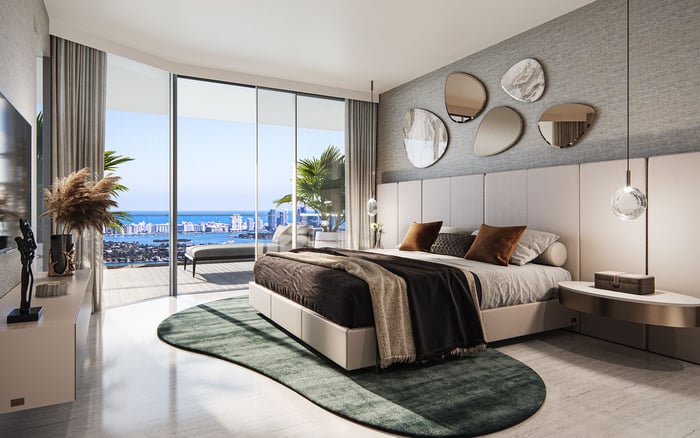
For a family office establishing an Edgewater residence, the essential diligence extends beyond the floor plan: power continuity, independent connectivity, confidential speech and discreet staff movement deserve their own acquisition brief.

For a family office moving between Paris and Edgewater, a residence may need to support more than private life. It may become a setting for investment discussions, document review and conversations that must remain within the room. The acquisition question is not simply whether an apartment has space for a desk, but whether work can continue discreetly when normal conditions change.
Start by defining what must remain available: secure communications, essential files, a comfortable working environment and controlled access. Then distinguish what belongs inside the residence from what should remain at a separate office. This is an operating brief, not a measured comparison between Parisian and Miami buildings.
For a shortlist that includes Aria Reserve Miami, attach that brief to the floor-plan review. Evaluate a beautiful room against its intended duties rather than assuming it can fulfill them.
A building's structural protection and a household's ability to work through a disruption are separate questions. Request the applicable design basis and building-specific documentation through the appropriate professionals rather than relying on general descriptions of Miami-Dade construction requirements.
Glazing deserves the same discipline. Ask qualified advisers to review the selected residence's specifications and applicable testing documentation. Do not equate impact resistance with continued electricity, cooling or connectivity.
Ask management to identify exactly which systems receive backup power. Separate life-safety equipment from residential receptacles, cooling, telecommunications equipment and any dedicated office space. Request documented runtime assumptions, fuel arrangements, maintenance responsibilities and restoration procedures. An unqualified reference to a generator is not enough.
The family office should also define its own stopping point: when to suspend work, move operations elsewhere or follow emergency directions. A continuity plan must never depend on remaining in a residence contrary to safety instructions.
For a residence under consideration at EDITION Edgewater, make connectivity a separate diligence discussion. Ask which services can reach the selected apartment, who controls installation permissions and whether the proposed alternatives share an entry point, riser or other dependency. These are questions to resolve, not claims about the project's infrastructure.
Look for a documented service path and a tested fallback. Ask an independent technology adviser to assess the available connections, equipment power needs and failover behavior. If a cellular backup is proposed, test it in the intended workroom rather than relying on a lobby demonstration.
The operating brief should specify which functions must survive an interruption and for how long. A household may prioritize calls and secure file access over every connected device. Assign responsibility for monitoring, software maintenance and periodic testing, including when the principal is abroad. Redundancy should describe how the office keeps working, not simply how many subscriptions it pays for.
If an Edgewater residence under consideration offers a separate office suite, evaluate it independently of the apartment. Clarify whether access is included in the purchase, subject to eligibility or governed by a separate agreement; do not assume an amenity is available to every buyer.
Review the proposed furnishings, entry controls, connectivity and equipment provisions. Treat any listed features as a starting point for questions, not proof of independently routed internet, confidential speech conditions or backup-power coverage.
Before incorporating such a suite into the family's operating plan, clarify allocation, access arrangements and governing terms. Then test the room against actual tasks: a private call, a document session or work by an assistant. Obtain written confirmation on visitor access, storage, equipment installation and permitted use. An office amenity can complement a residence without replacing a separately specified workplace.
When considering The Cove Residences Edgewater, request any available acoustic specifications relevant to the intended workroom. Ask what those specifications cover and how performance can be verified rather than assuming a particular sound-isolation rating or level of privacy.
Define the desired outcome before discussing finishes. Should ordinary conversation be unintelligible in an adjacent room? Must a confidential call remain private from a corridor or reception area? Ask an acoustic professional to translate those requirements into design criteria and an appropriate verification plan.
Review the complete enclosure: doors, glazing, partitions and service penetrations. A lock controls entry; it does not establish acoustic separation. Likewise, a room that sounds pleasant during a viewing has not necessarily been evaluated for speech privacy.
For an unfinished residence, clarify the specifications and the opportunity for testing before acceptance. For a completed space, arrange an assessment under agreed conditions. Coordinate proposed alterations with building approvals before assuming they can proceed.
Assess staff circulation as carefully as the principal's arrival. When reviewing Villa Miami, for example, ask to trace the proposed paths for household staff, an executive assistant, deliveries, maintenance personnel and invited advisers. Do not infer separate circulation from luxury positioning or an expansive floor plan.
Use realistic scenarios. Can an assistant reach the workroom without crossing a bedroom corridor? Where would a visitor wait? Would a delivery interrupt a confidential meeting? How would a technician reach communications equipment without unnecessary access to family spaces?
Request the applicable access rules and clarify credential issuance, visitor authorization, service scheduling and after-hours procedures. Within the residence, consider whether a reception threshold, lockable storage or a revised furniture plan could create useful boundaries, subject to approvals. Design discretion into daily movement rather than leaving it entirely to staff improvisation.
Consolidate the findings into a single decision document. For each critical function, record the required outcome, supporting documentation, unresolved questions, responsible adviser and any agreed acceptance test. Distinguish announced features from contractual commitments and completed, tested systems.
Ask counsel to review permitted business use, employee and visitor access, and any proposed purchase conditions. Ask technical advisers to assess power, connectivity and acoustic requirements together rather than as isolated upgrades. The most suitable residence is the one whose verified capabilities align with the family's intended use, without forcing domestic life to accommodate an improvised office.
For a discreet conversation about an Edgewater residence suited to your family's priorities, connect with MILLION.
If branded residences are on your mind — as a home or as an allocation — we would be glad to share what we are seeing, privately.
Begin a quiet conversationIdentify essential work functions, confidentiality requirements, access needs and acceptable downtime. Decide which activities belong at home and which require a separate workplace.
Request the applicable design basis and building-specific documentation through qualified professionals. Do not rely on general descriptions of local construction requirements.
No; glazing performance does not establish continued power, cooling or connectivity. Those systems require separate building-specific diligence.
Request a precise description of supported systems, including whether residential circuits, cooling and telecommunications equipment are covered. Clarify runtime assumptions, maintenance and fuel arrangements.
Ask a technology adviser to review service paths, shared dependencies, equipment power and fallback options. Test the proposed failover in the intended workroom.
Confirm eligibility, allocation, access arrangements and governing terms in writing. Assess connectivity, backup power and privacy against the family's intended tasks.
No; a lockable entry provides access control, not a guarantee of confidential speech. Assess the room's acoustic performance separately.
Request any available specifications relevant to the intended workroom and clarify their scope. Ask an acoustic professional how the required level of speech privacy can be verified.
Walk proposed routes for staff, visitors, deliveries and maintenance personnel against realistic daily scenarios. Confirm access rules and identify any crossings through private family areas.
Confirm permitted use, access arrangements and the systems needed for the intended work. Distinguish announced amenities from contractual commitments and tested capabilities.