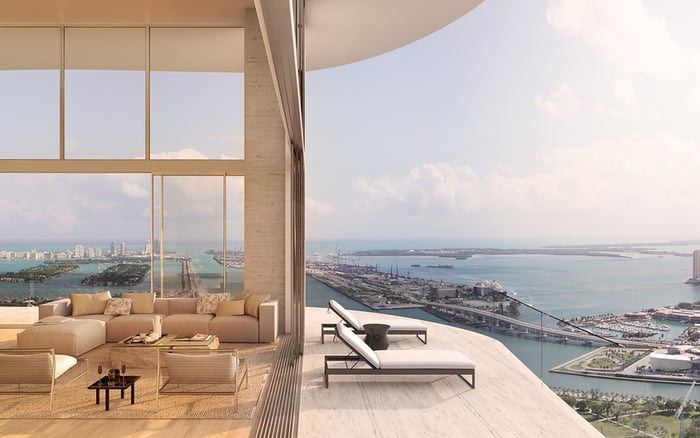
Villa Miami is positioned as residential-only, not a hotel-and-condominium tower. For prospective owners, the essential diligence concerns invited guests, amenity rights, public access, circulation plans, and the agreements that make privacy enforceable.

At Villa Miami, ownership due diligence begins by correcting the premise: the development is positioned as residential-only, without an integrated hotel. Buyers should distinguish residents’ invited guests from paying hotel customers, rather than assume a hotel population occupies another portion of the tower.
That distinction matters, but it is not a complete privacy guarantee. Residential-only positioning does not establish that every restaurant, arrival area, waterfront space, or potential dock access point is closed to outsiders. Nor does it confirm separate entrances, elevator banks, parking routes, or service corridors.
For an Edgewater buyer, the useful question is not simply whether the building has a hotel. It is who may enter each space, under whose authority, by which route, and who can change those permissions. Privacy becomes an ownership benefit when access rights and operating arrangements support it.
Villa Miami’s advertised amenity program spans approximately 20,000 square feet across three levels and is marketed for residents and their guests. The program is described as conceived and fully serviced by Major Food Group; 24-hour concierge, valet, and security are also advertised.
These offerings describe hospitality within a residential setting. They do not, by themselves, establish hotel operations. An owner’s dinner guest, a registered overnight visitor, and a hotel customer represent distinct access categories and should not be treated as interchangeable.
That distinction is useful when considering Waldorf Astoria Residences Downtown Miami, whose combined hotel-and-residence program contrasts with Villa Miami’s residential-only positioning. The contrast does not establish either project’s physical circulation or binding access arrangements.
For Villa Miami, request a written schedule distinguishing owners, tenants, immediate family, registered visitors, employees, and outside service providers. Each category should have defined permissions, rather than fall under the broad term “guest.”
The marketed wellness offering includes an Italian-inspired thermal spa with an indoor pool, treatment rooms, and a salon. A Technogym-equipped fitness floor, movement and recovery areas, a bayfront pool deck, a screening room, and a children’s playroom complete the advertised residential offering.
The described guest policy allows owners to extend amenity access to immediate family and registered guests through concierge coordination. That is a useful starting point, not a complete operating manual. Confirm whether the owner must be present, how visitors are registered, how long credentials remain valid, and whether access differs by facility.
Ask specifically about capacity limits, reservations, age restrictions, charges, and the rules for visiting family when an owner is away. A guest cleared to enter a residence may not hold the same privileges as someone booked for a spa treatment or invited to dinner.
The objective is a written, facility-by-facility access schedule that matches how the household intends to live.
A residents-only MFG restaurant is part of Villa Miami’s marketing, while The Copper Club is listed as an on-site members’ club within the residential amenity program. Neither description establishes the access rules for every dining space or category of club member.
Buyers should request the dining and club agreements to establish whether privileges attach automatically to ownership, require separate membership, or carry additional charges. Ask whether membership can extend to nonowners, whether private events can bring in outside attendees, and who has authority to revise eligibility or operating hours.
For a buyer also considering Cipriani Residences Brickell, the same questions belong in the comparison, without assuming equivalent access or service arrangements. Evaluate each project through its own agreements.
At Villa Miami, ask what contractual provisions, if any, address service continuity, operator replacement, and owner remedies. A dining identity is no substitute for defined obligations.
A bayfront pool deck is advertised as a residential amenity. That does not establish the status of every waterfront area, ground-floor space, restaurant entrance, or dock. Buyers should not treat “residential-only” and “no public access anywhere” as synonymous.
Request access-control plans that trace movement from arrival to residence and from arrival to each amenity. The review should identify security checkpoints, credential-controlled doors, elevator permissions, valet handoffs, deliveries, and contractor routes. These are questions to resolve, not confirmed features of Villa Miami’s design.
Ask the team to walk through practical scenarios: a dinner invitation, visiting family staying without the owner, a large private event, and a service technician arriving during a busy evening. The explanation should align with the plans and written rules.
Where commercial or public access is permitted, clarify its boundaries and legal basis. Physical separation and permission to enter are different protections; an owner needs to understand both.
The absence of an integrated hotel does not establish a short-term-rental prohibition. Rental rights require a separate review of the governing condominium documents, including minimum lease terms, permitted rental frequency, tenant screening, occupancy limits, and amenity eligibility.
For a seasonal household, determine whether leasing transfers amenity rights to the tenant and whether the owner retains any access during that period. Clarify how unaccompanied family stays differ from rentals and how recurring visitors are classified.
These distinctions matter even to an owner who never intends to lease. Permitted uses of neighboring residences can affect the number and turnover of people accessing shared spaces. Ask which restrictions are binding, who enforces them, and which amendment provisions could change them. Residential-only positioning is no substitute for that review.
Before treating an amenity description as an enforceable owner right, have counsel review the declaration, applicable rules, access-control plans, club and dining agreements, guest policies, and expense-allocation provisions together. Ask how conflicts among those documents are resolved and which provisions can change without individual owner consent.
The financial review should establish who pays for security, concierge coverage, dining operations, club facilities, and any shared infrastructure. Determine which costs belong to the association, which are charged separately, and how expenses are allocated if any spaces serve more than one user group. An unsupported fee estimate is no substitute for a current budget and contractual allocation.
Villa Miami’s residential-only positioning answers the hotel question at the marketing level. The more consequential ownership decision rests on documented access, clearly defined guest privileges, and obligations that remain clear after the sales presentation ends.
For a discreet discussion of Villa Miami and your South Florida ownership priorities, connect with MILLION.
If branded residences are on your mind — as a home or as an allocation — we would be glad to share what we are seeing, privately.
Begin a quiet conversationVilla Miami is positioned as a residential-only development without an integrated hotel. Hospitality-style services should not be confused with hotel occupancy.
The program is marketed for residents and their guests. Buyers should confirm the precise eligibility and access terms in the governing documents and operating agreements.
The advertised program comprises approximately 20,000 square feet across three levels.
The guest policy is described as allowing immediate family and registered guests access through concierge coordination. Owner-presence requirements, limits, and facility-specific permissions still need confirmation.
A residents-only MFG restaurant is advertised, but that does not establish access rules for every dining space. Review the applicable dining agreements.
The Copper Club is listed as an on-site members’ club within the residential amenity program. Membership eligibility, charges, and nonowner access should be confirmed in its agreements.
Separate entrances, elevator banks, parking routes, and service corridors are not established here. Buyers should request access-control and circulation plans.
A residential bayfront pool deck is advertised, but the access status of every waterfront and ground-floor area remains unresolved. Residential-only positioning does not establish property-wide exclusion of the public.
No such prohibition can be inferred from that positioning. Minimum lease terms, rental frequency, occupancy limits, and tenant amenity rights require document review.
Prioritize the declaration, access-control plans, guest policies, club and dining agreements, and expense-allocation provisions. Review them together with applicable rules and a current budget.