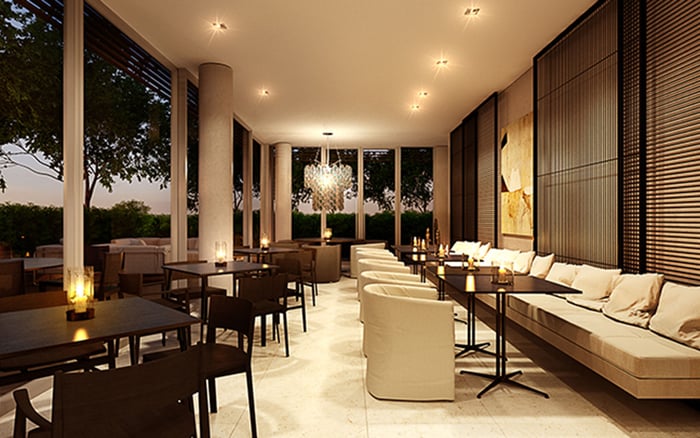
At Rivage Bal Harbour, acoustic privacy warrants its own ownership review. Buyers should distinguish finish specifications from measured sound isolation, evaluate airborne and impact noise separately, and establish access, documentation and contractual expectations before closing.

A residence can look exquisitely resolved while its acoustic performance remains unexamined. For buyers at Rivage Bal Harbour, that distinction deserves attention before finish selections and closing preparations dominate the conversation. Acoustic privacy is not a finish specification. It is a performance question involving the assemblies, connections and exposures surrounding a particular home.
The oceanfront development at 10245 Collins Avenue brings together Related Group, Rockpoint and Two Roads Development, with architecture by Skidmore, Owings & Merrill, interiors by Rottet Studio and landscape architecture by Enea Garden Design. Those credentials establish the design context. They do not establish how much sound passes through an installed wall or floor.
Neither verified quiet nor an acoustic defect should be inferred from the project's presentation. The buyer's task is more precise: identify the relevant sound paths, request meaningful evidence and determine what can be evaluated before ownership transfers.
Rivage's advertised residence features include private elevator entries, 10-foot ceilings, floor-to-ceiling glass and terraces up to 12 feet deep. Advertised specifications include Molteni&C kitchens, Sub-Zero and Wolf appliances, and Dornbracht fixtures. These details describe spatial character and product selection-not tested sound isolation.
The distinction matters because acoustic performance depends on concealed conditions. Gaps, penetrations, flanking paths and underlayment continuity can influence transmission even when visible surfaces appear impeccable. A finish inspection and an acoustic assessment answer different questions. Neither should substitute for the other.
For a buyer also considering Oceana Bal Harbour, the same discipline supports a fairer comparison: separate documented acoustic performance from impressions of craftsmanship. This is a due-diligence framework, not a claim that either property performs better or worse.
Begin by distinguishing airborne sound from impact noise. Voices and other airborne sound require a different evaluation from footsteps, dropped objects and furniture movement. A wall test cannot answer every question about the floor above, even when both concerns are casually described as soundproofing.
For a demising wall, ask an acoustic consultant whether ASTM E336 field testing is appropriate for the proposed investigation. For impact transmission from the floor above, ask about ASTM E1007. These are distinct testing protocols-not interchangeable labels or guarantees of a particular result.
The consultant should explain which classification each test produces and how the result relates to the buyer's concern. Do not accept a single rating as proof of comprehensive privacy. A useful assessment connects the noise source, the separating assembly, the test conditions and the receiving room.
This distinction also matters before corrective work. If the concern is impact transmission, a proposed wall treatment should not proceed without a diagnosis showing why it addresses that concern. Testing should guide the scope, rather than merely follow a product recommendation.
A useful document request begins with the acoustic consultant's scope and assembly-specific design targets. Ask which walls and floor assemblies those targets cover, whether the available results are laboratory or field measurements, and how the consultant interprets the difference.
Laboratory ratings and field classifications should be identified separately. The question is not simply whether a favorable number exists. It is whether the evidence addresses the installed conditions relevant to the home under consideration.
Request enough detail to understand that connection:
The locations and assemblies evaluated, including their relationship to the selected residence.
The flooring, underlayment and other relevant finishes present during testing.
The test protocol, resulting classification and intended design target.
The timing of testing and whether written results can be reviewed before closing.
Ask the consultant to explain the limits of any sample testing. A result from one location should not be assumed to resolve every adjoining condition throughout the building. Nor should an unanswered question be interpreted as evidence of deficient construction. It is a reason to clarify the scope of review.
The next step is unit-specific. Ask the consultant to review adjoining residences, amenity relationships, mechanical spaces and exterior exposure. These are categories for investigation, not documented Rivage noise problems.
For each relevant adjacency, ask what should be measured and why. A shared residential wall, a floor beneath another home and an exterior façade should not automatically be judged through a single STC/IIC checklist. Mechanical noise and façade exposure require criteria appropriate to those sources, selected and explained by the consultant.
Rivage's advertised glazing and terraces make exterior exposure a sensible part of that conversation, without establishing either a weakness or a particular isolation level. The same questions can accompany a Surfside search that includes Fendi Château Residences Surfside. Applying a consistent review brief across properties is more useful than assuming similar visual refinement produces equivalent acoustic conditions.
Buyers should also explain which rooms and activities matter most to them. This gives the consultant a practical basis for selecting test locations and interpreting results, keeping the review connected to the residence's intended use.
Before commissioning tests, establish what access can be arranged, which conditions will be ready for evaluation and when results could be available. Ask who would authorize access to adjoining spaces needed for the proposed work. Do not assume a purchaser can independently arrange every part of a field test.
Any proposed testing obligation, closing condition or remedy belongs in a conversation with the buyer's attorney. These provisions are matters to review and, where possible, negotiate-not existing Rivage contract terms. The technical brief and the legal agreement need to address the same expectations.
If testing identifies a concern, obtain a diagnostic scope before committing to corrective construction. Sound-isolation retrofits can involve invasive changes to walls or floor assemblies. A targeted investigation is therefore valuable before an owner authorizes work that could disturb otherwise satisfactory finishes.
The objective is not to demand an unsupported promise of silence. It is to understand what has been designed, what has been tested and how closely that evidence relates to the residence being purchased.
At Rivage, finish quality and acoustic privacy deserve parallel reviews. Keeping them separate allows the buyer to appreciate the architecture while making a more informed decision about everyday comfort, testing priorities and contractual expectations.
For a discreet perspective on South Florida ownership decisions, connect with MILLION.
If branded residences are on your mind — as a home or as an allocation — we would be glad to share what we are seeing, privately.
Begin a quiet conversationRivage Bal Harbour is an oceanfront condominium development at 10245 Collins Avenue, Bal Harbour, Florida 33154.
No. Product specifications and visible finish quality do not establish measured sound isolation through installed walls or floors.
No. The article recommends separate acoustic due diligence without asserting either an identified defect or verified acoustic performance.
Voices and other airborne sound differ from impacts such as footsteps and furniture movement. A demising-wall test does not replace a floor-impact evaluation.
Ask an acoustic consultant whether ASTM E336 field testing is appropriate for evaluating airborne sound transmission through the relevant demising wall.
ASTM E1007 addresses field impact-insulation testing. Ask the consultant how the proposed test would evaluate transmission from the floor above.
Request the consultant's scope, assembly-specific targets, laboratory and field results, tested locations and finishes, and the expected availability of written findings before closing.
Not automatically. Ask the consultant to select appropriate façade and mechanical-noise criteria rather than applying one STC/IIC checklist to every source.
No. Any proposed testing obligation, closing condition or remedy should be reviewed with the buyer's attorney rather than assumed to be an existing Rivage contract term.
Sound-isolation retrofits can require invasive changes to walls or floors. Diagnostic testing helps establish a corrective scope that addresses the relevant sound path.