A family-focused comparison of ORA by Casa Tua and The Residences at Mandarin Oriental, Miami, examining assessment estimates, service charges, caregiver permissions, and the practicalities of private-school travel.

For a family choosing a Miami residence, luxury is partly the absence of daily friction. A smooth caregiver arrival, a predictable school departure, and clearly priced household services can matter as much as the view. At ORA by Casa Tua Brickell and The Residences at Mandarin Oriental, Miami, the purchase question extends beyond the apartment: what will it cost, and how will it function on an ordinary school day?
ORA is planned at 1210 Brickell Avenue, with 76 stories, approximately 540 residences, and an estimated 2029 completion. Mandarin Oriental’s residential development is on Brickell Key, with a listed address of 750 Claughton Island Drive and an association with a new Mandarin Oriental hotel. The settings are distinct, but neither location nor branding establishes the better family fit.
The useful comparison is between two documented household plans, not two amenity brochures.
ORA’s advertised maintenance estimate is approximately $1.99 per square foot; Mandarin Oriental’s is approximately $2.25 per square foot. Neither is a verified final condominium assessment. Confirm the billing period, chargeable area, inclusions, and approved budget before calculating annual expenses or declaring one residence less expensive to operate.
A lower quoted rate does not settle the comparison if the homes differ in size or the assessments cover different services. Request a unit-specific expense schedule separating condominium charges, reserves, insurance allocations, utilities, property taxes, parking, and any hospitality or club fees. Identify items already included in the assessment to avoid double counting.
Advertised acquisition pricing also needs context. ORA has been marketed from $990,000 to $4 million, while Mandarin Oriental residences have been marketed primarily as two- to four-bedroom homes starting around $3.5 million. These figures do not confirm availability or contract prices. Current price sheets and the executed purchase agreement should establish pricing and deposits.
For families also considering The Residences at 1428 Brickell, apply the same expense worksheet rather than assuming nearby addresses carry comparable operating costs.
ORA’s advertised services include 24/7 concierge, valet, and housekeeping-related services. This is a marketed offering, not a promise that every use is included in maintenance. Ask for written rates and minimum charges for housekeeping, laundry, grocery stocking, in-residence dining, valet, and any rental-management services you intend to use.
At Mandarin Oriental, the association with a new hotel makes the boundary between residential privileges and hotel services especially important. Request written hotel-facility access terms, reservation requirements, guest policies, and charges. Do not equate the residential brand with unrestricted or complimentary hotel access.
Build the discretionary-service budget around your actual week: cleaning frequency, laundry needs, visiting relatives, and household vehicles. Ask each team to price that pattern rather than a generic service package. Where rates remain unsettled, retain a clearly identified allowance instead of presenting a precise annual total.
ORA’s marketed features include on-site professional management, concierge support for residents and guests, digital concierge services, and a dedicated flexible-stay check-in lobby. None establishes caregiver-specific access rights. A guest arrival process is not necessarily a recurring-worker credential, and a separate check-in lobby is not a verified nanny entrance.
For both properties, request the rules covering recurring caregivers, tutors, and household staff. Can an owner authorize scheduled entry? Are individual fobs available? What registration is required, and how are replacement staff approved? Clarify overnight-staff policies, service-entrance requirements, caregiver parking, and pickup staging before relying on a particular arrangement.
Review permissions alongside costs. Ask whether credentials, parking, or repeated valet use carry separate charges. Walk through a realistic handoff: a caregiver arrives as one parent leaves, a child needs to reach the vehicle, and another household member remains upstairs. The objective is not preferential treatment, but a secure routine with clear responsibilities.
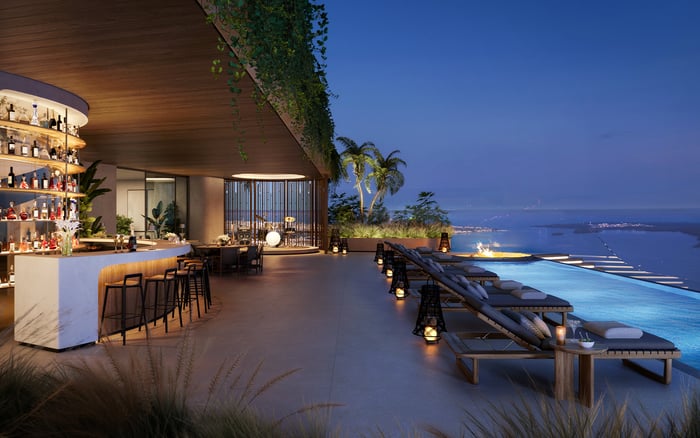
ORA’s advertised amenities include a rooftop pool, wellness spa, fitness center, sky garden, movement pavilion, private offices, and game lounge. Its four dining concepts include a 24-hour gourmet market, rooftop restaurant and lounge, open-fire dining concept, and two-story wine bar. For a family, the practical questions are age restrictions, reservations, caregiver accompaniment, and which spaces suit a weekday routine.
Mandarin Oriental’s advertised amenities include a dedicated kids’ club, private screening lounge, and indoor golf simulator. The kids’ club warrants particular attention, but its advertised presence does not establish supervised childcare. Confirm ages served, operating hours, staffing, booking procedures, fees, and whether a parent or caregiver must remain present.
Tour with a household schedule in hand. Consider where children might spend time after school and whether caregivers can accompany them. Separate anticipated convenience from confirmed services, especially when estimating childcare spending.
ORA’s mainland Brickell location and Mandarin Oriental’s Brickell Key setting create a meaningful routing distinction. For mainland schools, the latter adds an island-to-mainland connection. That alone does not establish which journey is faster, more reliable, or better suited to a particular family.
Test the actual route to each intended school around 7:00-8:00 a.m. and 2:30-4:30 p.m., adjusted to its schedule. Measure the complete departure, including elevator travel, vehicle retrieval, passenger loading, and the school’s drop-off queue. Repeat the exercise for afternoon collection and any regular extracurricular destination.
School-specific drive times, shuttle arrangements, bus-staging plans, and admissions outcomes are not established here. Ask schools directly about transportation and enrollment, and building teams about permitted pickup locations. For either development, distinguish a present-day route test from future building operations that still require written confirmation.
ORA’s marketed short-term, seasonal, and long-term rental flexibility adds another due-diligence question. One advertised policy specifies a three-day minimum, but condominium documents should govern the decision. Ask how flexible-stay arrivals are managed and how resident, visitor, and worker procedures interact. Rental flexibility alone proves neither disruption nor seamless separation.
Before committing, assemble three items: a unit-specific ownership budget, written household-access rules, and a tested school-transport plan. For ORA, resolve how flexible stays and service pricing intersect with daily family life. For Mandarin Oriental, resolve hotel privileges and the kids’ club’s operating terms. Neither project’s final annual ownership cost is established by the available estimates.
The stronger choice is the residence whose documented arrangements best support your household, with fewer assumptions between the sales presentation and a Tuesday morning.
For a discreet discussion of your family’s Miami property search, connect with MILLION.
If branded residences are on your mind — as a home or as an allocation — we would be glad to share what we are seeing, privately.
Begin a quiet conversationORA advertises approximately $1.99 per square foot, while Mandarin Oriental advertises approximately $2.25 per square foot. Neither is a verified final assessment; confirm the billing period, chargeable area, and inclusions before annualizing.
Not from the quoted maintenance rates alone. A meaningful comparison requires unit-specific assessments, taxes, insurance, utilities, parking, and any separate service or club charges.
ORA markets 24/7 concierge, valet, and housekeeping-related services, but their inclusion in assessments is not established. Request a written schedule distinguishing included services from separately charged use.
The residential development is associated with a new Mandarin Oriental hotel, but unrestricted or complimentary access is not established. Confirm facility privileges, reservations, guest policies, and service charges in writing.
ORA advertises a dedicated flexible-stay check-in lobby, not a verified caregiver-specific entrance. Ask separately about recurring-worker credentials, entry procedures, and service-entrance requirements.
Request written rules for recurring credentials, scheduled entry, replacement staff, overnight stays, parking, and child pickup. Ask whether fobs or parking arrangements involve separate charges.
That should not be assumed. The advertised kids’ club’s age limits, hours, supervision arrangements, and fees are not established here.
No school-specific comparison is established. ORA is on mainland Brickell, while Mandarin Oriental’s Brickell Key location adds an island-to-mainland connection for mainland school trips.
Test around 7:00–8:00 a.m. and 2:30–4:30 p.m., adjusted to the intended school’s schedule. Include vehicle retrieval, loading, and school queues rather than timing only the drive.
ORA markets short-term, seasonal, and long-term rental flexibility, with one advertised policy specifying a three-day minimum. The condominium documents should govern a purchase decision.