For a family office considering a move from Atherton to South Beach, pedestrian freedom and household efficiency are separate decisions. The strongest residential choice balances everyday walking with tested school routes, driver coverage, and precise airport ground logistics.
For a family office considering a move from Silicon Valley to South Beach, the most consequential amenity may be an unscheduled hour. Stepping outside without arranging a car is a compelling prospect. Yet a pleasant pedestrian neighborhood and an efficient household transport plan are not the same purchase.
The decision calls for two separate assessments: how freely the family can live near home, and how reliably it can reach destinations beyond that immediate radius. School gates, professional commitments, and aircraft departures belong to the second assessment. A residence should satisfy both, without allowing the appeal of one to obscure the demands of the other.
Atherton provides a useful Peninsula reference, not a proxy for every Silicon Valley neighborhood. This is a framework for evaluating a prospective move, not evidence of a broader family-office migration.
On a proprietary walkability scale, South Beach scores 80/100, or A−. Within that assessment, northern South Beach scores 90/100 and southern South Beach 61/100. The spread matters more than the headline: a neighborhood label cannot describe every front-door experience.
The flat street grid supports pedestrian exploration and local leisure. It does not establish that a household can dispense with cars. Begin with the destinations the family expects to use, then walk those routes from the residential entrance. Assess crossings, carrying purchases, accompanying children, and the return journey-not distance alone.
For a buyer evaluating Five Park Miami Beach, the useful exercise is a personal walking circuit, not an assumption that the South Beach average applies to the building. Apply the same discipline when viewing Apogee South Beach: test the doorstep against the household's routine before assigning value to pedestrian convenience.
These are address-testing exercises, not claims about either property's route times or services. The luxury is a routine that works without repeated coordination.
Atherton has separate walkability ratings of 50/100 and 40/100, alongside limited public transit. Those figures raise a useful question about car dependence, but they are not directly comparable with South Beach's proprietary walkability score. Subtracting them would imply a standardized comparison that does not exist.
Instead, compare tasks. Which ordinary outings currently require a driver or a personal vehicle? Which could realistically become walks from the proposed Miami Beach residence? Which would remain scheduled journeys regardless of the neighborhood's appeal?
When considering Setai Residences Miami Beach, make that distinction explicit in the purchase brief. Evaluate the residence alongside a written daily itinerary. Do not presume that a recognizable address delivers a particular transport outcome.
South Beach's alternatives include Citi Bike, the free Miami Beach trolley, rideshare, and an airport express bus. They broaden the choices; their existence alone does not resolve children's schedules, luggage movements, or overlapping appointments.
Treat school logistics as a constraint to test before committing to a residence. Start with the intended school and its actual arrival and dismissal requirements. Then evaluate the journey from each candidate home at the departure times the family would use.
A useful trial accounts for more than time in a moving vehicle. Include leaving the residence, boarding children, reaching the appropriate school entrance, completing drop-off, and continuing to the next commitment. Repeat the exercise for collection and any after-school destination. These are recommended planning steps, not established South Beach journey times.
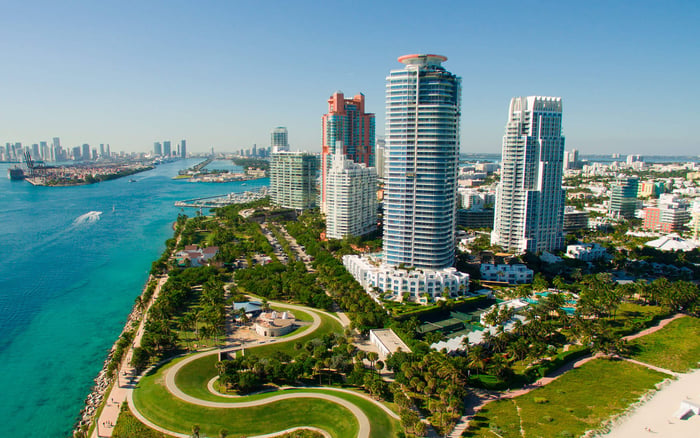
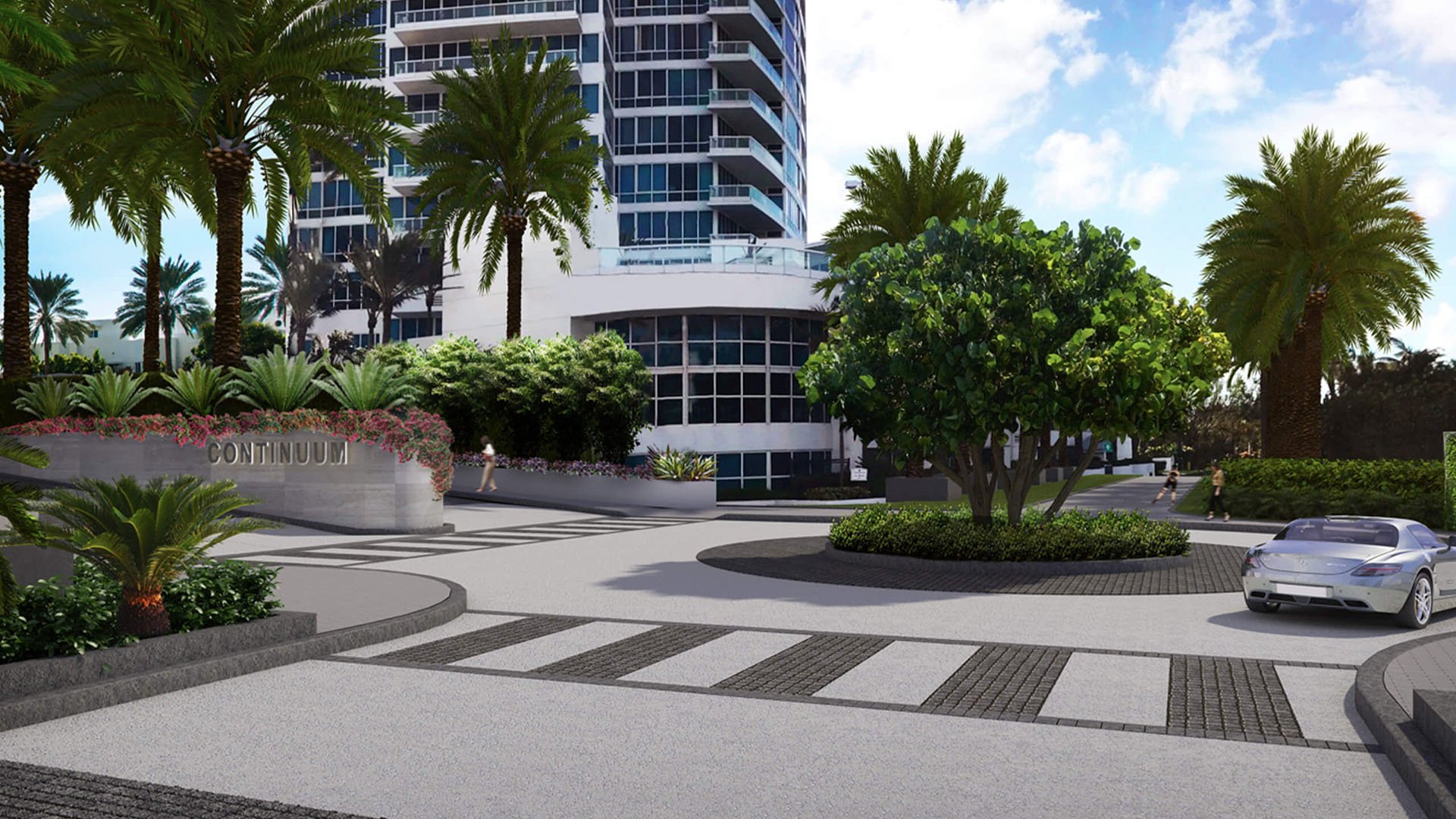
For a family considering Continuum on South Beach, the relevant comparison is the complete household schedule from that address. A pleasant local walk cannot establish whether one vehicle can cover two simultaneous commitments.
Driver dependence is not a binary question. A family might walk for discretionary outings while retaining planned coverage for school and aviation. Before changing staffing, document overlapping journeys, waiting periods, and backup arrangements. Budget against a tested weekly schedule, not the promise of a broadly walkable neighborhood.
For private aviation, the destination entered into the car's navigation system deserves scrutiny. Miami-Opa-locka Executive Airport, or OPF, has a general address at 14201 NW 42 Avenue, Opa-locka, FL 33054. An OPF fixed-base operator, or FBO, has a separate address at 15001 NW 42nd Avenue.
That distinction matters operationally. An airport pin is not necessarily the passenger's intended arrival point. Confirm the handling facility with the flight team and test the residential transfer to that specific entrance.
Keep three service windows separate. The FBO at 15001 NW 42nd Avenue has 24/7 availability. OPF's control-tower hours are 7 a.m.-11 p.m. local time. Customs service hours are 9 a.m.-midnight daily. None of these windows substitutes for the others, and customs hours should not be described as the airport's operating schedule.
For an acquisition decision, commission a door-to-FBO trial and separately confirm the passenger-to-aircraft arrangements. Do not turn a map estimate into a promised curb-to-aircraft duration. A faster overall journey must be demonstrated for the intended itinerary, not inferred from access to private aviation.
Commercial travel deserves its own route test. At Miami International Airport, taxi and ride-app pickup zones are on the arrivals or ground level outside baggage claim. Public transportation connects the airport's Metrorail station with Miami Beach, covering 41st Street to South Pointe Drive; MIA Mover links the terminal to that station.
Those options provide context, not a guaranteed household transfer time. Evaluate airport departures and arrivals separately, including the chosen pickup arrangement and the family's luggage requirements.
The Atherton comparison also requires restraint. Both San Francisco International and San José Mineta International are approximately 30 minutes away by car as a general area estimate. That is not an address-specific, peak-hour benchmark against which to promise a South Beach improvement.
The final residential shortlist should sit beside a tested weekly calendar. Walk the local circuit, rehearse school journeys, evaluate office or club trips, and confirm the exact airport facilities. Record departure times and repeat the journeys that matter most.
The most persuasive South Beach proposition is not necessarily a car-free life. It is the possibility of making local life more spontaneous while managing regional obligations deliberately. Treat that balance as a purchase criterion, with the same care given to privacy, layout, and the view.
Explore a residence that fits your family's daily rhythm with MILLION.
If branded residences are on your mind — as a home or as an allocation — we would be glad to share what we are seeing, privately.
Begin a quiet conversationSouth Beach supports pedestrian local living, but that does not establish car-free school, work, or airport logistics. Evaluate those journeys separately from neighborhood walks.
South Beach has a Walk Grade of 80/100, or A−, on one proprietary scale. It is a neighborhood assessment, not a guarantee for an individual residence.
The same assessment scores northern South Beach at 90/100 and southern South Beach at 61/100. Walk the intended routes from each candidate residence rather than relying on the overall grade.
No. Atherton's separate ratings of 50/100 and 40/100 are not standardized against South Beach's proprietary Walk Grade.
Test the exact home-to-school route at intended departure times, including drop-off, collection, and onward commitments. Use the complete schedule to assess vehicle and driver needs.
Options include Citi Bike, the free Miami Beach trolley, rideshare, and an airport express bus. Their suitability depends on the particular journey and household requirements.
OPF's general address is 14201 NW 42 Avenue, while an FBO is listed at 15001 NW 42nd Avenue. Confirm the handling facility so the transfer is planned to the intended passenger entrance.
No: the FBO at 15001 NW 42nd Avenue advertises 24/7 availability, while tower hours are 7 a.m.–11 p.m. local time. Published customs hours are 9 a.m.–midnight daily, a separate service window.
No fixed duration should be assumed. Test the route to the selected FBO at the intended departure time and confirm passenger-to-aircraft arrangements separately.
They are on the arrivals or ground level outside baggage claim. Commercial-airport transfers should be evaluated separately from private-aviation journeys.