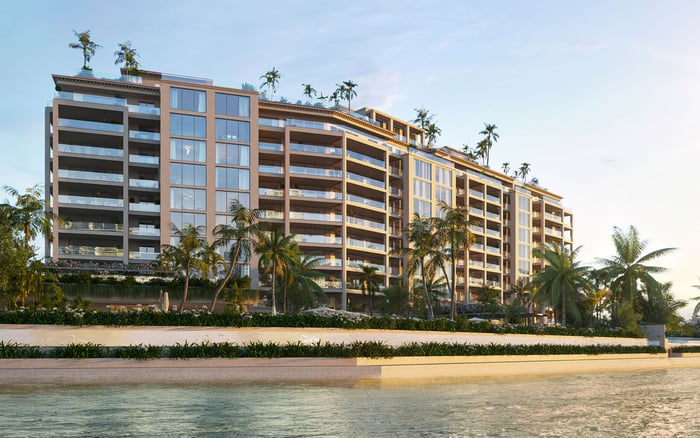
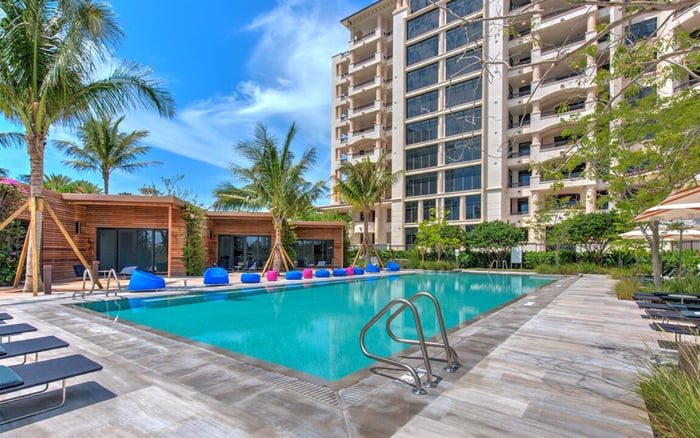
A practical owner review for Palazzo della Luna, connecting verified water-isolation scope, leak alerts, emergency access, and carefully defined mitigation contracts without assuming building-specific systems are in place.
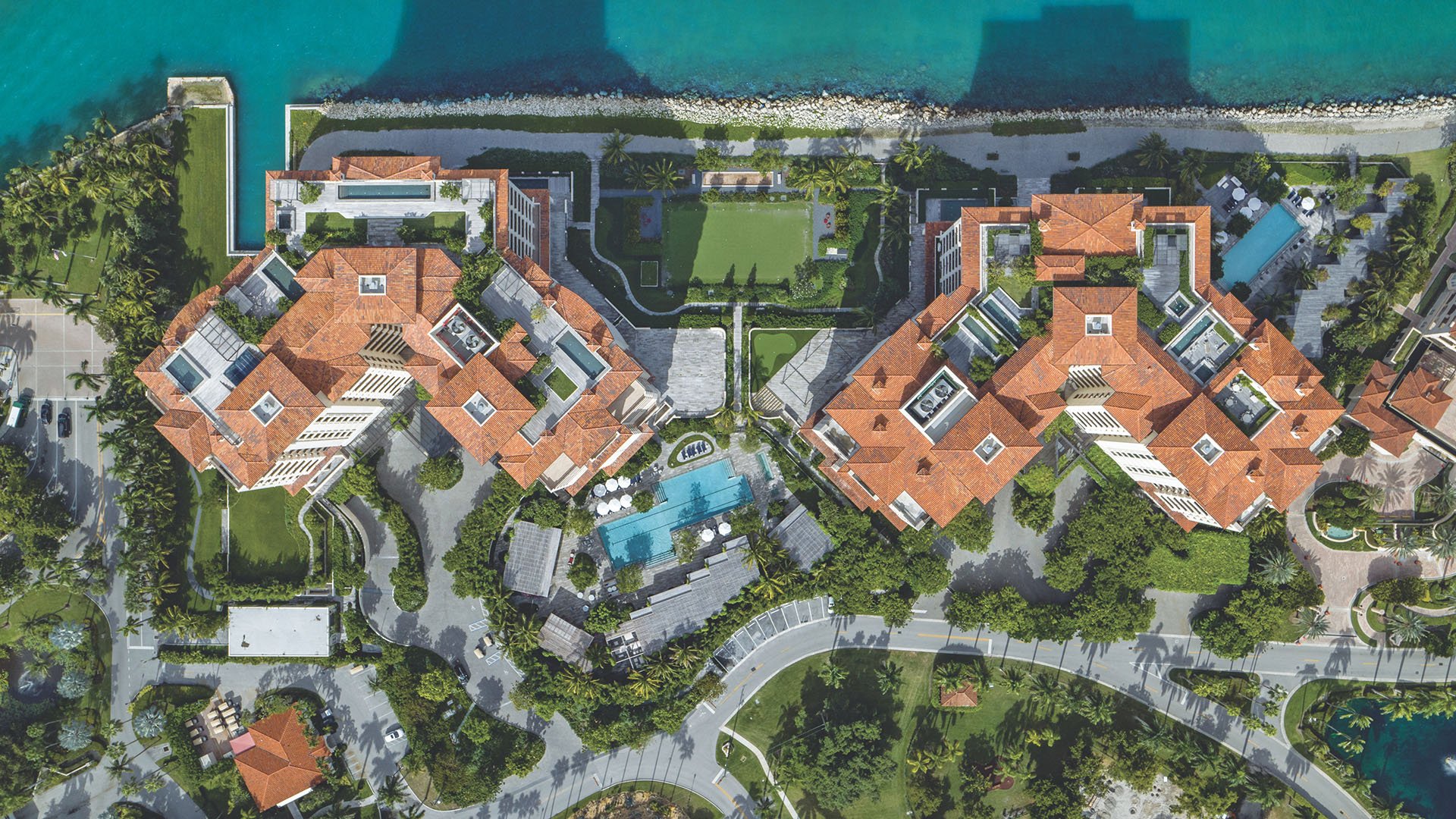
At Palazzo della Luna Fisher Island, the owner-operations question is not simply whether a leak sensor sends an alert. It is whether that alert leads to effective water isolation, authorized entry, and a clearly defined damage-response sequence when the owner is elsewhere.
The 50-residence condominium is located at 6800 Fisher Island Drive, Miami Beach, Florida 33109. Its amenities include a multilingual concierge and a waterfront lounge with butler-serviced bar facilities. Those services define the residential experience; they do not establish plumbing responsibilities or an emergency mitigation agreement.
The building’s plumbing layout, unit isolation-valve locations, installed leak-detection systems, and response contracts remain unverified in this review. Owners should treat it as a proposed diligence framework, not a description of equipment already installed. The objective is a documented chain from detection to action, with responsibility assigned at every step.
Before selecting hardware, request approved plumbing plans, a unit shutoff map, the declaration and maintenance matrix, alteration rules, and emergency-access procedures. Together, these documents should clarify what serves the residence, who maintains each component, and which changes require association approval.
Ask a Florida-licensed plumber or engineer to reconcile the drawings with actual conditions. The review should identify every water feed, accessible isolation points, and any uncertainty requiring further inspection. A valve map must be usable by an authorized responder, not just the person who prepared it.
An owner considering Palazzo del Sol Fisher Island should bring the same document-first questions to that residence’s review. Neither a shared location nor a similar ownership objective establishes equivalent infrastructure. The relevant evidence remains the plans, permissions, and operating procedures for the particular home.
Whole-unit protection should be a verified scope, not a product label. Trace every water feed serving the residence, including hot-water or recirculation connections where present. Ask the design professional to identify which feeds the proposed valve arrangement isolates and which remain outside its control.
The review must also confirm that closing a unit valve will not interrupt neighboring residences, common services, or fire protection. Any shared connection requires explicit treatment before installation. If complete isolation is not feasible within the proposed arrangement, the owner should receive a clear statement of the remaining exposure-not an unqualified promise of whole-unit coverage.
In the applicable Miami-Dade submeter arrangement, a shutoff valve is specified upstream of the submeter. That provision does not establish that Palazzo della Luna has, or must have, an automatic leak-triggered whole-unit shutoff system. Manual isolation, metering requirements, and automatic protective controls are separate questions.
Final design should be reviewed by a Florida-licensed plumber or engineer and receive the necessary association approval. This is a recommended technical review, not an established building specification or a declaration of code compliance.
Evaluate whole-unit flow monitoring alongside point sensors at selected wet areas. The proposed system should distinguish detection from action: what condition produces an alert, what condition triggers closure, and who receives each notification?
Request occupancy-specific thresholds for the designer’s consideration, particularly where the residence is used intermittently. Include an accessible manual override, and review backup power or communications rather than assuming either is present. The operating plan should state what happens when the owner cannot be reached or a communication path fails.
Owner and manager alerts should follow a defined escalation sequence. Specify who acknowledges the event, who can authorize entry, and who confirms the valve’s status. Hardware acceptance should include an observed test of detection, closure, and notification routing. Each function should be demonstrated, not merely listed on an equipment proposal.
A damage-response agreement should specify 24/7 dispatch and a written arrival target that accounts for Fisher Island access. Advertised round-the-clock South Florida service is not a contracted arrival commitment, nor does it establish a service agreement for this building.
Define the practical sequence: coordinate with building management, obtain authorized entry, locate and stop the water source where safely possible, assess electrical hazards, and protect vulnerable belongings. Qualified personnel should address electrical risks; owners should not enter an unsafe area to retrieve possessions.
Mitigation scope should expressly include containment, extraction, and drying. Require moisture records, photographs, and a communication schedule so the owner can follow progress without being on site. Moisture meters assess moisture in building materials; infrared cameras can reveal thermal anomalies that may indicate hidden leaks. Neither substitutes for investigating the water source.
The contract should name the responsible payer, define emergency spending authority, and establish approval thresholds. It should also state who may authorize work when the owner is unavailable. Resolve these provisions before a loss, when decisions can be made without immediate pressure.
Insurance billing and claims assistance are payment and administrative arrangements, not substitutes for service authorization. An offer of direct billing is not a guarantee of coverage or payment. Keep the work scope and payment terms distinct, and clarify the owner’s obligations under the proposed agreement.
Verify contractor credentials, insurance, and any claimed certifications. Require separate written authorization for reconstruction so emergency stabilization does not become an open-ended renovation commitment. The owner should understand where mitigation ends, which decisions require further consent, and how documentation will be shared with management and the insurer.
For an absent owner, establish entry permissions in advance and maintain an emergency contact card listing approved contacts and the escalation order. Confirm that those expected to respond have the authority and access to act.
The same diligence framework is useful when evaluating The Residences at Six Fisher Island. It belongs in that property’s review; it is not an assertion about its systems or service contracts.
Periodically test valves, sensors, communications, and alert routing under the approved operating plan. Mold colonization can begin within 24-48 hours, reinforcing the need for prompt extraction and drying rather than delayed inspection alone. That interval is not a guaranteed safe waiting period.
The desired outcome is straightforward: a verified isolation scope, actionable notifications, authorized access, and a response contract with clear deliverables and financial boundaries. For Palazzo della Luna owners, that operational clarity is the meaningful complement to the residential experience.
For a discreet perspective on South Florida ownership and residential selection, explore MILLION.
If branded residences are on your mind — as a home or as an allocation — we would be glad to share what we are seeing, privately.
Begin a quiet conversationPalazzo della Luna is located at 6800 Fisher Island Drive, Miami Beach, Florida 33109, on Fisher Island.
Palazzo della Luna is described as a 50-residence luxury condominium.
The property descriptions do not establish an installed whole-unit automatic leak-triggered shutoff system. Owners should verify equipment and scope through building documents and a professional review.
Request approved plumbing plans, a unit shutoff map, the declaration and maintenance matrix, alteration rules, and emergency-access procedures.
The proposed review should trace every water feed serving the residence, including hot-water or recirculation connections where present. It should confirm that closure will not affect neighboring units, common services, or fire protection.
The applicable submeter provision specifies an upstream shutoff valve. It does not establish a Palazzo della Luna requirement for whole-unit automatic leak-triggered closure.
Consider flow monitoring, point sensors, occupancy-specific thresholds, manual override, backup power or communications, and owner and manager alerts. These are proposed review items, not verified building features.
Specify 24/7 dispatch, a written arrival target accounting for Fisher Island access, source control, extraction, drying, photographs, moisture records, and management coordination.
Direct billing should not be treated as a guarantee of coverage or payment. The agreement should separately define service authorization, payment responsibilities, spending limits, and reconstruction approval.
Mold colonization can begin within 24–48 hours. That possibility supports prompt mitigation rather than delayed inspection alone, without establishing a safe waiting period.