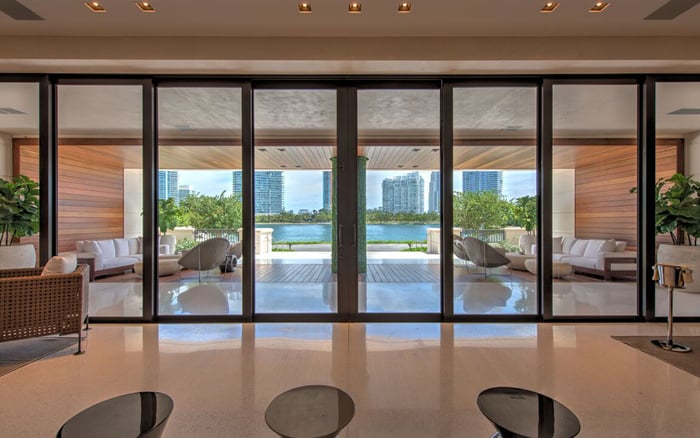
Fisher Island’s controlled entry is only the beginning of arrival privacy. Before closing, buyers should verify the full route from ferry or dock to residence, including parking rights, elevator access, and service-traffic crossings.

On Fisher Island, the approach to a residence begins before the building comes into view. Access is by private ferry or yacht rather than a conventional public road, creating a distinctive threshold between mainland life and island living. Yet controlled entry and private circulation are different propositions. Confidence in island access controls does not settle the question of who shares the final journey home.
Closing readiness therefore requires a continuous assessment: terminal or dock, island roadway, curb or valet, garage, elevator, and residence. The decisive question is not simply whether each stage is secured, but whether the transitions preserve the discretion the buyer expects-under ordinary operating conditions and during guest visits, deliveries, and move-in.
The ferry departs from Terminal Island Road, just off Miami Beach’s MacArthur Causeway. Guests require pre-arranged security clearance before boarding, placing the first arrival checkpoint on the mainland. Transportation operations run 24 hours a day, every day of the year, but continuous operation does not guarantee an individual departure or transfer time.
Before closing, request a written explanation of access procedures for owners, family members, guests, employees, and vendors. Establish who authorizes clearance, how changes are communicated, and what happens when a guest arrives without the expected authorization. For a household with frequent visitors, these details belong in the arrival assessment, not on a list deferred until occupancy.
Vehicle eligibility also deserves attention. Ferry limits accommodate private passenger vehicles less than 24 feet long and 8 feet wide. Members’ vehicle-and-trailer combinations have a separate limit of under 40 feet long and 8 feet wide. Designated commercial vehicles may use the ferry subject to applicable restrictions. Confirm the intended vehicle or moving arrangement against current requirements before scheduling it.
Once on the island, privacy becomes building-specific. Follow the actual owner route from the island roadway through the arrival area, rather than only the most polished entrance used for a showing. Observe where occupants leave their vehicles, where luggage is handled, and whether waiting or handoff areas overlap with other residents or service activity.
At Palazzo del Sol Fisher Island, amenity descriptions include valet service with optional self-parking, plus garage or underground parking for vehicles and golf carts. These are useful starting points, but they do not establish a particular residence’s parking assignment, elevator connection, or current operating rights.
Request confirmation of assigned spaces, self-parking permissions, golf-cart arrangements, and the path from each space to the residence. Clarify whether valet personnel, contractors, or delivery staff use any part of that route. A convenient garage can still involve shared circulation. Understand that distinction before treating parking as a privacy feature.
Private elevator entry is an appealing description, but the phrase leaves important questions unanswered. Does access depend on a credential? Who can authorize a visitor’s destination? Is the arrival vestibule shared? Is there a direct garage connection, and can service personnel use the same elevator or landing?
The amenities described for The Residences at Six Fisher Island include private elevator entry to each residence, alongside 24-hour security and valet service. Buyers should verify the current or proposed arrangements with the association or developer and distinguish amenity descriptions from documented access controls.
Request plans and an operational explanation together. A drawing may show where an elevator opens without explaining who can operate it; an access policy may describe authorization without revealing a shared vestibule. Where features are proposed rather than available for inspection, clarify what is documented and what remains to be confirmed. Neither security staffing nor valet service independently establishes an exclusive route home.
Dock arrival warrants its own review, not an assumption that it bypasses the ferry sequence. There are both guest and resident marinas, and island marinas are monitored access points. Their existence does not establish berth availability, suitability for a particular vessel, or a private transfer to any residence.
Confirm berth availability and applicable vessel limits before tying a purchase decision to yacht access. Ask how passengers are cleared, where guests disembark, how provisioning is handled, and how luggage moves from the dock to the residence. Then follow the onward route, including any vehicle or golf-cart transfer and the eventual building entrance.
Assess the complete sequence for the household’s intended use: an owner returning alone, guests arriving together, or passengers accompanied by provisions. Identify where people and goods change hands and whether those transitions meet the buyer’s expectations for discretion.
Residents, guests, employees, and vendors are verified for island access. Monitored access points include mainland terminals, the employee parking garage, ferry terminals, and island marinas. These controls establish an access framework; they do not prove that service traffic is physically separated from residential circulation.
Obtain building plans and operating rules that identify loading areas, service elevators, delivery routes, and any crossings through residential lobbies. Ask how movers, maintenance personnel, and household deliveries reach the residence. Where routes intersect, clarify whether separation depends on physical design, scheduling, staff supervision, or a combination of those measures.
For a buyer considering Palazzo della Luna Fisher Island, make the same inquiry at both the residence and building level. Do not transfer assumptions about another property’s garage, elevator, or service arrangements to the home under consideration. The purpose is to identify actual shared points, not to presume that every shared corridor is a defect.
Consolidate the findings into one written owner-arrival sequence. It should cover ferry and dock approaches where relevant, the island roadway, curb or valet handoff, parking, elevator access, and the final residence threshold. Record which arrangements are documented, which have been demonstrated, and which require confirmation before closing.
A useful review combines current plans, applicable operating rules, and a walkthrough of accessible routes. Ask the association or developer to clarify unresolved questions in writing, particularly where parking rights, credential permissions, or service access affect the intended ownership experience. This is a buyer-specific diligence framework, not a standardized island-wide closing requirement.
The strongest conclusion is not that an address promises absolute privacy. It is that the buyer understands each transition, accepts any shared circulation, and has verified the arrangements that matter most. On Fisher Island, discretion is best evaluated along the entire journey home.
For a discreet perspective on Fisher Island ownership and residence selection, connect with MILLION.
If branded residences are on your mind — as a home or as an allocation — we would be glad to share what we are seeing, privately.
Begin a quiet conversationNo. Island access controls do not establish an exclusive route through a building’s curb, garage, elevators, or service corridors.
The ferry departs from Terminal Island Road, just off Miami Beach’s MacArthur Causeway. Guests require pre-arranged security clearance before boarding.
Transportation operations run 24 hours a day, every day of the year. That does not establish a guaranteed individual departure or transfer time.
Published ferry limits accommodate private passenger vehicles less than 24 feet long and 8 feet wide. Confirm the intended vehicle against current requirements before arranging transport.
Advertised amenities include valet with optional self-parking and garage or underground parking for vehicles and golf carts. Buyers should confirm residence-specific assignments, rights, and connections.
Confirm credential controls, authorized users, any shared vestibule, and the connection to the garage. Private elevator marketing language alone does not establish exclusive use.
Private elevator entry to each residence, 24-hour security, and valet service are advertised. Verify current or proposed arrangements with the association or developer.
Confirm berth availability, vessel limits, passenger clearance, and provisioning procedures. Evaluate the complete transfer from marina to residence.
No. Controlled vendor entry does not establish physical separation from resident circulation; plans and operating rules should identify shared routes and crossings.
Request a sequence covering terminal or dock, island roadway, garage or valet, elevator, and residence. Support it with relevant parking rights, access rules, and service-route information.