A buyer-oriented review of directory privacy, intercom display names, access-control questions, and accurate public-facing records for the planned Mandarin Oriental Residences, West Palm Beach.
For a discerning owner, privacy extends beyond a private arrival or an elevator opening near the front door. It also rests in quieter operational details: the name visible on an entry panel, the information available to a delivery vendor, and the distinction between a building description and an ownership record. At Mandarin Oriental Residences, West Palm Beach, these questions belong alongside architecture and service in a considered purchase review.
The planned collection comprises 87 residences at 5400 N. Flagler Drive along the Intracoastal Waterway. Its announced program includes a 31-story tower, two- to four-bedroom homes, two multi-level private villas, and a full-floor penthouse. The property remains upcoming, not a completed residential address. That distinction matters when evaluating operating arrangements that have not yet been publicly established.
The central buyer takeaway is straightforward: physical privacy features and information privacy policies are distinct promises. Each requires its own written confirmation.
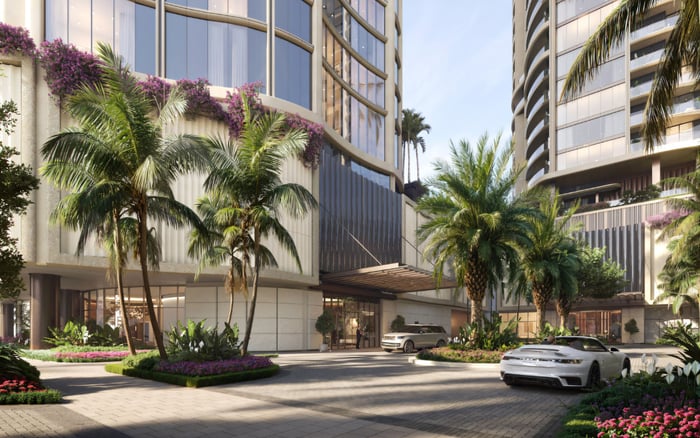
Private elevator access, wraparound terraces, a private porte-cochère, and concierge services form part of the planned residential experience. Those features address arrival, circulation, and domestic seclusion. They do not establish whether a visitor can browse resident names, whether an occupant can decline a directory listing, or whether an application exposes unit associations.
No resident directory, intercom directory, unit-owner roster, or approved resident-name display policy has been publicly established. Nor has an opt-out right for lobby, gatehouse, package-room, parking, or digital directories. This remains an unresolved operational question, not evidence that privacy protections will be absent.
A branded identity should frame expectations, not substitute for documentation. Buyers also considering Mr. C Residences West Palm Beach can apply the same questions independently. One property's directory arrangements should not be inferred from another property's branding or service concept.
The intercom's display convention deserves a precise answer. It has not been publicly established whether the system will use legal names, preferred names, initials, aliases, or unit numbers. Before closing, ask whether participation is mandatory, opt-in, or opt-out, and whether a chosen display name can change independently of legal title records.
A useful standard to request is unit-number-based calling by default, with resident-selected names displayed only after affirmative consent. This is a proposed buyer preference, not an announced project policy. Assess it against the final system's capabilities and adopted rules rather than treating it as an existing entitlement.
Request a practical demonstration of the proposed experience: what a visitor sees, how a call reaches the resident, and what happens when the resident does not answer. Ask who may authorize a name change, whether occupants and owners are treated differently, and how a request to withdraw consent would be implemented across connected systems.
For a household seeking discretion, the issue is not merely the label on the first screen. It is whether that choice remains consistent wherever directory information is used.
A directory review should follow information beyond the entrance. Ask whether resident details would appear on entry panels, resident applications, concierge consoles, security workstations, parcel platforms, or vendor portals. These are potential access points to clarify, not confirmed systems at this development.
For each proposed interface, request the visible fields, the users permitted to access them, and the purpose of that access. A staff member handling an arrival may need different information from a vendor making a delivery. The policy should explain those distinctions rather than rely on a general assurance of confidentiality.
Emergency contacts and occupant information should be addressed separately from public-facing directory entries. Request written rules for vendor access, retention, deletion, and restrictions on solicitation. Ask how inaccurate information is corrected and who oversees that process.
The same review can inform a purchase comparison involving Alba West Palm Beach. Compare documented privacy arrangements rather than assume that a waterfront setting establishes an operational standard.
Private elevator access does not identify the credentials that will operate it. Biometric, mobile, key-fob, and destination-dispatch credentials have not been publicly verified. The intercom manufacturer, directory software, access-control integrator, retention period, and remote-unlock workflow also remain undisclosed.
Request final technology and security specifications, then distinguish equipment capability from the rules governing its use. A system may offer a feature without establishing who can activate it, what information it records, or how long that information remains available.
Remote unlocking merits particular attention. Ask which roles would be permitted to release an entrance, how authorization would be checked, and whether the proposed workflow creates a record. Request the procedures for lost credentials, household changes, and vendor access. These are diligence questions, not descriptions of confirmed project functionality.
A new-construction purchase review should distinguish final specifications from those still subject to change and identify where the governing commitments are documented.
Public-facing building descriptions should identify the property as planned or upcoming and use 5400 N. Flagler Drive as the planned residence address. The sales lounge is a separate location at 205 Worth Avenue, Suite 321, Palm Beach. Combining these addresses can obscure the distinction between visiting the sales team and identifying the future residential property.
Entity names also require precision. Great Gulf is the project developer, while 5400 N Flagler Limited Partnership is the developer entity offering the real property for sale. Neither identification establishes the identity of an individual residence owner or occupant.
Do not treat a building profile, directory entry, title record, and occupancy record as interchangeable. Ask counsel to distinguish what may become publicly accessible through ownership documentation from what the building would display operationally. A directory preference should not be presented as a promise of anonymity in every other record.
Before closing, request the declaration, bylaws, rules, association disclosures, purchase contract, and final technology and security specifications. Ask where directory consent, display-name changes, access permissions, and retention obligations would be documented, and which party would administer each policy.
Buyers weighing Forté on Flagler West Palm Beach alongside this project can use the same document-led approach without assuming equivalent systems. The strongest comparison separates announced features, confirmed operating commitments, and questions still awaiting written answers.
For Mandarin Oriental Residences, West Palm Beach, the objective is to align the planned private residential experience with explicit information-handling rules. Architectural discretion is valuable; operational discretion must be defined.
For a considered approach to South Florida residential ownership, explore MILLION.
If branded residences are on your mind — as a home or as an allocation — we would be glad to share what we are seeing, privately.
Begin a quiet conversationThe property is planned and identified as upcoming, rather than completed. Operating specifications should be confirmed through formal developer documents.
The planned collection comprises 87 residences in a 31-story development. The announced program includes two- to four-bedroom homes, two multi-level private villas, and a full-floor penthouse.
The planned residences are at 5400 N. Flagler Drive in West Palm Beach, along the Intracoastal Waterway.
No, the sales lounge is at 205 Worth Avenue, Suite 321, Palm Beach, separate from the planned West Palm Beach residence address.
An approved resident-name display policy or resident directory has not been publicly established. This does not mean a policy will not exist.
It has not been publicly established whether the intercom will display legal names, preferred names, initials, aliases, or unit numbers. Buyers should request written confirmation.
An opt-out right has not been publicly established. Ask whether participation will be mandatory, opt-in, or opt-out across each proposed directory interface.
No, planned private elevator access does not confirm biometric, mobile, key-fob, or destination-dispatch credentials. Those specifications have not been publicly verified.
The recommended approach is unit-number-based calling by default, with resident-selected names displayed only after affirmative consent. This is a buyer preference, not an announced project policy.
Request the declaration, bylaws, rules, association disclosures, purchase contract, and final technology and security specifications. Seek written clarification of directory consent, access permissions, and retention practices.