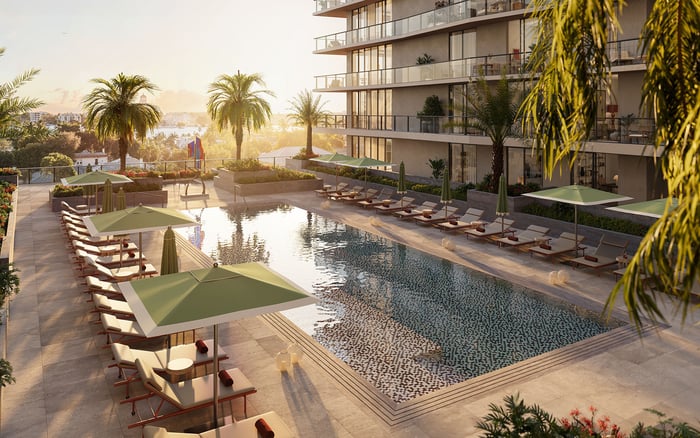
For seasonal owners at Mandarin Oriental Residences, West Palm Beach, announced valet, parking and EV infrastructure are a starting point. The essential due diligence concerns extended parking permission, battery-care responsibilities and documented key custody.

For a seasonal owner, the most consequential service conversation may concern departure rather than arrival. A car left behind needs a clearly defined parking arrangement, an approved battery-care plan if required, and an unambiguous chain of responsibility for its keys. These details deserve attention before a residence becomes part of an annual migration.
At Mandarin Oriental Residences, West Palm Beach, the announced address is 5400 N Flagler Drive along the Intracoastal Waterway. Plans call for 87 residences in a 31-story tower, with two- to four-bedroom homes, two multilevel villas and a full-floor penthouse. The proposed arrival experience includes a grand porte-cochère and 24-hour valet.
That is the welcome. What happens to an owner's vehicle during an extended absence is a separate question. Parking access is not a vehicle-care agreement. The distinction matters whether the car is an everyday sedan, an electric vehicle or a seldom-driven collector's automobile.
The project is planned as a standalone branded residence without hotel rooms. Advertised services include 24-hour concierge, dedicated 24-hour security and a Mandarin Oriental Residence Service Team. The planned team includes a Director of Residences, Lifestyle Agent and Food & Beverage Manager.
Those provisions describe the intended service setting, not a confirmed seasonal vehicle-care program. Neither a concierge desk nor continuous security establishes who may hold keys, connect equipment or authorize a third-party driver. Buyers should ask which role would oversee each requested task and whether building personnel or an independently contracted provider would perform it.
Keep three categories separate: announced amenities, permissions governing the property, and services specifically agreed for an owner's absence. Permission to leave a vehicle is not a commitment to inspect it. A commitment to coordinate a vendor does not necessarily confer responsibility for that vendor's work.
Allocated self-parking is advertised alongside valet, but the available project details do not establish the number of spaces assigned to each residence. Nor do they confirm permission for months-long unattended parking. Private storage lockers are advertised for each residence; they should not be interpreted as separate vehicle-storage rooms.
Request written answers tied to the residence under consideration:
Which spaces are allocated, and can their assignment change?
How many vehicles may remain during an extended absence?
Are there duration limits, notice requirements or additional charges?
Under what circumstances may staff relocate a vehicle?
Must keys remain on site, and who controls emergency access?
Ask for the governing parking provisions, not simply a description of the arrival experience. If a vehicle has particular clearance or handling requirements, submit them for written acceptance rather than assuming valet can accommodate them.
Buyers also considering Alba West Palm Beach should use the same residence-specific questionnaire. The purpose is to compare documented permissions, not infer equivalent storage arrangements from amenity language.
EV charging infrastructure is advertised, but the available details do not specify charger counts, power ratings or dedicated-versus-shared arrangements. More importantly for seasonal ownership, infrastructure alone does not establish scheduled charging, battery monitoring or trickle-charger service.
Separate two requests: leaving an EV connected or having staff connect it periodically, and using a 12-volt battery maintainer. Neither permission should be presumed from a general reference to EV charging.
For each vehicle, obtain manufacturer guidance and ask management to confirm whether the proposed arrangement is permitted. The written response should address equipment approval, the permitted connection location, who connects and disconnects it, electricity charges and any time limits. If monitoring is requested, define what is checked, how often and who receives an exception notice.
Establish what happens if power is interrupted or the vehicle displays a warning. Do not assume staff will diagnose a fault or drive the car. If those responsibilities fall outside the service scope, arrange an authorized alternative and document how that person gains access.
Dedicated 24-hour security is an announced amenity, but it does not establish vehicle-key or residence-key custody procedures. Buyers should request the proposed protocol for secure storage, release authorization, access records and incident notification.
A useful agreement identifies each key or credential, its permitted uses and the people authorized to receive it. Ask whether vehicle and residence keys are handled separately, whether releases and returns are logged, and how access is revoked when a household employee or vendor changes.
Driver authorization requires particular precision. Distinguish permission to move a car within the property from permission to take it onto public roads. Vendor handoffs should identify the recipient, approved purpose, expected return and procedure for deviations.
Ask who must be contacted if keys are lost, a vehicle is damaged or a handoff cannot be completed. Review insurance and liability provisions with appropriate advisers, including responsibility during any transfer between building staff and an outside provider. A courteous assurance is no substitute for knowing where responsibility begins and ends.
Two private house cars are advertised for residents, but booking rules, service radius and charges are not established. Do not treat them as a guaranteed fallback while a personal vehicle is unavailable.
Likewise, do not assume detailing, tire checks, vehicle exercise, off-site storage referrals or seasonal arrival preparation are included. Each requested service needs project-specific confirmation, a defined scope and an identified payer.
When evaluating Mr. C Residences West Palm Beach alongside this project, carry over those questions rather than presumed answers. Compare the documented support for your routine, including any exclusions.
These amenities describe an announced development, not verified operating services. Unspecified procedures are matters to resolve-not evidence that the requested support will be unavailable.
Before relying on a seasonal arrangement, request the applicable parking rules, charging permissions, key-custody protocol, service scope, fee schedule and liability terms. Ask which provisions are proposed, which are binding and which may change. Have counsel review commitments that materially influence the purchase decision.
Finally, make departure and return instructions explicit: authorized contacts, access permissions, escalation steps and any agreed arrival preparation. The goal is not an elaborate checklist for its own sake. It is a residence that supports absence with the same clarity expected at arrival.
For a discreet discussion of South Florida residences and the details that shape seasonal ownership, connect with MILLION.
If branded residences are on your mind — as a home or as an allocation — we would be glad to share what we are seeing, privately.
Begin a quiet conversationThe project is planned at 5400 N Flagler Drive, West Palm Beach, FL 33407, along the Intracoastal Waterway.
It is planned as a standalone branded residence without hotel rooms. The announced development includes 87 residences in a 31-story tower.
The advertised 24-hour valet does not establish a separate seasonal vehicle-care program. Buyers should obtain written permission for extended unattended parking.
Allocated self-parking is advertised, but the number of spaces per residence is not established in the available project details. Request the allocation for the specific residence.
No separate vehicle-storage rooms are established by the advertised provision. The stated amenity is private storage lockers for each residence.
No. The advertised infrastructure does not establish scheduled charging, battery monitoring or trickle-charger service during an owner's absence.
That permission is not established in the available project details. Confirm equipment approval, connection location, staff responsibilities and electricity charges in writing.
The advertised security and service team do not establish specific key-custody procedures. Request secure-storage rules, access logs, release authorizations and liability terms.
Two private house cars are advertised, but booking rules, service radius and charges are not established. Their availability should not be assumed for a particular journey.
Request applicable parking rules, charging permissions, key-custody procedures, service scope, fees and liability terms. Clarify which provisions are proposed, binding or subject to change.