A buyer-focused examination of advertised privacy features at 888 Brickell and Casa Bella, with practical guidance on lockout layouts, elevator access, sound separation, and unit-specific mechanical adjacency.
The most persuasive expression of residential luxury is often what goes unnoticed: another household's arrival, a service delivery, or activity beyond a bedroom wall. At 888 Brickell and Casa Bella, privacy belongs in the purchase conversation alongside interiors and views. But private access, sound isolation, and operational separation are distinct promises. Each requires its own evidence.
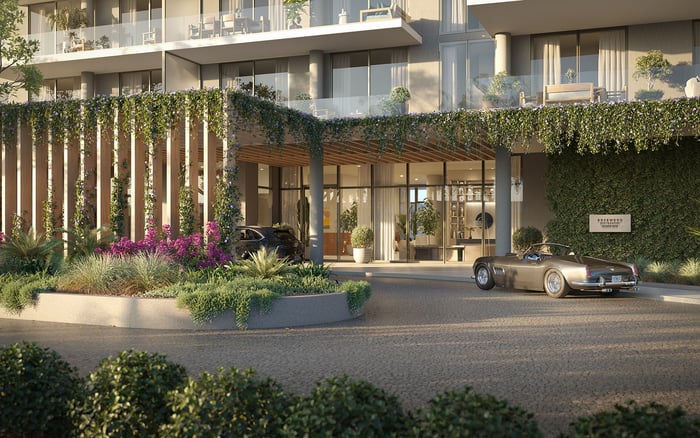
That distinction matters when comparing 888 Brickell by Dolce & Gabbana with Casa Bella by B&B Italia Downtown Miami. Both advertise controlled residential arrivals. At 888 Brickell, the hybrid residence-and-hotel configuration raises another question: how owner spaces remain separate when portions of a residence serve as guest accommodation.
The available specifications support a comparison of advertised privacy features, not a verdict on which building is quieter. A discreet entrance has value, but it is not evidence of acoustic performance.
888 Brickell advertises “state-of-the-art sound-proofing,” private entrances, and private or semi-private keyed elevators. These features establish privacy as a design intention. Neither individually nor collectively do they quantify sound isolation in a particular residence.
The hybrid layouts warrant closer scrutiny. A lockout function operates between two principal entry points, allowing residences to transition into individual hotel rooms and suites with private entries. Secondary bedrooms can operate as hotel rooms while the principal bedroom, great room, and loggia remain a separate residence or suite. Simultaneous owner and hotel-guest use is marketed as preserving privacy; that remains an operating intention, not acoustic test evidence.
For a purchaser considering this flexibility, the critical review concerns the boundary between those uses. Request the proposed lockout-door ratings, seals, hardware, and separating-wall details, along with a diagram showing each entry in every intended configuration. Ask how access permissions and service visits would work while an owner occupies the retained residence.
Numerical STC or IIC ratings, detailed separating-wall assemblies, slab thicknesses, and lockout-door acoustic specifications have not been identified in the available details. Ceiling heights reaching up to 11 feet are a spatial attribute, not proof of sound separation. Neither point establishes a defect; both clarify what still needs documentation.
At 1444 Biscayne Boulevard in Downtown Miami's Arts District area, Casa Bella is planned with 306 residences. Advertised arrival features include two private elevators and a private vestibule, as well as biometric access control. Buyers should confirm how those features apply to their selected layout rather than assume a uniform arrangement throughout the building.
The practical question is what “private” means for that residence. Determine whether elevator service is dedicated to one home or shared among several, who can authorize access, and how visitors and service personnel reach the vestibule. Biometric access is an access-security feature, not an acoustic specification.
Casa Bella's amenity program includes a 78-foot rooftop pool and deck, cabanas, landscaped gardens, a poolside bar, and a Mediterranean café. When selecting a residence, review these offerings alongside the location of pool pumps, rooftop equipment, and amenity service routes relative to sleeping areas. Their presence alone does not establish disturbance.
Project-wide STC, IIC, NC, or dBA criteria have not been identified in the available details, nor has a verified schedule locating residences relative to mechanical rooms, elevator equipment, refuse rooms, or amenity service spaces. Floor-to-ceiling glass and Biscayne Bay views describe the visual experience; façade acoustic specifications require a separate inquiry.
Begin with the exact residence, not a representative floor plan. Request unit-specific architectural and reflected ceiling plans, with adjoining spaces identified beside, above, and below the home. For 888 Brickell, bedroom proximity to shafts, service rooms, and hotel back-of-house areas remains unverified. Casa Bella requires the same unit-specific clarification for its relevant service and mechanical spaces.
A useful review should locate bedroom walls, elevator equipment, mechanical rooms, refuse areas, and service circulation on a coordinated drawing. At Casa Bella, include the rooftop amenity infrastructure. At 888 Brickell, include the separate-entry and lockout configurations. The objective is to replace assumptions about a desirable floor or exposure with a documented understanding of the selected home.
If the Brickell search also includes The Residences at 1428 Brickell, carry the same document requests into that evaluation. A consistent diligence standard is more useful than treating branding or an address as a substitute for unit-level evidence.
For both projects, request wall and floor acoustic specifications, façade ratings, mechanical-noise criteria, and available field-test results. Ask the design team to distinguish criteria that apply to the selected residence from broader design targets. Where testing is available, establish the assembly or location tested and its relevance to the proposed purchase.
At 888 Brickell, make the owner-to-hotel boundary an explicit part of that request. At Casa Bella, ask how the selected residence relates to amenity equipment and elevator systems. In both cases, keep the answers tied to drawings and specifications, not general assurances about luxury construction.
A specification not identified in the available details may still exist in technical documentation. The appropriate response is a focused request-not a conclusion that the building lacks acoustic planning or that an unexamined residence will be noisy.
Privacy also requires an operating framework. Request the applicable occupancy rules, delivery procedures, service-access arrangements, and amenity hours. For 888 Brickell, add the hotel operating provisions relevant to simultaneous owner and guest use. Ask who may enter each portion of the layout and how those permissions change between configurations.
For Casa Bella, confirm the relationship between residential arrivals and amenity or service circulation. At either property, distinguish what is shown architecturally from what is governed operationally. A private vestibule answers an arrival question; rules for deliveries and authorized entry answer a different one.
The purchase decision should rest on three aligned elements: the selected home's documented separation, its relationship to equipment and service spaces, and the rules governing daily use. Neither project can responsibly be ranked as quieter on the available evidence. The more useful distinction is which residence can be documented to suit the buyer's intended occupancy and expectations of discretion.
For a considered approach to residence selection in South Florida, connect with MILLION.
If branded residences are on your mind — as a home or as an allocation — we would be glad to share what we are seeing, privately.
Begin a quiet conversationThe available specifications do not support declaring either building quieter or ranking individual residence stacks. Unit-specific acoustic documentation and relevant test results are needed.
Advertised features include sound-proofing, private entrances, and private or semi-private keyed elevators. Those descriptions do not establish numerical acoustic performance.
Secondary bedrooms can operate as hotel rooms while the principal bedroom, great room, and loggia remain a separate residence or suite. The arrangement includes separate principal entry points.
Preserving privacy during simultaneous use is a stated operating intention, not published acoustic test evidence. Buyers should request lockout-door specifications and separation details.
Advertised features include two private elevators, a private vestibule, and biometric access control. Buyers should confirm the arrangement for their specific residence.
No. Biometric access addresses entry security rather than acoustic performance.
Buyers should locate pool pumps, rooftop equipment, elevator equipment, and amenity service routes relative to their selected residence. Adjacency alone does not establish disturbance.
Request unit-specific architectural and reflected ceiling plans, wall and floor acoustic specifications, façade ratings, mechanical-noise criteria, and available field-test results.
No. Ratings not identified in the reviewed sales materials may exist in separate technical documentation.
Review occupancy rules, deliveries, service access, and amenity hours. At 888 Brickell, also examine hotel operating provisions affecting simultaneous owner and guest use.