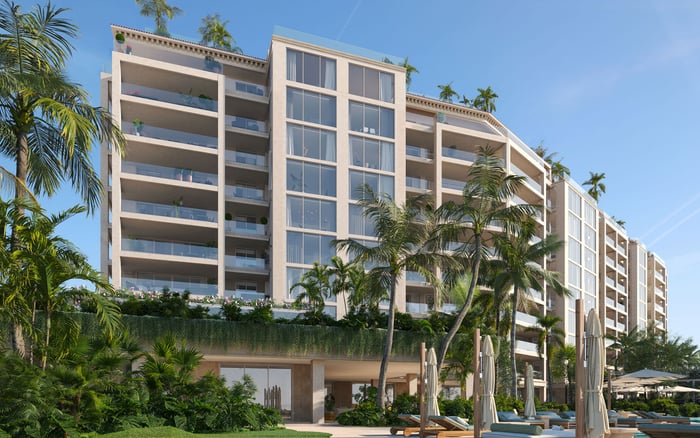
A buyer-focused framework for reviewing Palazzo della Luna’s insurance documents, distinguishing replacement-cost appraisals from claims provisions, and testing storm-deductible exposure against owner-level coverage.

For a buyer considering Palazzo della Luna Fisher Island, operational due diligence deserves the same attention as the residence itself. Insurance is more than an annual expense. Its valuation assumptions, deductible triggers and claims provisions help determine how a significant property loss could translate into an owner’s financial obligation.
The central question is not whether a building is insured, but how its insurance responds. A disciplined review connects three layers: the association’s master policy, the governing documents that allocate association obligations, and the buyer’s condominium unit-owner policy, commonly called an HO-6.
Treat this as a document-review framework, not a statement of Palazzo della Luna’s current coverage. Establish its replacement value, policy limits, storm deductibles, flood protection and allocation provisions directly from the applicable documents before drawing conclusions about personal exposure.
An insurance replacement-cost appraisal and a post-loss appraisal clause serve different purposes. Confusing them can leave a buyer confident in a valuation but unclear about how a disputed claim would proceed.
Florida condominium associations must maintain adequate property insurance, with replacement cost determined through an independent insurance appraisal or an update at least every 36 months. Request the latest appraisal, its effective date and any subsequent update. Then ask the association’s insurance specialist to reconcile that valuation with the policy’s insured values and limits.
A post-loss appraisal clause addresses a different stage: resolving a disagreement over the amount of loss. Review whether the master policy contains one, what activates it, how appraisers and an umpire are selected, and who pays the associated expenses. Ask counsel whether the wording preserves the insurer’s ability to deny coverage despite the appraisal process. Do not assume that a mechanism for valuing damage also resolves coverage disputes.
For a buyer also evaluating Palazzo del Sol Fisher Island, request these documents independently for each association. A shared destination does not establish shared insurance terms.
“Named storm,” “hurricane” and “windstorm” are not interchangeable labels. The controlling language is the policy’s definition of the event that activates each deductible, together with the insured-value basis used to calculate it.
Typical residential hurricane deductibles include 2%, 5% and 10%. Those percentages apply to the applicable insured value, not simply to the repair bill. They offer context, but do not establish a condominium association’s deductible or calculation method.
For illustration only, a 5% deductible applied to a $100 million insured building value equals $5 million. Neither figure represents Palazzo della Luna’s actual exposure. The example shows why a seemingly modest percentage can require substantial liquidity at the association level.
Condominium-association policies also warrant a separate review of hurricane-deductible mechanics. Commercial-residential insurers must offer either the hurricane-deductible structure specified under Florida’s rules or a separate deductible applicable to each hurricane. Do not assume the master policy operates like an individual homeowner policy.
Ask the specialist to identify the trigger, percentage or dollar amount, applicable insured value, and treatment by storm, building or location. Request a written calculation using the actual policy schedule, rather than relying on a verbal description of the deductible.
The association’s deductible is not automatically the amount assessed to owners. Before estimating a potential assessment, review the budget, reserves, available funding and governing-document provisions with the association’s advisers.
Nor should an association shortfall automatically be divided equally among residences. Apply the allocation formula that governs the particular obligation. The objective is a documented path from the association-level amount to the share potentially attributable to the residence under consideration.
For an alternative such as The Residences at Six Fisher Island, ask the same questions without importing assumptions from another property. Meaningful comparisons require each property’s applicable documents, not a generalized estimate for Fisher Island ownership.
A useful buyer worksheet separates three figures: the assumed association shortfall, the residence’s allocated share, and the amount the owner’s insurer confirms could be covered. Label the first two as scenarios until the underlying facts are established. Do not treat an insurance limit as guaranteed reimbursement.
Florida requires residential condominium unit-owner policies to include at least $2,000 in property loss-assessment coverage. That is a statutory floor, not evidence of sufficient protection against a substantial association loss.
The deductible for this required coverage cannot exceed $250 for each direct property loss. No additional loss-assessment deductible applies when a deductible has already applied to another covered property loss to the unit from the same event.
Coverage is conditional. It applies to assessments arising from direct losses of a type covered by the owner’s policy; it does not provide blanket protection for every special assessment. Evaluate a larger limit alongside the policy’s exclusions and sublimits, not in isolation.
Ask a Florida condominium-insurance specialist to confirm the proposed loss-assessment limit and identify any restrictions affecting assessments used to fund the association’s storm deductible. Review flood policies separately rather than assuming that the master property policy and HO-6 together answer every flood question.
Timing also matters. The maximum payable loss-assessment amount is generally governed by the coverage limit in effect one day before the event. Increasing the limit afterward should not be treated as a solution for that event.
For an owner who is not continuously in residence, establish who will receive association notices and coordinate with the insurance adviser. Keep assessment notices and the relevant loss and vote dates together.
Loss-assessment claim-notice requirements can depend on both the damage date and the association’s assessment vote, with an outside deadline described as three years after the damage occurred. That is neither a complete deadline calculation nor permission to wait. Have the applicable law, policy and loss date reviewed promptly.
The final review file should contain the replacement-cost appraisal, complete master policy and endorsements, flood policies, claims history, budget, reserves, assessment notices and allocation provisions. Have counsel and the insurance specialist reconcile those documents with the proposed HO-6 coverage.
The goal is not to eliminate every uncertainty. It is to distinguish insured protection from obligations that may require personal liquidity-before making the purchase decision.
For a discreet perspective on evaluating South Florida residences, connect with MILLION.
If branded residences are on your mind — as a home or as an allocation — we would be glad to share what we are seeing, privately.
Begin a quiet conversationNo. Its actual limits, deductibles, replacement value and allocation provisions must be established from the applicable association and insurance documents.
Florida condominium associations must determine replacement cost through an independent insurance appraisal or an update at least every 36 months.
No. The first establishes replacement-cost valuation, while the second addresses a policy process for resolving disagreements over the amount of loss.
Do not assume so. Review the policy definitions, deductible triggers and insured-value basis for each applicable provision.
It is based on the applicable insured value rather than simply the repair bill. The master policy must be reviewed to establish the precise calculation.
Residential condominium unit-owner policies must include at least $2,000. That minimum is not a benchmark for sufficient protection against a major association loss.
The deductible cannot exceed $250 for each direct property loss. No additional loss-assessment deductible applies when another covered property loss to the unit from the same event has already triggered a deductible.
No. The required coverage applies to assessments arising from direct losses of a type covered by the owner’s policy, subject to applicable terms.
The maximum payable loss-assessment amount is generally governed by the limit in effect one day before the event. A later increase should not be relied on to cover that loss.
Not automatically. Apply the governing documents’ allocation formula, then have an insurance specialist evaluate how the owner’s policy could respond.