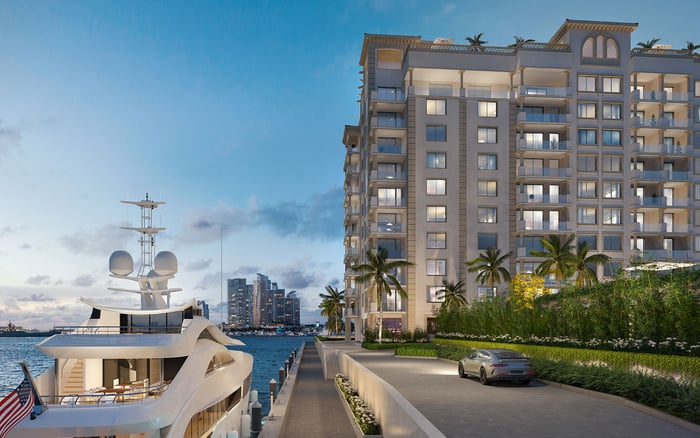
A considered Fisher Island furnishing plan connects customs clearance, mainland receiving, marine transfer, residence access, and insurance before valuable pieces leave their point of origin.

Planning a Fisher Island residence does not end with approval of the furniture plan. For a high-value interior, the less visible decisions deserve equal attention: how each piece enters the country, where it waits, how it crosses the water, and who accepts responsibility at each handoff. The objective is to protect both the collection and the intended arrival experience.
For an owner planning interiors at Palazzo del Sol Fisher Island, start with a coordinated delivery plan rather than a single moving date. Ask the designer, customs broker, logistics provider, installer, and insurance broker to work from one inventory and one sequence of approvals. Treat the installation as a chain of custody, not simply a delivery appointment.
Furniture, carpets, paintings, tableware, books, and similar furnishings fall within household-effects guidance. That does not mean every furnishing shipment qualifies for duty-free entry. Used household effects may qualify when they have been used abroad for at least one year and are not intended for another person or for sale.
For returning residents, the one-year condition can include goods available for the importer's use or used in a household where the importer resided. Supporting evidence of foreign use may be requested. Do not assume newly purchased pieces receive the same treatment, even when they travel alongside an established personal collection.
Build the inventory accordingly. Ask the customs broker to distinguish qualifying used effects from new acquisitions and identify the documentation each category requires. Unaccompanied household goods generally require Form 3299, the Declaration for Free Entry of Unaccompanied Articles. Qualifying household and personal effects should generally move within 10 years of the importer's last U.S. arrival from the country where they were used. Confirm how that timing applies before dispatch.
Goods valued at $2,500 or more may require formal entry. The question is not simply whether the furniture is personal, but which entry procedure applies to the shipment. An owner, purchaser, or licensed customs broker may enter imported goods; appointing a broker should include a clear allocation of responsibilities.
Formal-entry documentation can include Form 5106, Form 7501, release documentation, a customs bond or cash equivalent, commercial invoices, packing lists, shipping documents, and applicable duties and fees. Commodity-specific requirements administered by other government agencies may also apply.
Before authorizing shipment, request a written documentation checklist and establish who will resolve questions about ownership, value, and eligibility. Ask the broker to identify any commodity-specific issues in the inventory. Do not base an installation commitment on an unconfirmed release date. The customs plan should inform the delivery schedule, not follow the freight's departure.
Do not treat PortMiami as guaranteed holding space. The port has no obligation to store property that has not been transported, and is not intended to be transported, by water to or from the port. Nor is it obliged to provide extended storage or services beyond facility capacity.
Arrange mainland receiving separately. Ask the logistics provider to identify where goods will be received, inspected, consolidated, and held if the residence is not ready. Obtain written confirmation of availability, handling scope, storage charges, and arrangements for delayed onward movement.
When coordinating a furnishing program for Palazzo della Luna Fisher Island, consider making mainland inspection a decision point before island delivery. Ask whether condition photographs and an exception log can be reviewed before authorizing the next transfer. Identifying an issue at this stage gives the owner a chance to decide how to proceed.
Fisher Island's car ferry uses the Main Channel and Government Cut Turning Basin. Marine transfer is a distinct planning stage, not merely an extension of a mainland truck journey. Obtain written confirmation of transfer arrangements, vehicle limits, crate limits, and the receiving route before finalizing fabrication.
For a residence at The Residences at Six Fisher Island, request property-specific confirmation of delivery windows, elevator dimensions, receiving access, and installer permissions. Treat each as an item to verify, not an assumed amenity or an island-wide rule.
The same discipline belongs in a furnishing plan for The Links Estates at Fisher Island. Ask the installation team to validate the complete route to final placement and identify constraints before fabrication is finalized. Review packed dimensions, not just those shown on a design drawing. Do not assume access arrangements established for one residence apply to another.
Ask the insurance broker to confirm protection during international transit, customs custody, temporary storage, marine transfer, and installation. Review each stage explicitly. A general assurance that the shipment is insured does not establish which stages, values, or parties the protection covers.
Request a written explanation of valuation, exclusions, deductibles, and contractor limits. Ask how coverage responds when goods move between providers and whether the planned storage and handling arrangements affect protection. Confirm the treatment of damage discovered at inspection or after unpacking, including the required documentation and notification procedure.
Keep this discussion separate from the building's access requirements. Confirm any residence-specific insurance conditions directly, then have the broker assess how those conditions relate to protection for the furnishings. The objective is not merely to assemble paperwork, but to understand where responsibility begins and ends.
Before island delivery proceeds, consolidate the plan in a single installation file: inventory, condition photographs, customs release status, receiving confirmation, access approvals, and insurance confirmation. Ask one designated coordinator to track outstanding decisions so that changes reach every provider.
Allocate responsibility for damage, delay, storage, and redelivery in writing. Specify who can authorize additional handling or a revised delivery attempt, and how exceptions will be recorded at each handoff. At final placement, ask the installer to reconcile the inventory and document condition before signing off on the installation.
The most discreet installation is the one whose difficult questions have already been answered. For considered guidance on Fisher Island residences and the decisions surrounding ownership, explore MILLION.
If branded residences are on your mind — as a home or as an allocation — we would be glad to share what we are seeing, privately.
Begin a quiet conversationThe car ferry uses the Main Channel and Government Cut Turning Basin, making marine transfer a distinct delivery stage. Confirm transfer arrangements, vehicle limits, and receiving access before dispatch.
Used household effects may qualify when used abroad for at least one year and not intended for another person or for sale. Evidence supporting the claimed period of foreign use may be requested.
New purchases should not be assumed to qualify for the treatment available to qualifying used household effects. Ask the customs broker to assess them separately.
Unaccompanied household goods generally require Form 3299, the Declaration for Free Entry of Unaccompanied Articles. Confirm the complete documentation requirements before shipment.
Goods valued at $2,500 or more may require formal entry. Establish the applicable procedure before dispatch rather than assuming household use determines the entry requirements.
Qualifying household and personal effects should generally move within 10 years of the importer's last U.S. arrival from the country where the goods were used. Confirm how the condition applies to the shipment.
No. Port rules do not guarantee extended storage or services beyond facility capacity, so arrange mainland receiving and contingency storage separately.
Obtain written confirmation of marine-transfer arrangements, vehicle and crate limits, receiving access, elevator dimensions where relevant, delivery windows, and installer permissions. Validate the route using packed dimensions.
Ask the broker to review international transit, customs custody, temporary storage, marine transfer, and installation. Confirm valuation, exclusions, deductibles, and contractor limits in writing.
Use a shared inventory and condition photographs, and record exceptions at each transfer. Allocate responsibility for damage, delay, storage, and redelivery in writing.