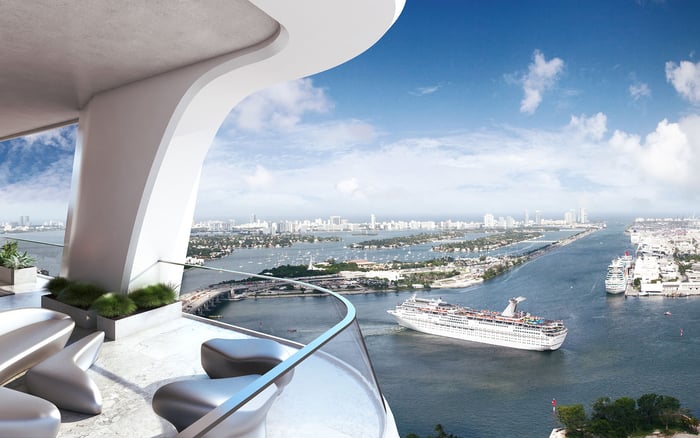
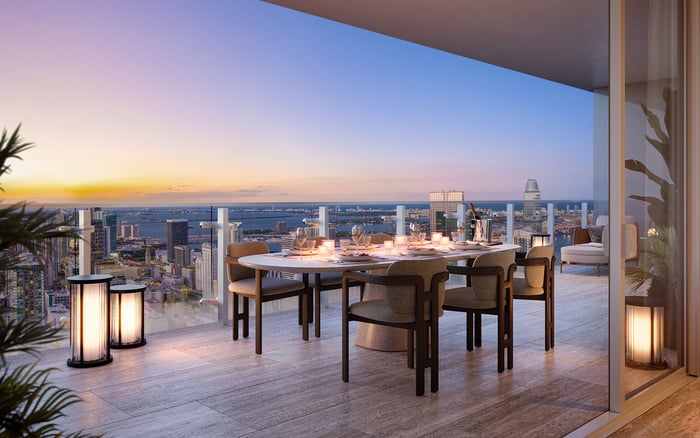
A buyer’s framework for evaluating terrace drainage, outdoor furnishings, alteration approvals, and storm preparation at One Thousand Museum, with a focus on written rules and clearly assigned responsibilities.

At One Thousand Museum Downtown Miami, every residence is advertised with multiple oversized balconies. For a buyer, that promise of outdoor living warrants an equally precise operational review: how water leaves the terrace, what may remain outside, and who prepares the space when severe weather threatens.
A residence feature does not confer unrestricted permission to furnish or alter it. Owners must belong to the condominium association and comply with the obligations and restrictions in its declaration, including dues and assessments for property upkeep and management. Evaluate the terrace through both its physical condition and its governing documents.
The objective is more than an attractive outdoor room. It is a space whose furnishings, maintenance requirements, and storm procedures fit the way the owner actually lives.
Before committing to a furnishing scheme, request the recorded declaration and amendments, current association rules, alteration standards, terrace and waterproofing instructions, hurricane plan, and maintenance-responsibility provisions. Review them together; furniture approval alone is not a complete answer.
Ask management to identify the provisions that apply to the particular residence. Have counsel clarify how the terrace and its components are classified, which responsibilities belong to the owner, and which belong to the association. Obtain written confirmation of the approval process for any proposed change.
A buyer also considering Aston Martin Residences Downtown Miami should build a separate document file for that property. Compare the clarity of each residence’s operating requirements rather than assuming rules transfer between buildings.
For One Thousand Museum, confirm drain clearances, permitted attachments, floor coverings, and storm deadlines in writing before purchase or installation.
Begin with a walkthrough focused on water movement. Ask management to identify drains, scuppers, and any overflow points serving the terrace, and explain which must remain accessible. Obtain the required clearances in writing before placing a sectional, planter, or storage piece.
Have an appropriate inspection professional document any ponding, staining, drain conditions, door thresholds, and waterproofing transitions. Request relevant leak and repair records, including information about unresolved work. Visible staining warrants investigation; it is not sufficient to diagnose a defect or assign liability.
The maintenance discussion should be equally specific. Who clears drains? Who inspects waterproofing? Who authorizes and pays for repairs? How do the documents allocate responsibility for resulting damage? Association dues alone do not answer those component-level questions.
Before selecting rugs, deck tiles, or planters, ask how the proposed arrangement must preserve drainage and inspection access. An assumed clearance distance or generic terrace detail is no substitute for building-specific instructions.
An annotated layout showing drainage points, access areas, and proposed furnishings is a useful deliverable. Submit it for the review management identifies as applicable, and retain the written response with the residence’s records.
A considered outdoor scheme begins with an inventory, not a shopping order. Request written guidance on seating, tables, planters, rugs, deck tiles, grills, umbrellas, lighting, screens, and storage containers. Ask whether restrictions govern dimensions, placement, appearance, attachment, or seasonal removal.
Keep three decisions distinct: whether an item is allowed, where it may stand, and how it may be secured. Approval for a freestanding chair is not approval to drill into a terrace surface. Likewise, an acceptable furniture layout does not establish permission for railing attachments, screens, or enclosures.
Florida condominium law generally subjects material alterations or substantial additions to common elements and association property to applicable statutory and declaration procedures. It also prohibits owner activity that adversely affects their safety or soundness. These principles make written authorization particularly important when a design touches building components.
For buyers weighing Una Residences Brickell alongside a Downtown Miami purchase, the same questions provide a useful comparison framework. They do not imply that the two associations permit the same furnishings or attachments.
Miami-Dade’s loose-object requirements cover exposed outdoor furniture, materials, and similar objects that could become windborne. Covered categories include chairs, tables, bicycles, toys, gardening supplies, household items, and debris. A terrace review must therefore extend beyond its largest furniture pieces.
When a National Weather Service severe-weather advisory is in effect for Miami-Dade County, best efforts must be used to secure covered objects in exposed outdoor locations. Described methods include storing them inside a building or bracing, bundling, or fastening them to a fixed structure sufficiently to prevent them from becoming windborne.
That public requirement does not grant building approval for anchors, drilling, or railing attachments. Confirm the association’s permitted methods separately. If indoor storage is the intended solution, identify the authorized location and establish how each item will reach it.
Florida condominium law also requires residential and mixed-use condominium boards to adopt building-specific hurricane-protection specifications that comply with applicable codes. Those specifications may address color, style, and other relevant factors. Boards may require protection that meets or exceeds code requirements, subject to the statutory process and condominium documents.
Qualifying hurricane-protection work receives distinct statutory treatment regarding material alterations. That framework is not blanket permission for an improvised furniture anchor or enclosure.
For an owner who travels, a deadline is useful only if someone can meet it. Obtain written confirmation of the building’s activation trigger, terrace-clearing deadline, approved securing methods, and inspection protocol. Establish whether any action is expected before the county advisory trigger.
Name a primary authorized contact and a backup. Confirm access arrangements, the intended indoor-storage location, and whether assistance is available through the building or must be arranged independently. Do not assume association membership includes moving private furnishings.
As a planning exercise, test whether the proposed furniture can be relocated with the personnel and access arrangements available. Resolve the logistics of oversized or difficult-to-move pieces before purchase, not during a weather alert.
A complete terrace file should connect three elements: the physical inspection, written furnishing and alteration guidance, and a workable storm plan. Seek clarification wherever those materials leave responsibilities or approvals ambiguous.
Before closing, review unresolved drainage observations, relevant repair records, and existing installations with the appropriate advisers. Keep approved layouts and correspondence accessible to whoever manages the residence during an absence. The most convincing outdoor living arrangement remains manageable when the owner is elsewhere.
For a considered approach to South Florida condominium ownership, explore MILLION.
If branded residences are on your mind — as a home or as an allocation — we would be glad to share what we are seeing, privately.
Begin a quiet conversationNo. A marketed balcony feature does not establish permission for particular furnishings, attachments, or alterations; confirm the applicable association requirements.
Request the recorded declaration and amendments, current rules, alteration standards, terrace and waterproofing instructions, hurricane plan, and maintenance-responsibility provisions.
Obtain the applicable distance directly from management in writing. Do not design around an assumed clearance.
Document ponding, staining, drains, thresholds, and waterproofing transitions. Request relevant leak and repair records to help evaluate those observations.
Review the governing documents and obtain clarification of owner and association responsibilities. Association dues alone do not establish who handles each component.
Request written guidance for the specific items and layout before installation. Confirm how drainage and inspection access must be preserved.
Best efforts to secure covered objects are required when a National Weather Service severe-weather advisory is in effect for Miami-Dade County. Confirm the building’s activation trigger and deadline separately.
They describe indoor storage or bracing, bundling, or fastening to a fixed structure sufficiently to prevent objects from becoming windborne. Building approval for the chosen attachment method remains a separate question.
It does not establish blanket permission for terrace anchors or drilling. Obtain building-specific approval guidance before touching building components.
Arrange an authorized primary contact and backup, confirm access and approved storage, and document the clearing deadline. Establish who will perform the work rather than assuming the association will move private furnishings.