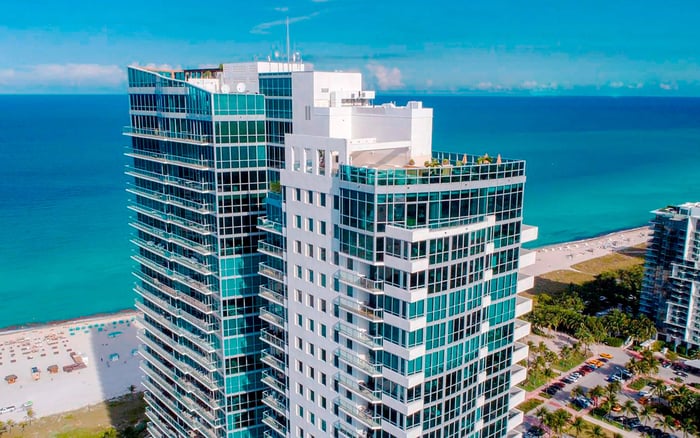
For buyers comparing Faena House and The Ritz-Carlton Residences® South Beach, insurance deserves the same attention as service and design. Replacement-cost appraisals, storm deductibles and owner loss-assessment coverage help define the financial side of the resident experience.

In luxury condominium ownership, peace of mind is part of the resident experience. Design and service shape daily life; insurance provides a different kind of comfort: knowing which losses are covered, which expenses remain shared and what an owner may need to fund after a storm.
For buyers considering Faena House Miami Beach alongside The Ritz-Carlton Residences® South Beach, that distinction deserves attention before purchase. A residential name does not establish a master policy’s limits, deductible or claims performance. Nor does it reveal how an individual owner’s insurance responds to an association assessment.
The useful comparison is contractual, not reputational. Review replacement-cost valuation, translate wind deductibles into potential cash obligations and test the owner’s loss-assessment protection against those obligations. These steps clarify the financial dimension of ownership without implying that either property delivers better claims handling or greater resident satisfaction.
Florida condominium associations must maintain adequate property insurance based on replacement cost established through an independent insurance appraisal or appraisal update at least every three years. For a buyer, the appraisal date and valuation deserve scrutiny alongside the policy’s stated limit.
Replacement-cost coverage pays the current cost of replacing damaged property without deducting depreciation. Actual-cash-value coverage subtracts depreciation. The distinction matters, but the phrase replacement cost is no substitute for reading the policy: limits, covered property and endorsements still require review.
For each residence, request the latest appraisal or update, the master policy with all endorsements, and the certificate of insurance. Ask the association’s insurance adviser to explain how the appraisal relates to the insured property and policy limits. The certificate alone is not a complete coverage description.
Keep the inquiry specific. Which property falls within the association’s insurance responsibility? Which portions remain the owner’s responsibility? The answers depend on insurance terms, governing documents and applicable law-not simply the residence’s purchase price or interior specification.
Association boards may set property-policy deductibles consistent with industry standards for similar communities in the same geographic area. That does not make every deductible interchangeable. Hurricane or windstorm deductibles can differ substantially from the standard property deductible, and wind coverage may be purchased separately.
Begin with the applicable storm provision. Ask whether the deductible is a dollar amount or a percentage and, if a percentage, exactly which insured value serves as the basis for calculation. Request a written dollar illustration using the actual policy; do not assume the percentage applies to the eventual repair bill.
Next, establish whether the deductible operates per occurrence or per season. That distinction belongs alongside the amount itself. A headline percentage cannot convey the full obligation without the terms governing its calculation and application.
Finally, examine funding. Association deductibles and covered losses exceeding insurance proceeds can become common expenses or owner assessments, subject to law and governing documents. Review the budget, reserves and allocation provisions to understand how an owner’s share would be determined. Do not assume it would be divided equally among residences.
For buyers also considering Setai Residences Miami Beach, the same document-led review provides a consistent basis for comparison without suggesting that the buildings share policies or deductible structures.
An owner’s HO-6 loss-assessment coverage can reimburse certain assessments arising from covered association property or liability losses. It complements the master policy; it does not guarantee payment whenever the board levies a special assessment.
Florida requires condominium unit-owner property policies to include at least $2,000 in property loss-assessment coverage for assessments arising from the same direct loss. That is a statutory floor, not a recommended limit for either residence.
For property loss-assessment coverage to respond, the underlying loss must arise from a peril covered under the owner’s policy. Not every special assessment qualifies. Higher overall HO-6 limits do not automatically remove loss-assessment sublimits or restrictions on assessments attributable to an association deductible.
Ask the owner’s insurer to address three points in writing: the applicable loss-assessment limit, any separate restriction for association-deductible assessments and the covered perils relevant to the proposed protection. Compare those answers with the association’s actual storm deductible and allocation rules.
Timing also matters. Loss-assessment claim deadlines can involve the underlying loss, notice of claim and the board’s vote to levy the assessment. Have the insurer or adviser identify the applicable deadlines rather than assuming the assessment’s payment date controls the claim.
Review the association’s master policy and the owner’s unit policy together. Neither replaces the other. For an owner managing the residence from elsewhere, a written explanation of that division is particularly useful.
Request a responsibility breakdown tied to the governing documents and policy terms. The objective is to identify where association protection ends and owner protection begins, then resolve uncertainties before a loss-not during an assessment dispute.
Flood deserves a separate inquiry. Flood protection generally requires separate coverage and should not be assumed to fall within ordinary condominium property insurance. Confirm the relevant association and owner arrangements independently of the wind review.
Florida also requires insurers to offer qualifying wind-mitigation discounts and provide homeowners with information about them. Ask about eligibility and documentation, but do not treat a potential discount as evidence of either building’s deductible or coverage quality.
Create a side-by-side file for Faena House and The Ritz-Carlton Residences® South Beach containing the same documents: master policy and endorsements, certificate, replacement-cost appraisal, declaration, budget, reserves, claims history and recent board minutes. If also considering The Ritz-Carlton Residences® Miami Beach, apply the same review to that property separately.
For each residence, distinguish coverage currently in force from proposals, preliminary budgets or anticipated arrangements. Where a purchase involves pre-construction materials, confirm which insurance terms are projected and which are actually bound. Marketing descriptions do not establish a final insurance program.
The decision should turn on documented obligations: what is insured, how the storm deductible works, how a shortfall could be allocated and what the owner’s policy would reimburse. Neither residence should be declared the insurance winner without that comparison. The more reassuring ownership proposition is the one whose risks the buyer can understand and plan for.
For a discreet approach to your Miami Beach residence search, explore MILLION.
If branded residences are on your mind — as a home or as an allocation — we would be glad to share what we are seeing, privately.
Begin a quiet conversationNeither should be ranked on branding alone. A defensible comparison requires the actual master policies, appraisals, deductibles and owner-allocation provisions.
Replacement cost must be established through an independent insurance appraisal or appraisal update at least every three years.
Replacement-cost coverage pays the current cost of replacing damaged property without deducting depreciation. Actual-cash-value coverage subtracts depreciation.
Hurricane or windstorm deductibles may differ substantially from standard property deductibles. Their calculation basis and application per occurrence or season should be confirmed.
Association deductibles and covered losses exceeding insurance proceeds can become common expenses or owner assessments, subject to applicable law and governing documents.
Florida requires at least $2,000 for assessments arising from the same direct loss. This statutory floor is not a recommended coverage limit for either residence.
No. Property loss-assessment coverage depends on the underlying loss being caused by a peril covered under the owner’s policy, along with applicable policy terms.
Not necessarily. Loss-assessment sublimits and restrictions on assessments attributable to association deductibles can remain despite higher overall limits.
Yes. Flood protection generally requires separate coverage and should not be assumed to be included in ordinary condominium property insurance.
Request the master policy and endorsements, certificate of insurance, replacement-cost appraisal, declaration, budget, reserves, claims history and recent board minutes. Review these alongside the proposed owner’s policy.