A buyer-focused framework for evaluating acoustic privacy at 2200 Brickell, from unit-specific assembly documentation and mechanical adjacency to flooring approvals, complaint procedures, and contractual protection.

In a luxury condominium, privacy is both visual and acoustic. A beautifully composed room can still disappoint when footsteps, neighboring conversation, or equipment vibration intrude. At 2200 Brickell, buyers should evaluate quiet with the same precision they bring to layout, finishes, and contractual terms.
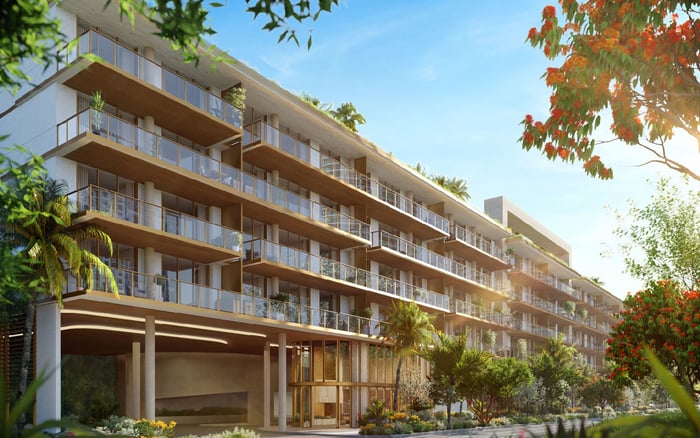
The project is a five-story residential condominium at 2200 Brickell Avenue, Miami, FL 33129, with architecture by Revuelta Architecture International and interiors by ODA New York. Those credentials establish design authorship, not acoustic performance. Current completion status, unit-specific sound ratings, mechanical-room adjacency, and completed-building acoustic test results for individual residences are not established here.
The essential distinction is between an attractive design proposition and a documented operating condition. Neither the building's scale nor its address establishes what a particular bedroom shares with neighboring residences or service infrastructure. Begin with the exact residence and stack, then work outward.
Sound isolation calls for distinct lines of inquiry. STC addresses airborne transmission, such as voices. IIC addresses impact-generated, structure-borne sound, including footfalls and furniture movement. Mechanical vibration is a separate concern that a wall rating alone cannot resolve.
The acoustic-code benchmarks to verify are STC 50 in laboratory testing or 45 in field testing for separations between dwellings and between dwellings and public or service areas. For floor-ceiling impact isolation, the corresponding benchmarks are IIC 50 in laboratory testing or 45 in field testing. Confirm the applicable code edition and precise field-test metric with the project's professionals and an independent acoustic consultant before treating these figures as governing requirements.
These are minimum compliance thresholds, not a promise of luxury-level quiet. Laboratory results describe a tested assembly; they do not, by themselves, establish the performance of the installed separation beside or above your residence.
Request specifications for the relevant walls and floor-ceiling assemblies, along with documentation identifying what was actually tested. Ask whether the test configuration matches the proposed or installed floor finish, underlayment, and ceiling construction. Without that context, a rating is an incomplete purchase criterion.
A sales floor plan is no substitute for coordinated technical drawings. Mechanical-room adjacency is not established here for any particular 2200 Brickell residence or stack. That uncertainty calls for a document request, not an assumption that equipment is either nearby or safely remote.
Request approved architectural, mechanical, electrical, and reflected-ceiling plans for the exact location. Have the review identify shared walls, slabs, ceilings, shafts, and service spaces. Examine what sits beside, directly above, and directly below the residence, particularly around bedrooms and rooms intended for quiet work.
Mechanical equipment and elevators can generate structure-borne vibration. A substantial separating wall therefore does not settle the question. Request equipment-isolation details and have a qualified consultant assess how vibration is addressed, rather than relying on distance alone.
For a buyer also considering Una Residences Brickell, the useful comparison is the quality of unit-specific documentation available for each candidate. No acoustic ranking between the projects is established here. Apply the same adjacency questions to both.
An acoustic separation is more than its principal wall or slab. Piping, electrical devices, recessed cabinets, soffits, and ducts must be treated so that penetrations do not compromise the separating assembly. A technical review should examine these details, not simply the headline rating.
Ask the design team to identify the penetration treatments specified for the residence's relevant boundaries. Where installed conditions are accessible, consider an independent acoustic inspection. Where they are not, distinguish clearly between design intent, documented construction, and measured performance.
For flooring, request the tested finish and underlayment as a complete system. Ask whether the association's alteration requirements preserve that system or require documented alternatives. Approval of a finish should not be taken as evidence of impact-isolation performance without supporting details.
The goal is not an absolute guarantee of silence. It is a clear understanding of what has been specified, what has been installed, and what evidence supports the expected result.
Physical isolation and condominium governance are separate protections. Even a carefully specified floor assembly needs an ownership framework that addresses alterations and complaints. 2200 Brickell's association noise rules and enforcement history are not established here.
Obtain the declaration, rules, alteration requirements, and written complaint procedure before relying on general assurances of quiet living. Verify flooring standards, documentation requirements, inspection authority, hearing procedures, and available remedies. Ask who evaluates an alleged flooring violation and what evidence the governing documents require.
Review the written procedure for practical clarity: where a complaint goes, how conditions are documented, who can inspect, and how an unresolved matter progresses. Have Florida condominium counsel assess the applicable documents and the remedies they support.
Apply the same discipline when comparing The Residences at 1428 Brickell. Compare the documents available for each residence rather than inferring enforcement quality from branding or presentation.
Miami-Dade's construction-noise restrictions address noise-producing construction equipment and machinery at or near residences, including multifamily residences, between 8:00 p.m. and 7:00 a.m., subject to applicable exceptions and waivers.
The county's construction-noise waiver process requires an active building permit and advance notice to adjacent or adjoining properties at least 72 hours before the permitted work. These provisions concern construction, repair, alteration, and demolition activity. Confirm the applicable requirements and any exceptions with counsel before relying on them for a particular property or activity.
They should not be treated as a specific enforcement rule for ordinary footsteps or furniture movement. Renovation machinery, resident impact noise, and equipment vibration require distinct inquiries. For ownership decisions, examine the condominium's governing documents rather than using a construction restriction as a substitute for resident-noise provisions.
Organize the decision around three sets of evidence: the residence's acoustic assemblies, its relationship to equipment and service spaces, and the condominium's alteration and complaint framework. Keep unanswered questions visible; a general statement of code compliance does not resolve them all.
Consider an independent acoustic inspection where access permits, and ask Florida condominium counsel to review inspection rights and contractual remedies. Clarify which conditions can be evaluated before commitment and how unresolved items are addressed in the transaction documents.
The strongest purchase decision is not necessarily the one accompanied by the highest advertised rating. It is the one supported by relevant documentation, a clear understanding of the residence's surroundings, and enforceable terms appropriate to the buyer's expectations.
For a discreet perspective on residence selection and luxury ownership diligence, explore MILLION.
If branded residences are on your mind — as a home or as an allocation — we would be glad to share what we are seeing, privately.
Begin a quiet conversationIt is a five-story residential condominium at 2200 Brickell Avenue, Miami, FL 33129, with architecture by Revuelta Architecture International and interiors by ODA New York. Current completion status is not established here.
Unit-specific acoustic ratings and completed-building airborne and impact-noise test results are not established here. Request documentation tied to the exact residence and its separating assemblies.
STC addresses airborne sound transmission, while IIC addresses impact-generated, structure-borne sound such as footfalls and furniture movement. Neither should substitute for a separate review of equipment vibration.
The benchmarks discussed are STC 50 and IIC 50 in laboratory testing, or 45 in field testing. Confirm the applicable code edition and precise field-test metric before applying them to the project.
No; minimum compliance thresholds are not a project-specific promise of luxury-level quiet. Laboratory results do not by themselves establish installed performance.
Request approved architectural, mechanical, electrical, and reflected-ceiling plans for the exact stack. Review shared walls, slabs, ceilings, shafts, and service spaces beside, above, and below the residence.
Mechanical equipment and elevators can generate structure-borne vibration. Reviewing equipment isolation addresses a concern that wall soundproofing alone may not resolve.
Request the tested floor finish and underlayment, relevant assembly specifications, and the condominium's flooring alteration requirements. Determine whether approved changes require supporting acoustic documentation.
The construction-noise provisions discussed concern construction, repair, alteration, and demolition activity, rather than a specific enforcement rule for ordinary footsteps or furniture movement. Resident impact-noise concerns require review of the condominium's governing documents.
Consider an independent acoustic inspection and Florida condominium counsel's review of inspection rights and contractual remedies. Clarify how unresolved acoustic or adjacency questions will be addressed before commitment.
.jpg&width=700&height=438&fit=cover)