Relocating a family office and its art collection from Los Angeles to Bay Harbor Islands requires property diligence, museum-quality logistics, continuous insurance and a carefully sequenced installation plan.

Moving a family office from Los Angeles to Bay Harbor Islands is not simply a residential relocation with valuable objects attached. For a serious collection, the property acquisition and transport plan should proceed as one coordinated exercise. The residence must physically accommodate the art, the building must operationally admit the carrier, and the interior environment must support the collection after installation.
That integration should begin during buyer diligence. Ceiling height and usable wall area matter, but so do doorway clearances, turning radii, glazing, HVAC precision and security. UV-protective glazing deserves particular attention where works will receive strong daylight. A visually compelling wall is not necessarily an appropriate display surface if solar exposure or environmental variation cannot be managed.
The residence, building access and transport plan should be tested as one system.
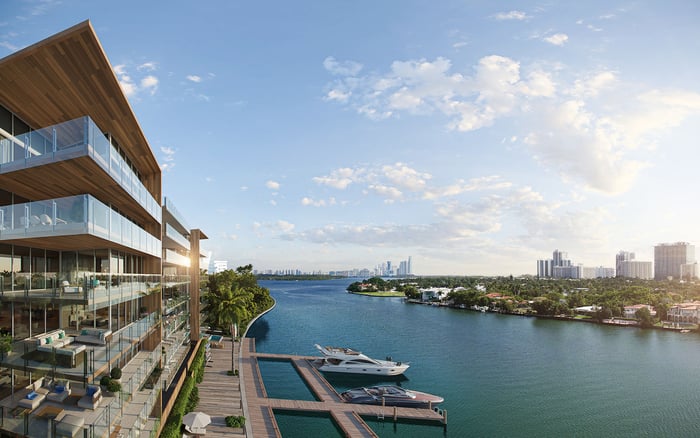
Bay Harbor Islands offers a waterfront setting with proximity to Bal Harbour, yet each condominium should be evaluated on its own documentation and physical constraints. Buyers reviewing Alana Bay Harbor Islands or another island residence should ask collection-specific questions before contracts, closing logistics and installation dates become fixed. This is the distinction between admiring a room and verifying that it can perform as a private exhibition environment.
The carrier’s written scope should specify climate-controlled, door-to-door service from the Los Angeles residence or storage facility through delivery inside the Bay Harbor Islands home. Valuable works should receive museum-quality packing and handling, not ordinary household-freight treatment. For large, fragile or unusually shaped pieces, require custom crating and document responsibility for crate design, packing, unpacking and debris removal.
Vehicle specifications also matter. Ask the carrier to document climate controls, vibration-mitigation measures and monitoring procedures for the interstate journey. Confirm that the service is genuinely door to door and includes in-residence delivery and installation rather than terminating at a loading area or lobby.
Test scheduling early. The selected arrangement should be reconciled with closing, building access, storage contingencies and installer availability before any work leaves California. Dimensions, fragility, packing requirements and access conditions should inform the written scope for each work.
Request full-risk, wall-to-wall insurance from pickup through delivery. Basic transit coverage may not address the full sequence of handling, temporary storage, unpacking and final installation. The family office should verify in writing when coverage begins, when it ends, which exclusions apply and whether every subcontracted stage is included.
Declared-value protection should rely on a current appraisal or the owner’s documented assessment for each work. The schedule of values, packing inventory and insurance documents should use consistent identifying information so that titles, dimensions and values do not diverge across records.
Condition reporting is equally important. Obtain visual inspection reports before packing and again at relevant handoffs, supported by chain-of-custody documentation recording who handled each work and when. This documentation is a governance tool as much as a claims safeguard, giving the family office, carrier, insurer and installer a common record from origin through final placement.
Freight-elevator and service-access requirements should be confirmed for the specific Bay Harbor Islands condominium. Obtain the current move-in, service-access and vendor requirements directly from management rather than relying on a prior move, a verbal summary or a carrier’s experience at another property.
The written package should clarify freight-elevator reservations, approved access hours, loading procedures, protection requirements, certificates of insurance, vendor registration and any deposits or fees. Ask whether art delivery is governed by standard move-in rules or a separate service protocol. Residences such as Bay Harbor Towers and Onda Bay Harbor should each be treated as a distinct operating environment, without assuming that one building’s procedures apply to another.
Field-verify all measurements. Have the carrier compare crate dimensions and vehicle requirements with the actual loading area, freight elevator, corridors, doorways and interior turns. Confirm both cab dimensions and door openings. If a work cannot follow the normal route, the alternative should be engineered, authorized and insured before shipment-not improvised on delivery day.
Climate responsibility does not end when the vehicle arrives. Review the residence’s HVAC precision in relation to the collection, alongside glazing and anticipated placement. Installation sequencing should prevent packed works from remaining in uncontrolled service areas while rooms, mounts or lighting are unfinished.
Climate-controlled storage can bridge a delayed closing, renovation or installation sequence. Insurance should expressly extend through the storage period and subsequent handling, while the facility’s intake and release procedures should preserve chain-of-custody continuity.
For buyers considering The Well Bay Harbor Islands or another lifestyle-oriented condominium, amenity appeal should remain separate from collection diligence. Ask how the private residence performs, how service access operates and whether environmental settings can be maintained with sufficient precision for the intended works.
The cleanest plan works backward from a confirmed installation window. First, verify that the residence is complete, environmental conditions are stable, and wall preparation, mounts, lighting and security are ready. Then secure building access, installer availability, carrier timing and any storage contingency. Only after those elements align should the collection depart Los Angeles.
A family-office move book can consolidate the inventory, declared values, condition reports, crate dimensions, transport scope, insurance evidence, management approvals, elevator reservation, installer plan and emergency contacts. Decision rights should also be clear: identify who may approve a schedule change, authorize storage, accept a condition exception or pause an installation.
The result is discreet rather than dramatic. Art moves through an approved route, documentation follows every handoff, and the collection arrives at a residence already prepared to receive it. For confidential guidance on aligning a Bay Harbor Islands purchase with collection logistics, consult MILLION.
If branded residences are on your mind — as a home or as an allocation — we would be glad to share what we are seeing, privately.
Begin a quiet conversationBegin during property diligence, before closing and transport dates are fixed. Coordinate the residence, building access, carrier schedule and installation plan.
Require museum-quality packing and handling with climate-controlled, door-to-door service. Specify custom crating for large, fragile or unusually shaped works when appropriate.
Ask for written details on climate controls, vibration-mitigation measures and monitoring procedures. Confirm that delivery extends into the residence rather than ending at the loading area.
Request full-risk, wall-to-wall coverage from pickup through delivery. Confirm whether handling, storage, unpacking and final installation are included.
Use a current appraisal or the owner’s documented assessment for each work. Keep identifying details consistent across the inventory, insurance and packing records.
Obtain visual inspection reports and chain-of-custody documentation. These records should track condition and handling from origin through installation.
Requirements should be verified for each condominium. Obtain the current written move-in, service-access and vendor rules directly from building management.
Verify the loading area, elevator cab and opening, corridors, doorways and interior turns. Compare those measurements with every crate and relevant vehicle requirement.
It can bridge a delayed closing, renovation or installation sequence. Confirm insurance continuity and documented intake and release procedures.
Review ceiling height, usable wall space, glazing, HVAC precision and security. Installation routes and room readiness are equally important.