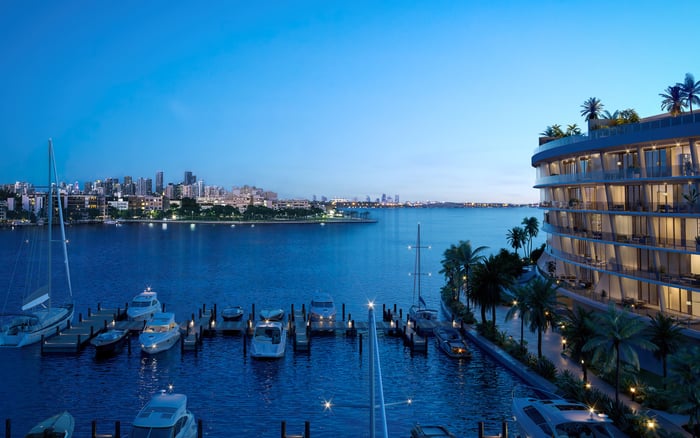
At Vita at Grove Isle, the freedom to personalize a residence must be assessed against two distinct layers of control: the developer's discretion over original specifications and the condominium association's authority over post-closing alterations. Buyers should review the controlling documents before committing to materials, contractors, or a completion calendar.

Vita at Grove Isle is a 65-residence condominium on a private island in Coconut Grove, developed by Ugo Colombo's CMC Group. Its design team includes CallisonRTKL, S&E Architects, and Carlo and Paolo Colombo of A++ Architecture. The interiors have been presented with Italian marble, book-matched stone slabs, Noce Canaletto wood paneling, and custom designer millwork.
That level of curation defines the project, but it does not make every illustrated finish or detail contractually fixed. Sketches, plans, materials, and specifications are conceptual and may be revised at the sole discretion of the developer, builder, or architect, subject to applicable law. For a buyer, the decisive question is not simply what appears in a presentation, but what the purchase agreement and incorporated documents obligate the developer to deliver.
At the highest end of the market, design freedom begins with document clarity.
This distinction is essential in new-construction purchasing. Developer discretion over the original building and an association's authority over later owner work arise from different legal instruments, apply at different stages, and can produce different remedies.
After closing, customization may be governed by the condominium declaration, amendments, architectural standards, alteration procedures, and board-adopted rules. The complete recorded declaration and an authenticated Vita-specific renovation manual have not been established here. General Miami condominium practices therefore provide a diligence framework, not confirmation of Vita's final rules.
Associations commonly review plans, material samples, permits, and contractor information before work begins. Particular scrutiny often falls on flooring and acoustic underlayment, windows and doors, wet-area relocation, plumbing and electrical changes, and anything affecting the exterior or common elements. Even a visually subtle change can require close review if it touches a slab, riser, waterproofing assembly, facade component, or shared building system.
Florida condominium law generally requires approval by 75 percent of total voting interests for a material alteration or substantial addition to common elements when a declaration does not establish another procedure. A declaration may set a different process, including meaningful board authority. Buyers should therefore avoid treating the statutory percentage as an automatic answer.
A proposed stone, wood floor, door system, or plumbing fixture may suit the residence aesthetically yet fail a technical or procedural standard. Flooring is a frequent pressure point because acoustic performance can affect neighboring homes. Wet-area changes can raise waterproofing and shared-system concerns. Exterior-facing elements may be restricted to preserve visual consistency or building performance.
This is particularly relevant in a waterfront setting, where an owner may favor natural materials and broad indoor-outdoor continuity while the building prioritizes uniform assemblies and controlled installation. Nearby luxury options such as Four Seasons Residences Coconut Grove and Park Grove Coconut Grove reinforce the neighborhood's emphasis on considered design, but each condominium is governed by its own documents. Approval at one property says nothing definitive about approval at another.
Before placing a nonrefundable order, the buyer's team should compare the specification against the current alteration criteria and obtain written approval through the prescribed channel. Verbal assurances from a contractor, designer, or sales representative are no substitute for the controlling process.
Even an accomplished residential contractor may be unable or unwilling to satisfy a condominium's requirements. Miami associations commonly require active licensing, permits, insurance, certificates of insurance, deposits, elevator reservations, and adherence to building procedures. Together, these conditions can narrow the field of eligible firms.
The original structural work illustrates a separate layer of control. Ceco Concrete Construction served as shell contractor, Florida Concrete Unlimited as concrete contractor, and Cemex supplied concrete materials. Those developer-led appointments concern the base building. They do not establish that an owner can retain those firms, must use them, or may freely select any contractor after closing.
Associations also possess an irrevocable right of reasonable access to a unit when necessary to maintain, repair, or replace common elements or prevent damage. In practice, work involving slabs, risers, or shared systems may require inspections and coordination at several stages. A contract with the owner's builder should anticipate approval milestones, access obligations, correction periods, and responsibility for delays caused by incomplete submissions.
Vita topped off in 2024, and late 2025 was identified at the time as the targeted completion period. That target concerned developer-managed base-building delivery, not the duration of an owner's post-closing renovation. Current delivery, permit, and turnover conditions should be verified directly rather than inferred from an earlier target.
Once owner work begins, permitted hours, blackout periods, elevator scheduling, inspections, and project-duration limits can extend the calendar. Long-lead materials introduce another dependency: ordering too early risks conflict with an approval decision, while ordering too late can leave the residence awaiting installation. A prudent schedule runs backward from written approvals and confirmed building access, with contingencies for resubmissions and permit review.
Island access may also require operational planning, but no Vita-specific loading, worker-access, or seasonal construction schedule has been established here. Buyers should request the current logistics rules rather than assume that practices at Mr. C Tigertail Coconut Grove or another nearby condominium will apply.
A disciplined review should encompass the purchase agreement, declaration, amendments, current alteration application, architectural guidelines, flooring and acoustic standards, contractor insurance criteria, work-hour rules, deposits, inspection procedures, and stated approval timelines. Buyers should also confirm whether their agreement contains any finish-substitution rights, owner-option deadlines, or waiver provisions.
Municipal conditions merit equal attention. Grove Isle residents previously litigated project approvals, with one lawsuit dropped while some city approvals were reportedly pending. A later lawsuit alleged that permits were issued without required platting. These disputes do not determine an individual alteration request, but they make current permit verification prudent before a substantial build-out.
Chapter 720 protections concerning HOA architectural review should not automatically be applied to this condominium. That chapter governs homeowners' associations, while condominium rights must be assessed under the project's legal structure and applicable condominium documents. Counsel familiar with Florida condominium law can identify the controlling provisions.
For buyer's-guide purposes, the central lesson is straightforward: secure documentary certainty before converting a design concept into purchase orders, contractor commitments, or a fixed move-in date. Investment planning is strongest when the renovation budget accounts for administrative time, compliance costs, and schedule contingencies alongside finishes and labor.
For discreet guidance on South Florida's most considered residences, connect with MILLION.
If branded residences are on your mind — as a home or as an allocation — we would be glad to share what we are seeing, privately.
Begin a quiet conversationThe project materials reserve discretion to revise conceptual sketches, plans, materials, and specifications, subject to applicable law. Contractual delivery rights depend on the purchase agreement and incorporated documents.
No. Developer discretion concerns original project delivery, while association authority generally governs owner alterations after closing.
Not necessarily. Flooring may be subject to material, acoustic underlayment, installation, and approval requirements in the governing documents.
A firm may be ineligible if it cannot satisfy applicable licensing, insurance, permitting, deposit, access, or building-procedure requirements.
Request the declaration and amendments, alteration procedures, architectural guidelines, acoustic standards, insurance criteria, work-hour rules, and approval timelines.
No. The 75 percent threshold generally applies to material alterations of common elements when the declaration does not establish another procedure.
Florida condominium associations have reasonable access rights when needed to address common elements or prevent damage, which can support inspections involving shared systems.
Restricted work hours, blackout periods, elevator coordination, inspections, resubmissions, and project-duration rules can all affect the schedule.
No. That target related to developer-managed building completion and was separate from any owner's post-closing renovation calendar.
No. Chapter 720 governs homeowners' associations and should not automatically be treated as controlling a condominium without reviewing its legal structure.