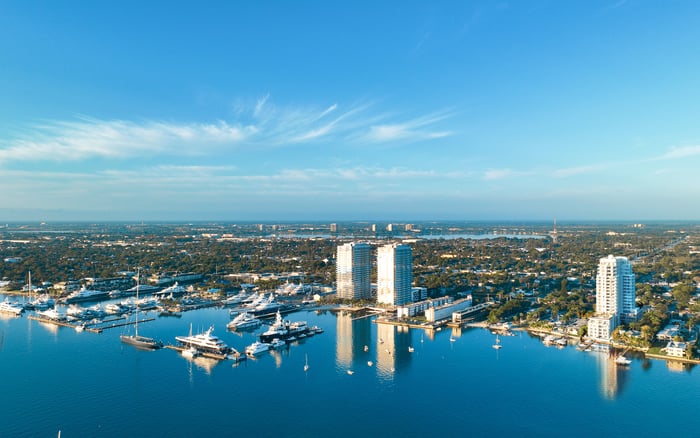
A discreet planning guide for Mexico City families considering West Palm Beach real estate, with emphasis on U.S. situs assets, lifetime gifts, domicile, entity structuring, Florida probate, and cross-border reporting.

For many Mexico City families, West Palm Beach is no longer simply a winter address. It is a private, polished base for education, banking, art, philanthropy, family offices, and multigenerational leisure. Yet the more substantial the residence, the more important the first legal question becomes: who should own it?
A West Palm Beach home is U.S. real property. For a nonresident noncitizen, that means the asset is U.S.-situs property and may require a federal nonresident estate tax filing if U.S.-situs assets exceed the filing threshold. Florida has no state estate tax for decedents dying after December 31, 2004, but that does not remove federal estate tax exposure. At the high end of the market, where waterfront residences and branded condominiums can represent a meaningful portion of family wealth, the distinction is not academic.
This is why a purchase at Alba West Palm Beach, Forté on Flagler West Palm Beach, or a comparable new residence should be modeled before the contract is signed. The right answer may differ for a single buyer, a married couple, a family holding company, or a parent acquiring a residence primarily for children.
For U.S. citizens and U.S. estate and gift tax residents, federal transfer-tax planning generally reaches worldwide property. For estate and gift tax purposes, residence turns on domicile: living in the United States with no definite present intention of leaving. That is different from income-tax residency, where a green card or substantial U.S. presence can change the analysis.
For a Mexico-based buyer who remains a nonresident noncitizen for estate and gift tax purposes, the focus is narrower but still consequential. U.S. real property, including a West Palm Beach condominium or house, is U.S.-situs property. If the owner dies holding it directly, the estate may face federal estate tax filing requirements and, depending on values and available deductions, possible tax. The federal estate and gift tax rate schedule reaches a top marginal rate of 40%.
The estate and gift tax treaty list does not include Mexico. Mexican buyers should therefore not assume treaty relief will soften the U.S. transfer-tax result. The absence of a treaty makes pre-acquisition planning especially important for families accustomed to coordinating assets across Mexico, the United States, and sometimes Europe.
Luxury buyers often think in family terms: buy now, give later to children, transfer to a spouse, or move ownership into the next generation once the preferred residence is chosen. With U.S. real estate, that instinct can create a gift-tax event.
For nonresident noncitizens, U.S. gift tax can apply to lifetime transfers of U.S.-situs real or tangible property. A direct gift of a Florida home, or of a fractional interest in that home, should therefore be reviewed before any deed is signed. The annual gift-tax exclusion for 2025 is $19,000 per recipient, a figure that is usually modest relative to West Palm Beach luxury values. For 2025, gifts to a spouse who is not a U.S. citizen are eligible for a special annual exclusion of $190,000, rather than the unlimited marital deduction available for citizen spouses.
For U.S. citizens and residents, the 2025 federal basic exclusion amount for estate and gift tax is $13.99 million. That can be powerful, but it applies within a broader worldwide system. A buyer who becomes a U.S. transfer-tax resident may find that Mexican, U.S., and other global assets all need to be considered together.
Entity ownership is not cosmetic. Gifts of intangible property by nonresident noncitizens are generally treated differently from gifts of U.S. real estate, which is why holding structures can materially affect gift and estate planning. Direct title, a limited liability company, a corporation, a trust, or a layered structure can each produce different consequences.
That does not mean an entity is automatically best. A foreign-owned U.S. disregarded entity, such as a single-member LLC, may have annual reporting obligations for reportable transactions, including Form 5472 with a pro forma corporate return. A corporation may alter estate exposure but introduce other tax and operational consequences. Trusts require careful drafting and coordination with both U.S. and Mexican counsel.
For a family considering Mr. C Residences West Palm Beach or The Ritz-Carlton Residences® West Palm Beach, the ownership vehicle should align with intended use. A personal retreat, a dynastic asset, a seasonal rental, and an eventual resale can point to different structures. Changing the structure after closing can itself trigger tax consequences, so the most elegant planning often happens before acquisition.
Florida’s appeal is partly its simplicity: no state estate tax, strong property rights, and a mature luxury market. Still, Florida law has its own rules. If a nonresident dies owning Florida property, ancillary administration may be required to transfer title. That can add time, cost, and privacy concerns for a family used to centralized estate administration in Mexico.
Florida homestead law can protect a primary residence from many creditors, but it can also restrict how the residence may be devised when the owner is survived by a spouse or minor child. For families with children from prior relationships, civil-law marital regimes, or separate family branches, those restrictions deserve close attention.
Mexican marital-property characterization also matters. Civil-law regimes such as conjugal partnership and separation of property can affect who is treated as owning family assets. A deed that appears simple in Florida may not tell the whole story for Mexican family law, tax, or succession purposes.
A West Palm Beach residence may be primarily personal, but investment considerations often enter the conversation. Some owners rent seasonally, some hold for long-term appreciation, and others view the residence as part of a larger relocation option.
Nonresident foreign owners renting U.S. real property may face 30% withholding on gross rental income unless they make an election to be taxed on a net basis as income effectively connected with a U.S. trade or business. That election can make expenses relevant, but it also adds filing discipline. Rental use should be coordinated with condominium rules, insurance, financing, and the family’s own travel patterns.
On sale, a foreign seller of U.S. real property is generally subject to FIRPTA withholding, commonly 15% of the amount realized. Withholding is not necessarily the final tax cost, but it can affect liquidity and closing mechanics. A family office should model the exit before acquisition, especially if funds will later be repatriated or redeployed into Mexican assets.
Second-home planning is most effective when the family is candid about future presence. A Mexico City buyer who later satisfies the green-card test or substantial-presence test may become a U.S. income-tax resident. That can bring broader reporting obligations, particularly if Mexican accounts and investments remain in place.
U.S. persons with foreign financial accounts exceeding $10,000 in aggregate value may need to file an FBAR. Form 8938 reporting for specified foreign financial assets is separate and may also apply to U.S. tax residents with substantial Mexican assets. These reporting regimes do not depend on whether the West Palm Beach residence is personally beloved, modestly used, or held for family prestige. They follow status and asset ownership.
Mexican residents are generally subject to Mexican income tax on income from all sources, including foreign-source income. Mexican income tax law generally exempts inheritances and bequests, and also exempts certain gifts between spouses and direct-line relatives, subject to statutory conditions. The challenge is that a transfer favorable in Mexico can still carry U.S. consequences if it involves U.S. real property.
The best planning meeting is specific. Who will use the home? Who will pay expenses? Will children inherit it, or is the expectation a sale? Is the buyer married under a conjugal partnership or separation of property regime? Could the family’s time in the United States increase over the next decade? Will the residence ever be rented? Will financing be used? Is privacy more important than administrative simplicity?
None of these questions should be answered in isolation. The right structure for a Mexican entrepreneur, a retired couple, or a family acquiring for university-age children can differ meaningfully. A coordinated U.S. and Mexican tax, estate, and real estate team should review the plan before closing, not after the first family meeting in the new residence.
Does Florida have a state estate tax? Florida has no state estate tax for decedents dying after December 31, 2004. Federal estate tax can still apply.
Can a nonresident noncitizen owe U.S. estate tax on a West Palm Beach home? Yes. A West Palm Beach home is U.S. real property, so it can be included in U.S.-situs assets for federal estate tax purposes.
Is there a U.S.-Mexico estate and gift tax treaty? Mexico is not on the estate and gift tax treaty list. Buyers should not assume treaty relief for U.S. transfer taxes.
Can I simply gift the Florida home to my children? A direct lifetime gift of U.S. real property by a nonresident noncitizen can be subject to U.S. gift tax. Review the transfer before signing any deed.
Does an LLC eliminate all tax concerns? No. Entity ownership can change the analysis, but it may also create reporting obligations and other tax consequences.
What is the 2025 annual gift exclusion? The 2025 annual gift-tax exclusion is $19,000 per recipient. That amount is usually small compared with luxury real estate values.
What if my spouse is not a U.S. citizen? For 2025, gifts to a noncitizen spouse have a special annual exclusion of $190,000. They do not receive the same unlimited marital deduction as citizen spouses.
Could spending more time in Florida change my tax status? Yes. A green card or substantial U.S. presence can make a Mexico-based buyer a U.S. income-tax resident.
What happens if a nonresident dies owning Florida property? Florida ancillary administration may be required to transfer title. Planning can reduce delay, expense, and uncertainty for heirs.
Are Mexican inheritances always tax-free for U.S. purposes? No. Mexican law may treat inheritances and certain family gifts favorably, but U.S. rules can still apply to U.S. real property.
For a discreet conversation and a curated building-by-building shortlist, connect with MILLION.
If branded residences are on your mind — as a home or as an allocation — we would be glad to share what we are seeing, privately.
Begin a quiet conversation