A practical guide to evaluating acoustic privacy in a Broward oceanfront second home, from bedroom adjacencies and elevator operation to amenity schedules, traffic exposure, and acoustic documentation.
For a part-time owner in Broward, acoustic privacy deserves the same scrutiny as the view. A residence should support the way you intend to live: sleeping late, taking confidential calls, reading beside an open terrace door, or arriving for a restorative weekend. Begin with those priorities, not a general request for a quiet building.
A single showing is not enough to judge whether a home meets your expectations. The more useful question is specific: what can you hear in the bedroom or office, under which conditions, and how consistently? Treat the checks below as buyer diligence, not a code-mandated testing protocol.
Ask for a floor plan showing the residence's relationship to elevator shafts, lobbies, mechanical rooms, service corridors, amenity decks, loading areas, and surrounding roads. Request the relevant layouts above and below, not just those of neighboring apartments on the same level.
Mark the primary bedroom, guest bedrooms, and intended office first. Then identify which exposures remain uncertain. Do not assume that a corner position, higher floor, or ocean-facing living room establishes privacy throughout the residence.
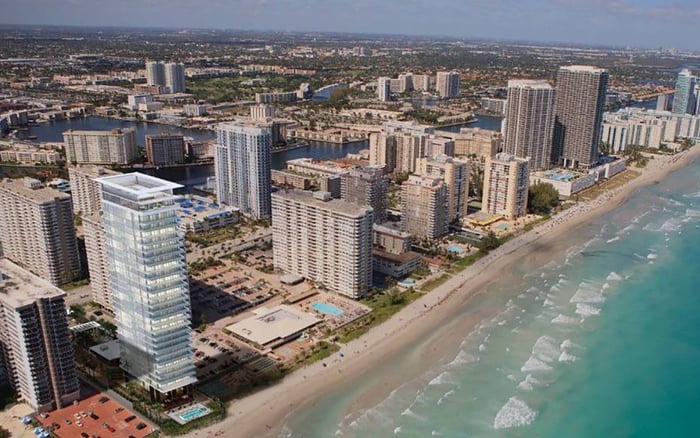
For a Hallandale Beach search that includes 2000 Ocean Hallandale Beach, apply this exercise to the specific residence under consideration. The project name is a starting point for the search, not evidence of acoustic performance. Ask which adjacencies the plans confirm and which still need clarification.
In Florida, the 2023 building-code provisions for sound transmission address covered interior assemblies separating dwellings or sleeping units from neighboring units and public or service areas, including corridors and stairways. They provide a useful baseline, but do not establish that a particular existing condominium complies or will satisfy your preferences.
For covered walls, partitions, and floor/ceiling assemblies, the laboratory airborne-sound minimum is Sound Transmission Class, or STC, 50. The airborne field-testing alternative is Normalized Noise Isolation Class, or NNIC, 45. Keep the metric and testing setting attached to every number you receive.
Covered floor/ceiling assemblies generally require a laboratory Impact Insulation Class, or IIC, of at least 50; the field-tested impact threshold is 45. Airborne and impact performance are separate. An STC result alone does not establish how a floor assembly performs against impact sound.
With each result, request the tested assembly, location, method, and date. Ask whether the documentation concerns the actual residence, another location, or a laboratory assembly. These interior ratings are not a complete answer to exterior traffic exposure or equipment noise.
Arrange a quiet period inside the residence while building staff coordinate ordinary elevator operation. Listen in the bedroom and office, not just beside the entrance. Note whether sound coincides with arrival, departure, door movement, or lobby activity. Proximity alone does not prove its source.
For mechanical exposure, ask management which nearby systems are operating during the visit and which, if any, are inactive. Record any hum, intermittent sound, or perceptible vibration, along with its location. Do not enter restricted equipment spaces or request unsafe changes to building operation.
Elevator machine rooms, spaces containing driving machinery, and specified controller rooms or spaces require independent ventilation or air conditioning. That requirement protects equipment against overheating; it does not prescribe a specific noise level inside an adjacent residence.
In Fort Lauderdale, a buyer considering Auberge Beach Residences & Spa Fort Lauderdale should request the same residence-specific checks. The purpose is not to presume a problem, but to establish what was operating when the home was evaluated.
For a residence near an amenity deck, request operating hours, event rules, and the location of service access. Ask which activities you can reasonably observe during a return appointment. An empty deck answers a different question from one in ordinary use.
Listen from the rooms where quiet matters most while permitted activity is underway. Note voices, furniture movement, doors, and other audible events separately. A sound that is acceptable while entertaining may be unwelcome during sleep or a work call. Define that distinction before comparing properties.
If your stays will center on weekends, include a representative weekend visit. If evening privacy matters, arrange an evening appointment where access permits. Ask about your anticipated occupancy dates, but do not treat any single visit as proof of conditions throughout the year.
Evaluate exterior exposure with balcony doors fully closed, then open, while remaining in the same room. Record the door position and whether the residence's air conditioning is operating. Repeat the comparison in the bedroom and intended office rather than relying on the living room alone.
For a Pompano Beach shortlist that includes The Ritz-Carlton Residences® Pompano Beach, include this comparison in the residence review where access and completion status allow. Where listening is not yet possible, distinguish design documentation from performance that remains to be tested.
Use a simple log: room, time, door position, equipment status, audible event, duration, and your reaction. Separate observations from assumptions about their source. The objective is a repeatable comparison, not an unsupported pass-or-fail decibel figure.
Seek acoustic test documentation, equipment plans, available complaint records, and amenity operating rules. Ask whether any documented concern involved the same residence or adjacency, what action followed, and whether follow-up testing occurred. Treat the absence of complaint entries as a reason to continue listening, not a guarantee of silence.
Detailing also belongs in the review. Openings and penetrations for piping, electrical devices, recessed cabinets, bathtubs, soffits, ventilation, and exhaust ducts must be treated to maintain the required rating of the separating assembly. Ask for clarification where renovation work or plans raise questions about those details.
Where an exposure could change your purchase decision, consider an independent acoustic specialist. Define the concern precisely so the proposed assessment addresses the relevant room, sound type, and operating condition-not an unrelated assembly rating.
Before committing, classify each priority room as acceptable under observed conditions, unresolved, or requiring further evaluation. Keep the conditions beside each conclusion. For a part-time home, distinguish privacy you have tested from privacy you are merely expecting.
For a considered approach to your Broward oceanfront search, explore MILLION.
If branded residences are on your mind — as a home or as an allocation — we would be glad to share what we are seeing, privately.
Begin a quiet conversationMap bedrooms and the intended office against elevators, mechanical rooms, amenities, service areas, and roads. Request relevant layouts above and below the residence as well.
No. STC 50 is the cited 2023 code's laboratory airborne-sound minimum for covered assemblies, not proof of a particular residence's compliance or suitability for your preferences.
The cited 2023 provisions specify NNIC of at least 45 as the airborne field-testing alternative. Identify field results separately from laboratory STC ratings.
No. Airborne and impact requirements are separate; covered floor/ceiling assemblies generally have a laboratory IIC minimum of 50 and a field-tested impact threshold of 45.
Coordinate ordinary elevator operation with building staff while listening in the bedroom and office. Log sounds and their timing without assuming the elevator is necessarily their source.
No. The independent ventilation or air-conditioning requirement protects specified elevator equipment spaces against overheating, rather than establishing a noise level inside an adjacent home.
Arrange visits during representative permitted activity, including evening or weekend periods relevant to your intended stays. Review operating hours and event rules alongside your observations.
The comparison helps establish whether exterior exposure is acceptable under both ways you intend to use the residence. Keep the room and other observed conditions consistent.
Request acoustic test documentation, equipment plans, available complaint records, and amenity rules. Clarify whether each test concerns the actual residence, another location, or a laboratory assembly.
Consider it when an unresolved exposure could change your purchase decision. Ask a specialist to address the relevant room, sound type, and operating condition.